

Fear and Trauma: The monster under the bed by Sharon Dempsey
Women understand fear as an omnipresent spectre in our lives. It shows up early on, when we are conditioned to be wary of strangers and dark alleyways, as if our vigilance is enough to provide a protective mantle. We are instructed to not wear revealing clothes, to not be the drunk girl at the party, to not work home alone at night. Or just like Red Riding Hood going into to the dark forest, we are said to have placed ourselves in danger.
No one conditions men to not be the threat.
Women are avid readers of crime and horror. It is a defensive reaction to the threat that exists in society, igniting our sense of survival. The purpose of reading, and I would also say writing, is to feel an emotional connection, to experience the ‘other’ and to feel understood, in seeing the familiar made unfamiliar on the page. Making the ‘stone stony’ as the Russian literary critic Viktor Shklovsky, describes it. When we have experienced trauma, the retelling of the event can be helpful and necessary. We relive the experience through the telling, and in part give ourselves distance.
My Grief, My Pain, My Fear, My Anger

When son died, from cancer, I sought refuge in reading and writing. It was the dark aesthetic that I sought. I could no longer relate to a world portrayed as anything but a bleak hopeless, landscape. I needed the darkness and brutality that can be found in the crime genre. My grief, my pain, my fear, and my anger had to be reflected in the pages I was reading. Later reading was not enough; I needed to write about my grief and pain to find voice and for what I had experienced. This is what trauma is: not the action of the incident but the aftermath of living with a disturbing, depressing life event.
To voice my trauma, I turned to crime fiction a genre that has saved me in so many ways. Reading a crime novel can provide us with the thrill of free fall, yet we happily go along with this knowing that the genre offers resolution and the restoration of moral order. We can go along for the ride knowing there is safety in the end with the release of the tension being healing, soothing and cathartic.
That Which Scares Us
Writing about that which scares us is defensive vigilance in action. We are processing what we would do should we find ourselves in danger. Inspiration for The Locked Room, my story included in FEAR, an anthology of female crime writers, originated when I was living in a rented flat in London. I was twenty-one and it was my first time away from home. On the second week of my great adventure, my flat was broken into, ransacked and some of my belongings where taken.
What plagued me afterwards though wasn’t the burglary, instead I focused all my fear on a locked door inside the flat. The owners had said they stored their belongings inside the locked room but every time I passed that non-descript door in the hallway, I felt a sense of being watched. It was the not knowing that terrified me.
My Story
My story emerged from a passage from my work-in-progress novel, ‘Cró Island’. The Brams move from London to the Irish island as caretakers, with high-profile influencer Ellery, documenting their life for her thousands of TikTok followers. When the couple are found dead the police initially think they are dealing with a murder-suicide. As DS Nora Dale and DI Dylan Kennedy begin investigating, they discover that Ellery’s online life might hold the key. The story was inspired by an old Hammer Horror film called ‘The House That Bled to Death’.
FEAR
Andrea Carter’s story, ‘Nightshift’ perfectly encapsulates the near constant fear assessment that women undertake to survive. A female taxi driver finds herself taking one last customer to the foothills of the Wicklow mountains in the dead of the night. The reader goes along for the ride, full of trepidation not knowing if the passenger means ill intent. Kit Conway’s story, ‘Just off for a Run,’ plays on the notion of the older female not being a likely target for predatory men while using her fears as motivation to run faster.
Women write and read about fear and terror in the form of crime fiction and horror to subdue the unknowable. It is our way for facing the monster under the bed. Take this collection and delve into our fears knowing that we are all processing the horrors of the real world within the safe confines of a book.
(c) Sharon Dempsey
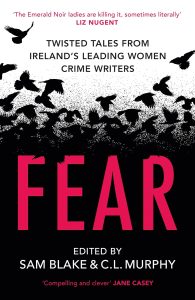
About FEAR: Twisted Tales from Ireland’s Leading Women Crime Writers
Thirty-two Irish female crime authors come together to explore some of life’s greatest fears in an anthology of original stories teeming with terror.
Edited by crime authors Sam Blake and C.L. Murphy, and including a foreword by Emmett J. Scanlan, this collection explores a pulse-quickening spectrum of the fears that keep us awake at night – from dolls, clowns and ghosts, to fi re, heights and doors in hidden rooms. Here you’ll find tales of being buried alive, being forgotten, of loss and betrayal – and more.
Full of thrilling twists and chilling reveals, Fear will keep you on the edge of your seat until the very last page.
Authors featured: Cecelia Ahern, Alice Bell, Sam Blake, Jen Bray, Andrea Carter, Amanda Cassidy, Marie Cassidy, Edel Coffey, Kit Conway, Claire Coughlan, Sharon Dempsey, Michelle Dunne, Fiona Gartland, Karen Gillece, Carmel Harrington, Catherine Ryan Howard, Arlene Hunt, Amy Jordan, E.V. Kelly, Olivia Kiernan, Casey King, Hannah King, Catherine Kirwan, Siobhan MacDonald, Andrea Mara, Michelle McDonagh, C.L. Murphy, Gill Perdue, Louise Phillips, Eithne Shortall, Michelle Teahan and Mary Watson.
Women’s Aid
The editors’ royalty earnings from worldwide sales of this book (expected to be at least €8,000) will be donated to domestic violence charity Women’s Aid (RCN 20012045). Contributing authors have donated their stories without renumeration to help make this possible.
Order your copy of FEAR online here.
And read more Meet the Authors of Crime Fiction on Writing.ie here.


