

Bernie McQuillan, author of the just-published novel, The Lobster Pot, on how her life experiences have informed her writing over the years . . .
Reading my first story in front of an audience in the moody interior of The Black Box Belfast, with its dark green walls and framed posters, was one of those not-forgotten moments. Not because there were lots of people (there wasn’t) but this was a story I’d worked on for weeks and no one booed me. There was even a tinkle of applause as I stepped back into the shadows. It was the launch of The Incubator volume 5, 2015, organised by the fabulous founding editor Kelly Creighton & team and designed to give exposure to new work. When Kelly thanked all the writers for coming, I flushed, looking around at the smiling faces. Did she mean me in the word ‘writer’? Up until then, I’d never thought of myself as one. This scribbling was something I did from time to time, alone and hidden, a secret hobby. But for a brief moment I was out in the open and I wanted to do it again. Kelly’s vision and generosity towards newbies was, I discovered, typical of the writing community across this island.
Summer School
Back in 2010, I’d signed up for the one week summer school at Queen’s University. It was poetry and prose, with readings and discussion led by lecturers like Ian Sansom and Sinead Morrissey. We were reading Flaubert, Woolf, Brennan, McGahern, Chekov and thinking about structure, beginnings, endings and everything in-between. We talked about how their work impacted our thinking, our writing, our very being. After a lifetime of working in the health service, it was a delight to concentrate on something that was just for me. It was enough to spur me into signing up for a part-time MA in creative writing.
Life Experiences

You might say, and I did ask myself, why not just get on with writing those stories I’ve been thinking about? Why spend valuable time reading books I wouldn’t normally read, commenting on others’ work and completing assignments? But sharing drafts and talking about style, voice, dialogue, pacing and characterisation as well as reading widely and deeply all helped me become more confident. There were more experienced writers in my classes and endless variety in backgrounds, life experiences and writing style. It was quite the MA class, including Michael Magee (Close to Home), Sheila Llewellyn (Walking Wounded, Winter in Tabriz), Gerard Brennan (Wee Rockets++) and others. Ian Sansom supported us all and moved on but still I listen out for his velvety voice on Radio 4 and his articles in the Guardian.
Little Wins
In the years after the MA and that Black Box session, I found a home for a few of my short stories amidst many rejections. I wrote, inspired by hospital life, about emergency department doctors outside work, about botched surgery and alcoholism. I wrote about cat hairs on a husband’s trousers revealing an affair in Women’s Way, about a missing girl in a Bundoran caravan park. A flash fiction piece made the Fish longlist, but I had the flu and the pleasure passed me by. These little wins were like rocks rising above the water, steps for me to cross a stream. I was a little way across but fully expecting the next rock to topple me into the water. All around, submerged stones were the stories no one wanted because they didn’t come alive for the reader.
A lot of the time I’d tell myself to catch myself on. I’d already too much going on in my life; a growing family, a busy job, studying, reading. Yet there were always stories circling in my head. I’ve always loved watching people, the way we meander around subjects; the glances and asides in snippets of conversation overheard; the signs of selfishness that forewarn of future conflict in couples, families or friends. I love walking down streets looking into windows, clocking the differences in décor and tidiness, noticing how gardens are lost under plastic toys and gadgets or clipped to perfection, whether clothes hang on washing lines, how tree roots crack pavements, consider overflowing bins and men with leaf blowers keeping out of the house until dinner time. Sometimes I convinced myself I’d nothing new to say.
How Suddenly Life Can Change
Then my brother died in a traffic collision a few miles from home. His life shouldn’t have ended like that, as a passenger in someone’s car. I knew from my job just how suddenly life can change but this was personal. Taking writing seriously was my response. That summer, I was back in Glenveagh Castle amid the granite towers, manicured gardens, the backdrop of Lough Beagh, water slapping against the boathouse. I was thinking about John Adair and the village curse after his tenant evictions, and the missing Arthur Kingsley Porter, another owner. I wrote pieces about a children’s home in Donegal, a village mired in scandal, the turbulent love life of a nurse in London. Building my characters, writing their backstories. I’d finally learned not to fire out early drafts but to sit on them and to edit again, and again.
I did some courses, like the Cheshire Novel Prize Summer School and an editing week with Brian Langan at the Irish Writer’s Centre (and many more too), bussing up and down from Belfast every day. This was before online programs took off, and I’d do more editing on the way home until I had a draft I could submit. Eventually one competition, the Watson Little x Indie Novella Prize, shortlisted my novel. I kept working on it, responding to edits until The Lobster Pot emerged. A story of one village curse, two missing men and three women (Kitty, Isabel and Alannah) searching for answers over four decades. It is published with Indie Novella.
(c) Bernie McQuillan
https://www.berniemcquillan.com
Bernie McQuillan will be presenting at this year’s Insider’s Guide to Publishing.
About The Lobster Pot:
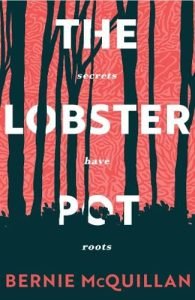
Kitty lay on the forest floor for a long time, her body adapting to the rocks beneath the grass. She was in no hurry to go home. Tommy wouldn’t be looking for her. He would go straight to bed, counting down the nights until he could escape Rathmore and her, his rotten roots. He never asked her about her own life and ambitions, never assumed she wanted anything more than to snare a local man and have his babies.
She dreamt the hut he had built for his old trysts was still there, among the roots and the boat engines and the decaying yew trees. She saw the shovels in their usual place, leaning against the wall. She knew there would be no need for consecrated ground.
Three decades later, Kitty returns to her childhood home to find her village as twisted as she found it. She needs to find her brother, without getting entangled. But how do you remember what you’ve tried to forget?
Order your copy online here.
And read more Meet the Author articles on Writing.ie here.


