

Co-founder of Calabash Literary Festival, the Caribbean’s largest literary festival and second-generation hotelier at popular resort Jakes, Justine Henzell does not think of herself as the owner of paradise. She prefers another word entirely. “Custodians,” she says. “We feel honoured to be custodians of paradise.”
Jakes is famous for many things, but especially its night tapestry. The stars are startling in their clarity, suspended over the Caribbean Sea in an almost theatrical display. Many visitors, Justine notes, arrive from cities where the night sky has disappeared beneath artificial light. Here, the darkness still belongs to the stars and the sea.
Jakes itself feels less like a hotel than an eccentric artistic dream assembled over decades. Scattered along the shoreline are individual cabins facing directly onto the water, each entirely different from the next. Four-poster beds look out across the sea. At night, the roar of the waves becomes a lullaby. The cabins are furnished with reclaimed wood and filled with antique furniture, painted in exuberant shades of pink, turquoise and blue.
It was in the same place, in cottage called Treasure Cot built by her grandparents in 1941, that a young writer wrote his international best seller Roots. His name was Alex Haley. This location comes with form.
Jakes and the Calabash Literary Festival
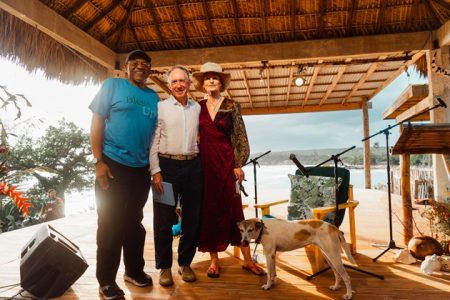
Jakes is host to the world-renowned Calabash Literary Festival, established in 2001, and was co founded with the acclaimed poet, playwright & professor Dr. Kwame Dawes and brand visionary and author Colin Channer.
And Jakes is also home to the late Perry Henzell, Justine’s father, who wrote and directed The Harder they Came (1972) Jamaica’s first and most famous feature film starring Jimmy Cliff (who died last year) and which film was transformed into an award winning London musical, now entering its second year. Justine is guardian of the film and also a respected film producer in her own right.
Calabash: an ambitious cultural experiment
What began as an ambitious cultural experiment on a remote stretch of Jamaican coastline has quietly become one of the most admired literary festivals in the world and is quite unique in its egalitarianism, size and engagement.
“Our writers tell us it’s the best audience they’ve ever read in front of,” Justine says.
Calabash is held every two years on the lawns beside the sea at Jakes, where a large tent rises against a backdrop of crashing waves rather than corporate branding. In an era where festivals are saturated with sponsor logos, Calabash remains stubbornly protective of its identity.
“We don’t allow any branding on the Calabash stage at all,” Justine says. “The backdrop is the Caribbean Sea.”
There is not even a Calabash logo on the stage. Instead, there is a bamboo podium decorated with flowers arranged by Justine’s mother, the legendary Sally Henzell, now 85 and still very much the spirit of Jakes. The result is an atmosphere that feels intimate despite attracting thousands.
An Engaged Audience
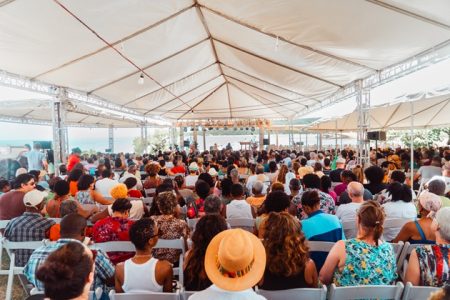
Former US Poet Laureate Billy Collins was astonished when told he would read before an audience of 2,000 people. “I’ve never ever read to that many people anywhere,” he told Justine.
Unlike festivals such as Hay or Edinburgh, Calabash operates from a single central stage. Everybody listens together and they listen passionately.
“You will hear responses,” Justine says. “You’ll hear ‘oh’, ‘ah’. The audience is very engaged, and our authors love that.”
The programming itself is intentionally eclectic. Fiction, memoir, poetry and nonfiction sit side by side in what Justine describes as an “earthy, inspirational, daring and diverse” festival.
Openly gay writers share the stage with political commentators, novelists, musicians and poets. There is no censorship and no children’s programming.
“If you choose to bring your child, that’s your responsibility,” Justine says matter-of-factly. “We do not censor what is said on the stage.”
Authors, Readers, Journalists and Locals
That commitment to openness extends beyond the programme itself. There are no VIP enclosures or segregated dining areas. Authors, readers, journalists and locals eat together at Jack Sprat restaurant during the festival.
“Salman Rushdie literally walked among the people and sat at a table with everybody,” Justine recalls.
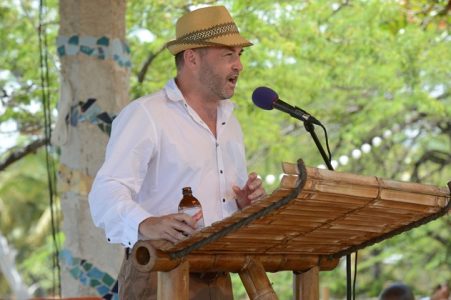
Over the years, Calabash has welcomed some of the world’s leading literary figures including Ian McEwan, Joyce Carol Oates, Padma Lakshmi and Colum McCann. Yet despite its global reputation, the festival remains deeply rooted in the local community.
One of Justine’s favourite memories involves passing one of the hotel gardeners during the day while he worked on the grounds. Later that evening she saw him again, now changed out of work clothes and sitting beneath the tent listening to the readings.
“That’s how it is,” she says. “Everyone wants to come and listen to a story.”
Fishermen sit alongside diplomats. University professors share benches with tourists and local families.
“Jamaicans are great storytellers,” Justine says. “But we’re also great listeners.”
Calabash: free and open to the public
Perhaps most remarkably of all, the festival remains entirely free and open to the public. That decision has made funding an ongoing challenge. Jamaica lacks the large arts endowments available elsewhere, and Calabash survives through volunteer effort, donations and careful stewardship. None of the founders are paid. Jakes itself is given over entirely to the festival.
Yet the founders refuse to compromise the festival’s ethos for commercial convenience. “Our audience is fiercely protective of the festival,” she says. “They feel ownership of it.”
That loyalty has helped Calabash survive hurricanes, economic uncertainty and the Covid pandemic, which forced the postponement of the 2022 edition.
A Secret Line-Up
The author line-up is traditionally kept secret until a month before the festival begins, part of a deliberate philosophy that audiences trust Calabash itself as much as the names appearing on stage. “People trust us,” Justine says.
As literary festivals become increasingly commercialised, curated and exclusive, Calabash feels almost radical in its openness. A festival by the sea, where the stories matter more than the status attached to them.
The next Calabash Literary Festival will take place from May 21 to May 23, 2027 in Treasure Beach, Jamaica. Attendance is completely free. Visitors simply arrive and walk into the festival grounds. No registration is required.
Accommodation ranges from luxury beachfront villas to modest guest houses and even camping on the beach, making the festival unusually accessible for international visitors.
(c) Jillian Godsil
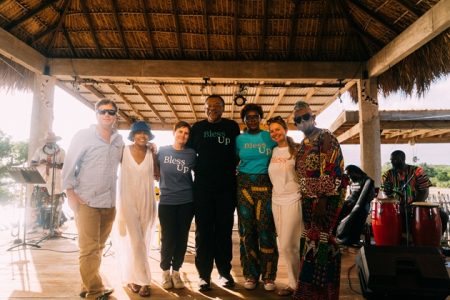
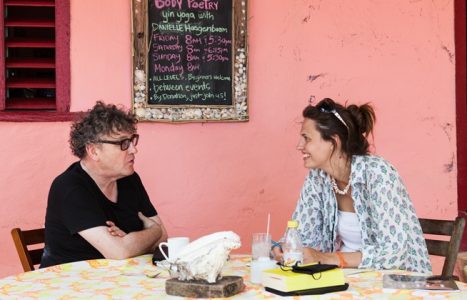
Photos show Zadie Smith, Ian McEwan, a Marlon James reading, Colum McCann, Paul Muldoon interviewed by Olivia Cole, and (above) Justine beside Dr Kwame Dawes (on the left) and her brother Jason (far left) who runs Jakes.
See here for more Big Idea articles on Writing.ie.


