

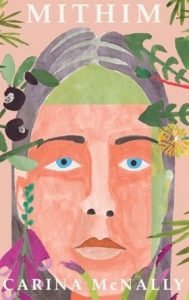
Mithim by Carina McNally
Mithim, by Carina McNally, is a debut novel from the Irish writing mind of Carina McNally. It is told in the first-person, an Irish folk tale told against the occupation of Ireland by Oliver Cromwell’s forces when the English invaded and occupied Ireland in 1649. Mithim is a displaced noble daughter, a survivor of the occupation and a practitioner of healing. “Healing Women” were a priesthood of sorts, and Mithim is secretly one of them, hiding from English soldiers deep in the Wexford forest. Mithim is from a noble family, the McMurroughs.
Their domicile, Killenea Castle, was burned to the ground in 1649. Since then, Mithim has lived simply in the Wexford forest. She is thoughtful and intentional, while those around her have fallen prey to betrayal or are in fact victims of the hated British soldiers. We are reminded that Mithim is a woman, and women of that time were socially and religiously constrained. Add an occupying army, and an author has all elements of metaphor to make an historical point about injustice derived from fear. Carina McNally subtly points to change by underscoring that “Sugar, pepper and paprika are norms in the kitchen. The flavors of faraway lands, once exotic, are now commonplace…”
An Irreligious Mind
There are yet deep vestiges of religious background in the irreligious mind of Mithim. She mythologizes trees in the same way others pray to the Virgin Mary. “…it’s a tree that brings good luck and prosperity to land where it grows.” Since then, science has revealed a tree’s mystery in a subtraction of mystery, and limited paths to expression for the embedded religious sentiment. But Mithim is a facile player. She knows that life is precious and not to be squandered from fear. As a noble woman and recent commoner, Mithim communicates within a normalcy of both classes. She is tacitly accepted by both, as a healer, and as a woman in a special relationship with nature and bounty. Mithim, in fact, is a well-conceived character for her time, and perhaps ours.
The action as written did not take place, and the author is clear about that from the beginning. Fiction entertains and enlightens. What does the author of Mithim seem to intend for a reader to experience? As a novel that leans on history, the author intends fiction to be instructive. It is.
The author intends that the reader reflect on the imbalance of societal power which excluded women, including religion. Her examples are copious. As a character, Mithim reads women better than men, and remains elevated in the reader’s imagination during the story — she is her own woman, she is telling her own story, which exists, as folk stories often do, between the allegorical and the mythopoeic, especially Irish folk stories.
(c) Tom Casey
Order your copy of Mithim online here.
And you can read more from Tom Casey on Writing.ie here.


