

Shoe Dog by Phil Knight
“They wore my shoes. Every step they took, every shot they made, felt like a part of me. It’s one thing to watch a sporting event and imagine yourself in the players’ shoes—every fan does it. But it’s something entirely different when the athletes are actually wearing your shoes.”
— From Shoe Dog by Phil Knight
In 1962, a 24-year-old American had big dreams: to live a life full of purpose and meaning, much like a game where you always win and leave your mark. He didn’t become the bestselling author, renowned politician, famous journalist, or great athlete he had imagined, but Phil Knight—founder of Nike, the world’s most popular sports brand—achieved a success that many only dream of. How did he do it? By loving his work so much that it became a game.
In the early days, Knight himself admits that his idea seemed like a “crazy” one. But that didn’t stop him. As he writes in his memoir, Shoe Dog, “Let everyone call your idea crazy… just keep going. Keep going. Don’t even think about stopping until you get there, and don’t even think about where ‘there’ is. Whatever happens, just keep going.” That advice, which Knight unexpectedly gave himself, became his guiding principle. Half a century later, he believes it’s the best—and perhaps the only—advice anyone could follow.
A runner himself, Knight knew shoes. What began as a term paper on running shoes led to a life-changing trip to Japan. With the determination of an athlete, nothing stood in his way, even when doubts crept in. Knight began importing Tiger sneakers from the Japanese company Onitsuka into the United States, borrowing $50 from his father to fund the first batch. When the first twelve pairs arrived, Knight examined them closely, sent two pairs to his former Oregon track coach, Bill Bowerman, and a partnership was born. A year later, the company, Blue Ribbon, turned a profit of $8,000. And as they say, the rest is history.
Despite this, the company struggled in the early years, constantly teetering on the edge of bankruptcy. Knight was bold with his investments, often risking every dollar he earned. There was little capital, but Nike’s success exceeded expectations year after year. Bowerman, with his innovative ideas for sneakers, played a significant role in helping the company grow.
Knight was often questioned about his reckless approach. “I put every spare dollar back into the business. Was that so reckless?” he reflects. “It didn’t make sense to me to have cash sitting around. Of course, that would have been the most prudent thing to do. But there were plenty of cautious, conservative, and prudent entrepreneurs around.”
Knight’s explanation for his success is refreshingly simple and valuable for any entrepreneur:
“As I drove to Portland, I marveled at my sudden sales success. I couldn’t sell encyclopaedias, and I hated it. I was a little better at selling mutual funds, but I felt empty inside. So why was selling shoes so different? Because it wasn’t selling. I believed in running. I believed that if people would go out and run a few miles every day, the world would be a better place, and these shoes were better for running. People sensed my belief and wanted to have a piece of it.”
Confidence, Knight realized, was the key.
For Knight, Nike was never just about making shoes—it was about creating a culture. Even as Puma and Adidas dominated the market, Knight’s dream seemed like madness. But he didn’t give up. Nike eventually became a household name, so much so that the company was renamed from Blue Ribbon to Nike, Inc.
Shoe Dog isn’t just a memoir; it’s a deeper reflection on the trials and triumphs of building an iconic brand. After reading it, I’ll never look at my Nike sneakers the same way again. Knight’s candidness, sharp wit, and willingness to share both his flaws and his personal losses make the book both relatable and compelling. He opens up about the company’s challenges, including a $25 million bill from the US Customs Service, which threatened to sink Nike if it couldn’t be paid.
I also learned some interesting facts, like how every Nike office around the world has a phone number ending in 6453—spelling “NIKE” on the keyboard. I discovered the origin of Nike’s famous logo, the meaning behind the company’s name (after the ancient Greek goddess of victory), and the story of how some of Nike’s most iconic models like the Pre Montreal, Air Jordan, and Cortez were named.
I was touched by Knight’s recollection of his father, initially sceptical about the brand, who eventually became proud after seeing people on the streets wearing Nike shoes. After a basketball game where a fight broke out, Knight’s father excitedly called him to say, “Oh, Buck, Buck, that was one of the most incredible things I’ve ever seen. The camera kept zooming in on Tomjanovic’s shoes… and you could clearly see the Nike logo! They kept showing close-ups of the Nike logo!”
That was when Knight realized the true impact of his work—and perhaps, at last, that all the struggles were worth it.
Through Shoe Dog, I also learned about the athletes who helped shape Nike’s identity—Tiger Woods, Michael Jordan, Cristiano Ronaldo, Rafael Nadal, Grigor Dimitrov, and more. Knight doesn’t see them as mere endorsers; they’re integral to the brand’s culture.
The book also sheds light on the journey of Nike’s core team, who fought alongside Knight to save the company from bankruptcy, culminating in the brand’s eventual IPO. As Knight puts it:
“It’s never just a business. And it never will be. If it ever really becomes just a business, then this business is in trouble.”
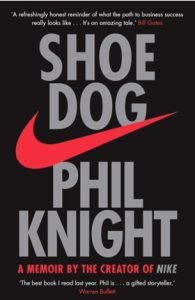 Today, Nike’s annual profits exceed $35 billion, with over $100 million regularly donated to charity. Nike’s products are sold in over 5,000 stores worldwide, and the company employs more than 10,000 people. The rights to adapt the memoir into a movie were bought by Netflix, with Knight himself set to produce. Since its release in 2016, Shoe Dog has been a New York Times bestseller—and it’s undoubtedly one of the best autobiographies I’ve ever read.
Mr. Knight, I believe all your risks have paid off. And if that isn’t a true victory, I’m not sure what it is!
(c) Milena Tseneva
Order your copy of Shoe Dog by Phil Knight online here.
And read previous reviews from Milena Tseneva on Writing.ie here.


