

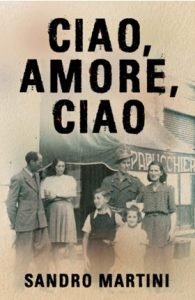
I don’t remember much about writing the first draft of Ciao, Amore, Ciao, a novel started the day I buried my mom and dad’s ashes in a little cemetery in the foothills of the Dolomites. I think the expression is, “in a fugue state”. They’d left me twelve weeks one from the other—my mom a week before Christmas, and my dad, before the first days of spring.
The anguish was raw, and the subject was family—my family—beginning with my dad’s brother who vanished in 1942. Literally vanished. Sometime in the 1950s, they gave him a medal and a plaque in the war cemetery in Schio, Italy, for dying, I guess, in a war no one gave a damn about. Not then and not now.
No body, no dog tag, nothing ever came home of the nineteen-year-old boy who left Italy one summer’s day in 1942 for the Eastern Front. On his way to Baku, to protect the oilfields, that was the mission, but somewhere during the march through the fields of Ukraine, ARMIR—the Italian Army in Russia—was diverted to the river Don and assigned the task of protecting the western flank of the German VI Army, stalled at the gates of Stalingrad.
In December, the Russian Red Army had crushed through the Italian flank, and that was that. A quarter of a million Italians—pathetically equipped for winter warfare—were caught in the sack, and around 100,000 would never find their way home.
 As I grew older, that story began to exert a puzzling pull on me. More so because it was a history that Italy—and my dad—were seemingly keen to forget. (The shocking truth of what happened on the Eastern Front in 1942/’43 remained concealed for years in Italy, right up until the publication of Giulio Bedeschi’s Centomila Gavette di Ghiaccio broke the “omertà”.)
I suppose post-war Italy was in a hurry to run from its disgrace. And I guess my dad, too, was in a hurry to run from his sorrow—to Brazil, to France, to Switzerland, and eventually South Africa.
This collective guilt and humiliation was what I had to explore in the novel since it played such a dominant role not only in my dad’s life, but also in Italy’s post-war mindset. Looking back at it, it’s obvious now that I could never have written this novel while my dad was alive given that I had to rummage about in his story, in the awful shards of his broken past. His stain. And in writing this history, this history of my family of no-ones, I had to recognize and accept how his childhood—losing his big brother, and his mom’s decade-long, shaming search for closure—had infected mine.
My dad was fractured by his childhood. Born in 1930, he was a teenager during the German occupation. Poverty and war, and then the vicious reprisals of 1945, these were the bookends of his youth in Schio, scene of an horrific massacre when a hundred suspected fascists—including women and children—were shot in cold blood while awaiting trial.
That happened in what is now the town’s library, a stone’s throw away from my dad’s childhood home. A massacre so barbarous, it made headlines on the New York Times. He never said a word of what he saw. But that was my dad’s youth, and in telling that story, I began to see him through a different lens. Not as “Dad”, but as a boy who’d somehow found a way to survive the violence of that world.
And so, in exploring that brutality—of the massacre, of the madness of the Italian retreat through the ice of a Russian winter, of the loss of his brother, and eventually his father too in the closing days of the war—the first draft of Ciao, Amore, Ciao was never going to be anything but an emotive, vivid affair. I was mourning not only his death, not only my mom’s death, but also the death of my own childhood.
The decision, however, to retain this impassioned language during the editing phase of the novel was one deliberately taken. A novel that explores the violence of war—and ARMIR’s twelve-day retreat is the stuff of pure horror—requires honesty. And honesty committed to a page is not that easy. You can’t explore the intense themes of a novel like Ciao, Amore, Ciao without hurting yourself. To do so would be to brutalise your own history, to dishonour your own memory.
In the end, the search for meaning in my family’s history was the driving force that gave this novel life, and a dispassionate relating would have been incongruously antithetical to the voice of the story. Ultimately, the shame isn’t in the honest embrace of pain—it’s in the dishonesty of trying to mask it.
Still, it was somewhat surprising that Ciao, Amore, Ciao found an audience on publication. Perhaps it’s because the novel fits in with the zeitgeist that prizes authenticity in an age of cultural sameness and the fake humanity that is the promise of AI. Whatever the reason, one thing I know for certain—in adopting that emotive, passionate, honest voice, I unexpectedly stumbled upon myself in Ciao, Amore, Ciao. And I found my dad, too, there amidst the rubble of the past.
Too late, of course, to make any difference. But isn’t that always the way of it?
(c) Sandro Martini
About Ciao, Amore, Ciao by Sandro Martini:
An enthralling dual-timeline WWII family mystery, based on the heartbreaking true story of the massacre in a small town in Italy in July of 1945, from award-winning, bestselling novelist Sandro Martini.
“A gripping saga that roots excruciating betrayals in a nation’s tragic history.” –Kirkus Reviews
In the winter of 1942, an Italian army of young men vanishes in the icefields of the Eastern Front. In the summer of 1945, a massacre in Schio, northeastern Italy, where families grieve the dead, makes international headlines.
In present-day Veneto, an ordinary man is about to stumble onto a horrifying secret.
Alex Lago is a jaded journalist whose career is fading as fast as his marriage. When he discovers an aged World War II photo in his dying father’s home, and innocently posts it to a Facebook group, he gets an urgent message: Take it down. NOW.
Alex finds himself digging into a past that needs to stay hidden. What he’s about to uncover is a secret that can topple a political dynasty buried under seventy years of rubble. Suddenly entangled in a deadly legacy, he encounters the one person who can offer him redemption, for an unimaginable price.
Told from three alternating points of view, Martini’s World War II tale of intrigue, war, and heartbreak pulls the Iron Curtain back to reveal a country nursing its wounds after horrific defeat, an army of boys forever frozen at the gates of Stalingrad, British spies scheming to reshape Italy’s future, and the stinging unsolved murder of a partisan hero.
Ciao, Amore, Ciao is a gripping story of the most heroic, untold battle of the Second World War, and a brilliantly woven novel that brings the deceits of the past and the reckoning of the present together.
Order your copy of Ciao, Amore, Ciao online here.
And read more about the writing of memoir on Writing.ie here.


