

Hannah Brennan, author of Nothing Left Behind, tells us: half-finished novels aren’t failures – they’re making you a better writer.
I always find it interesting when writers “confess” to having a novel they never finished, languishing in a drawer. Sometimes, people seem embarrassed at not having made it to The End.
I’m always quite cheerful when talking about the books I embarked on, only to give up 10, 20 or 30 thousand words in. Not only do I look back at them fondly, I think they’ve made me a better writer.
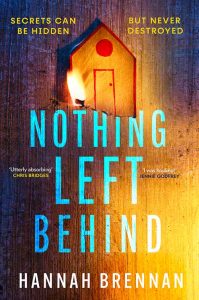
After signing the deal for my debut, I wrote book two in a happy-but-terrified bubble. Nothing Left Behind is the second novel in the Detective Liz Field series, and for the first time I was facing an actual, proper deadline – not one I’d imposed upon myself to minimise procrastination.
Those false start projects were a real comfort to me, in the end. I put them aside them for different reasons, and there were pitfalls I now knew how to avoid.
To prove that abandoned stories make us all better writers, I’ve looked back at three of my not-meant-to-be books.
Plotting vs pantsing
The barmaid who never showed up for work
I once convinced myself that to avoid not finishing a novel, I should become a stringent plotter. I wrote a very detailed plan about a girl who never turned up for her pub shift, with a convoluted baby-swap storyline.
By the time I was twenty-thousand words in, all I had done was describe, in astonishing detail, the day-to-day regulars of my local Wetherspoon.
There was nothing thrilling about this pub thriller, and my plan hadn’t stopped me veering wildly off course. I happened to watch an Australian TV series with a similar baby-swap plot, and felt enormously relieved. It was the perfect excuse stop trying to ‘fix’ my pub-slice-of-life diorama.
I’d enjoyed writing the setting and the characters, and I’m sure one day I will use them all in a different story. But, in hindsight, I realised my initial idea wasn’t hooky enough, and I’d forced myself to plot a storyline I wasn’t in love with.
I’m incredibly grateful to the TV show that halted my slow-progress, because not only was it brilliant, it meant I didn’t waste a year on a book that was going nowhere.
Knowing what story you want to tell
The accidental rom-com
Now, this book might not belong in this article, because I did actually get to The End. I proudly presented my agent with a synopsis and first three chapters of my brand new thriller, only for him to tentatively ask if I was writing romance now.
In my defence, it was lockdown and I was single, living at home with my parents. It was the glimmer of romance I needed in the year that kissing was made illegal.
I’m still quite proud of the book. It was about revenge porn, and a girl who protests at the invasion of her privacy, ex-boyfriend in tow for support.
A thriller, it was not.
My agent would have supported me in trying a new genre, but I knew I wanted these characters to exist in a proper crime setting. I put the book away for two years, before I had a revelation in the middle of the night, and a thriller idea I loved.
Nothing you write is ever wasted. When I finally get time to pen this thriller, those cute romance moments will be there as flashbacks.
The accidental rom-com also made me really think about a book’s positioning and genre at the outset. I’m not afraid to try something new one day, but I’d like to do it intentionally!
Putting the slow in slow burn
The inheritance family drama
Of all the books I’ve never finished, this one stings. It was about the black sheep of the family becoming the sole benefactor of her grandfather’s will, to the horror of her half-siblings.
I am a huge fan of Lisa Jewell and Liane Moriarty, and this was my attempt to write a crime novel that didn’t have a police thread. I wanted to focus on the complex dynamics of one family, and write a tense slow-burn kidnap plot.
I was only 12 thousand words in when I sat back and decided that the opening just wasn’t doing it for me. The stakes weren’t high enough, there wasn’t enough tension – but more than that, I wasn’t excited to get back to writing it every evening.
It made me question what openings I do like to write. For me, it’s high-octane, high-stakes cinematic drama.
For Nothing Left Behind, the first thing I pictured was my childhood house burning to the ground – then not just the house, but half the street.
Again, I know one day I’ll have a new, exciting way to use those characters and that inheritance story. But trying to emulate my favourite authors wasn’t enough to propel me through that first draft.
What to do with your half-finished book?
If you do have a not-quite-completed story on a hard drive somewhere, then I think it’s always worth going back and having re-read.
Sometimes, picking up an old project can spark new inspiration. Other times, there’s a lesson to be learned from why that story wasn’t meant to be.
I think it’s also far more common than aspiring authors realise, for a writer not to have smashed it out of the park with the first book they ever wrote.
Either way, I’d hate to think of any writer out there thinking their books were failures, just for being unfinished. Writing stories isn’t a pass or fail exercise – and every word written is part of the learning curve.
(c) Hannah Brennan
About Nothing Left Behind by Hannah Brennan:
‘Emergency. Which service do you require?’
‘He’s trying to burn down my house. He’s going to kill me.’
They thought it was another false alarm. They were wrong.
This page-turning crime thriller debut is perfect for fans of Nadine Matheson, Sam Holland, and Helen Fields.
As the acrid smoke clears, Detective Liz Field can only watch as the charred remains of Anne Evans’s home slowly collapse – with her body still trapped inside.
A heroic Response officer almost died trying to save Anne from the fire, but he was too late.
When they pick through the rubble, it seems the blaze that tore through her house left nothing behind.
Detective Field is handed the case, but resources are already stretched thin following a high-profile shooting just days earlier. Despite years of frantic 999 calls and false alarms, it appears no one knows much about Anne. The person in the system only appeared nine years ago. But why?
The more Field discovers, the more disturbing the picture becomes.
Anne had been written off as a nuisance – a paranoid recluse. But is it really paranoia, if all that you feared comes true?
Order your copy of Hannah’s ‘finished’ novel, Nothing Left Behind here.
And read more Resource articles on Writing.ie here.


