

‘Memoir is the story that an individual chooses to form out of the raw material of their life.’
I remember learning, as a child, that every snowflake has a different pattern. Each with its own unique symmetries, forming, falling and melting into the world. Looking out our living room window, I could see the back fields transformed under a blanket of white. It seemed impossible that this mass was made up of such utterly singular, individual entities.
We inhabit a body, briefly, in a specific time and space. Like everyone else who has ever lived, we are afforded an utterly unique perspective, and our individual stories, should we choose to tell them, are part of a much larger narrative.
Memoir is the story that an individual chooses to form out of the raw material of their life. It is one of the most available art-forms because everyone has a story, and most people have access to a piece of paper and a pen. To write down the events of your life is easy enough, but to compose a story that others might want to read can be a complicated and challenging task. Here are some aspects of the process I wish I had understood before I began:
Autobiographical acts are, in many ways, political acts. It can take a long time to process our personal experiences. There are social and cultural forces at work intent on keeping us from integrating what we think and feel and do. The idea for In Ordinary Time came to me in an instant, but it took another ten years to unpack what I wanted to say.
When I committed to writing the book, I was living in New York and working a part-time admin job. Miraculously, I found the only affordable apartment left in the city where I could withdraw after a long youth troubled by addiction, emigration, and the death of my brother. I craved solitude and looked forward to uninterrupted swathes of time where I could lay on the couch, read good literature and stare into space. I might type a single sentence, take a nap. Type another sentence, sob. These were not outwardly productive years, but I was developing a processing mechanism, a way of working, and through it, a way back to myself.
 The search for a self is a primary concern of memoir, and it requires some reckoning with past selves. Memories emerge with their contradictions, uncomfortable truths, competing impulses and unfinished business. They ask us to look, again, at experiences we once found too ugly or raw or frightening. These complexities are a gift to the memoir writer, because they are the experience, and writing into them gives texture and shape to the story, clarifying its intention, allowing its narrator to emerge.
The narrating “I” of personal narrative is a persona, a character in a story, just like everyone else who shows up on the page. The narrator navigates from present to past. Mine arrived with a voice that was detached but empathetic, and she whittled my large and unwieldy manuscript down by a half. Once she arrived, it was clear what no longer served the story she was telling.
In Vivian Gornick’s brilliant handbook The Situation and the Story, she says every work of literature has a both. The situation is the circumstance in which the narrative is taking place, sometimes this is the plot. In personal narrative, the situation is historically and culturally specific. Writing about my life brought me in touch with a political age, Ireland in the late twentieth century, with all its attendant social and cultural conditioning. I could see that I hadn’t been shaped in a vacuum, that I belonged to a lineage, of women in particular, who had inherited the older scars of famine, colonisation, Magdalene Laundries and the Church/State coalition. By locating the situation of my narrative, I had found the thread that connected my personal narrative to a much larger social one.
The story, according to Gornick, “is the emotional experience that preoccupies the writer: the insight, the wisdom, the thing one has come to say.” Although I sensed it, I couldn’t have articulated it fully until I had finished writing: that we are shaped, not just by personal cataclysms, but by historical traumas from our collective past.
Finally, it helped to find an organising or guiding principle to run through the book and keep it on course. I used the linear Gregorian and the cyclical Celtic calendars. The concept of time enabled me to explore the ways we think about the traumatic. Linear clock-time is sliced into units with discreet boundaries: seconds, minutes, hours, etc. It does not account for the inner life of the individual. Trauma that happens in the past does not always remain within the bounds of clock-time, or within the bounds of an individual life. The cyclical time of the Celtic calendar allows the past to interpenetrate the present. In writing In Ordinary Time, I felt like I was forging a connection to something I had been cut off from, a much larger narrative, the ongoing foundation of an ancestral past. Writing a memoir does not have to be a healing process, but it was for me.
(c) Carmel Mc Mahon
About In Ordinary Time:
In 1993, aged twenty, Carmel Mc Mahon left Ireland for New York, carrying two suitcases and a ton of unseen baggage. It took years, and a bitter struggle with alcohol addiction, to unpick the intricate traumas of her past and present.
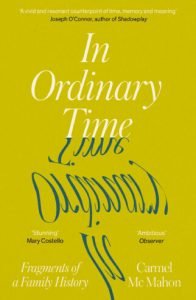
Candid yet lyrical, In Ordinary Time mines the ways that trauma reverberates through time and through individual lives, drawing connections to the events and rhythms of Ireland’s long Celtic, early Christian and Catholic history. From tragically lost siblings to the broader social scars of the Famine and the Magdalene Laundries, Mc Mahon sketches the evolution of a consciousness – from her conservative 1970s upbringing to 1990s New York, and back to the much-changed Ireland of today.
Order your copy online here.


