

When I started writing my memoir, The Electrician’s Children, in 2020 I didn’t know what I was getting into. There were challenges to overcome – including some I had never heard of. They were:
Getting started
When my brother Myles, my sister Ruth and I would meet (once in a blue moon) we’d say, ‘Some day we should write all this down’. ‘All this’ meant the extraordinary trajectory our lives had taken since our mother made a fateful decision way back in the 1930s on a mountain in Donegal. I eventually suggested that we write together. They agreed, but quickly unagreed again, by saying, ‘Why don’t you do the writing, and we’ll check it’.
Everybody told me, ‘Just start’. I remembered the famous advice given to new writers, ‘Apply the seat of the pants to the seat of the chair’. OK – once you get going you may want to cross out half of the first chapter but at least there’s something there to work on.
Fear not – once you ‘just start’, words will come to you that you hadn’t remembered were even in your vocabulary. The act of writing instantly reconfigures your thinking into sentences.
Learning the ropes
I thought I knew a thing or two about writing – I’d written a few bits and bobs over the years. How wrong I was! A novelist friend from the family next door suggested that I take an online course, in writing memoir, with the Irish Writers Centre. I took two – by Ivy Bannister and Ciara Considine. They taught, they reviewed some of my work, and they facilitated peer review with others on the course. In short, they saved my bacon.
I also read books – including during the period when I was writing. It doesn’t mean you will write in the same style as what you read. It simply recalibrates your brain. I read through J.B. Priestley’s The Good Companions, on and off, as I was writing.
Gathering content
I had more source material than I thought. I remembered that in the attic somewhere I had stored my diaries since the early 1970s. Not only so, but my mother and her siblings had written a record of their memories of Donegal life in the 1920s and 30s – what a gift!
Since the book is about our family’s continuing experience of missionary life all over the world, I thought I’d be clever and do a few Zoom interviews with very cooperative relatives. In the end, I didn’t use them.
There turned out to be a better way. It’s perfectly normal for missionaries to send regular reports to their supporters. In self-disclosing generosity my brother and sister gave me total access to decades of their reports – warts and all.
Sticking to a plan
It became clear that my delightful collection of tales about living in other cultures wouldn’t cut the mustard. The overall story had to have forward movement. The back-stories needed to be ‘seeded in’ early on. The plight of a missionary imprisoned in Japan was mainly significant because of what I had already told the reader about his family.
I re-wrote until the story, including the characters, could develop chapter by chapter. Indeed, when I’d completed the piece about my own teenage years, I looked at that young guy in some consternation and thought, ‘My, he has a long way to go!’
I checked the beginning and end of every chapter to make sure the reader would think ‘What on earth is going to happen next?’ ‘How are the going to get out of this one?’
I aimed to attract readers of various different groups by mentioning details about them that only insiders would know. My hope was that, upon publication, they would contact each other and say, ‘Hey, did you know you’re in this book, The Electrician’s Children?’.
Maintaining perspective
On one of the writing courses they said, ‘If you are stuck, write concisely what is happening in each chapter’. This gave me amazing clarity. I printed out that skeleton summary and referred to it constantly the rest of the way.
I also wrote the kind of blurb which I imagined would nudge people into buying the book. I spent a long time in Eason’s just reading the blurbs on the backs of other books. I even met their manager in Dun Laoghaire that way!
Watching the style
I tried to avoid saying to the reader, “Hi – here’s some stuff you need to know”. Instead, it should become obvious to them because of what they have seen in the story so far.
At one point I realised that the dialogue in the book was carefully curated – much too carefully, to the point where it had become scarce. Dialogue brings a story alive – even it’s just a phrase. So, I went back over the whole manuscript to insert all the dialogue I could remember.
One thing the writing course suggested for a memoir was ‘fictionalisation’ – painting in colour where you don’t actually remember it, a telling comment that someone could have said, but didn’t. I chose not to do that. Maybe my motivation was because I was being a high-and-mighty self-righteous ‘official’ missionary. More likely because I was afraid to get the extra detail wrong!
Anticipating the aftermath
As I got near finishing my writing, agents, editors, and publishers referred to my hard work as a ‘first draft’. It sounded so dismissive – belittling almost. But, believe me, a first draft is gold dust. This is when you will be glad you did that self-editing – leaving no loose ends for them to tidy up. They will notice. Go easy on those editors. Take the pressure off them. They’re busy people!
Another totally unanticipated outcome blind-sided me – and one I failed to prepare for. I now feel vulnerable, subjected to public scrutiny. Friends now say, ‘I didn’t know all that stuff about you’. Like I said – I didn’t do the fictionalisation and now I need to take the consequences!
(c) David Wilson
About The Electrician’s Children:
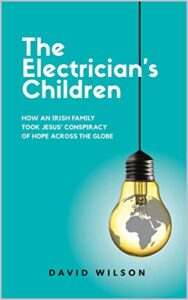 The Electrician’s Children is a memoir of three generations of an Irish family. It begins in remote, rural County Donegal in the 1920s and proceeds across five continents to the present day. The electrician’s two sons and one daughter, struck by their parents’ unpretentious faith, one by one became champions of the plain-spoken message of Jesus. The Electrician’s Children recount their adventures not only throughout Ireland and the UK but also in Russia, East Africa, East Asia, Western Europe and Pakistan. What impact will inequality, conflict in Northern Ireland, the arts, diplomacy, poverty, culture wars, burnout and personal tragedy have on how their counter-cultural message of hope and mercy is received?
Order your copy online here.


