

The Perfect Recipe for Cooking Up a Deliciously Funny Children’s Book by Sonya Anise
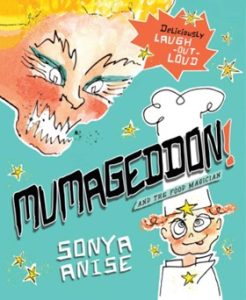
Sonya Anise shares the perfect recipe for blending words and pictures in her debut children’s book MUMAGEDDON! And the Food Magician.
My sojourn into children’s books became an epic journey. Like unsuspecting fairytale characters, I merrily entered the Enchanted Forest of Tales Untold—a vast and shadowy realm where peril lurks. Nothing familiar, I knew, if I were to discover those elusive golden eggs, I’d have to stray from the path…
This past year, as author-illustrator, my life mirrored MUMAGEDDON! And the Food Magician—a rambunctious adventure of twists, turns, and surprises. Like my little food magician, it felt as though I too were baking an elaborate cake, stacked tier upon tier. A delicate balance: meticulously measuring each ingredient and whisking them together to conjure something truly delicious.
Writing and illustrating are distinct skills, each requiring its own headspace. Here’s how I combined them to create my perfect recipe for bringing my book to life.
Words First: Building the Foundation
The journey began with words. I actually wrote most of the story 25 years ago, but didn’t have the audacity to tell it. So it was put aside, forgotten, but it often whispered to me. Two decades of motherhood and life experience later, I transformed what was once a funny, twisty tale (inspired by my childhood hero Roald Dahl) into a richer story with themes of acceptance, forgiveness, unconditional love, finding your voice, and following your heart.
It was essential to complete and edit the text before picking up a pencil to sketch. Once finished, I printed and read it, jotting down whatever illustrations sprung to mind: boy flying on fire-breathing dragon, Stepmonster’s wild beastly hair, a sinister (detention centre) school. My imagination roamed, delving into the characters’ hearts and minds—visualising their quirks, mannerisms, and subtle details that reveal more than text alone conveys. I pondered what my child self, my daughter, nieces, nephews, and young readers might like to see.
The Dance Between Words and Pictures
 I love picture books, and never outgrew Dr Seuss, so I gave equal importance to both words and pictures—the illustrations weren’t afterthoughts, they were integral to the story.
Writing in verse is very rewarding—poetry’s economy of words means each line is tightly packed with ideas, so illustrations really help break it up, providing visual cues for young readers understanding of the story … allowing pause … to absorb the text.
Humour was key. I leaned into exaggeration, inspired by (another childhood hero) Quentin Blake’s wild expressive style: the boy shrinking beneath a towering presence or the potion erupting into a chocolatey mess. Absurd hyperbole added energy and humour, balancing darker moments, keeping the tone light and fun.
I used speech bubbles throughout as verbal asides by the book, offering fun facts, word definitions, and a voice of reason, which undercut serious moments and allowed use of bigger words and concepts. The book itself became a character, engaging directly with the reader.
Shaping the Book: Layout and Flow
Once the text and illustrations took shape, I focused on layout and design. I wanted the book to feel substantial, but manageable for children, so I chose a size that showcased the illustrations without being too big to hold or fit in a bag.
I worked with double-page spreads, thinking about the rhythm and pace. Where were the natural breaks? When did the illustrations need to take over spanning full or double pages? I soon realised that nearly every moment deserved a depiction.
White space plays a key role in design. It’s as important as the words and pictures, providing room to breathe, so elements complement each other rather than compete.
Illustrating the Story
Illustrating children’s books seems simple—it’s not. Though I’m an artist, it’s a different skill. Illustrations must tell stories without words, convey character, mood, and emotion. My book’s funny, so the pictures needed to heighten its humour, bringing the verse to life.
Starting with loose sketches refined over time, the characters began to take shape, often evolving on their own. This organic process was magical—as they revealed themselves, subplots emerged that I hadn’t anticipated.
I wanted their personalities to leap off the page. For me, less is more—Stepmama’s exaggerated pointy finger (shorthand for her cruelty and bossiness) made the rest of her body unnecessary in one scene. As both author and illustrator, I could remove lines from the text when images conveyed the same message, which let the page breathe.
I included small animals with exaggerated expressions to accentuate the drama and humour, which helps readers empathise with the characters.
From Sketch to Final Artwork
Once I was happy with the pencil sketches, I used permanent calligraphy pens on coarse paper for the lines, creating a rough, spontaneous quality. The watercolour washes were light, adding just enough colour to complement the drawings without overwhelming them.
Continuity was essential. As characters developed, I returned to earlier illustrations to ensure consistency, making adjustments to help the personalities shine. With each page, I felt more connected to them.
Typography: Bringing the Words to Life
My design background taught me that typography, though subtle, is crucial to storytelling. I paid close attention to fonts, using a simple, familiar one for the narration and a bolder, playful one for the boy’s voice. For the stepmother, I used a heavy, shouty font to match her tone.
Wanting the words to feel as alive as the pictures, I avoided rigid blocks of text that intimidate young readers. Instead, I let the type flow across the page, echoing the playfulness of the verse without overpowering the illustrations. I used line breaks strategically to guide the rhythm, prompting readers to pause at the right moments for comic or dramatic effect—which helps when reading aloud. Key words were highlighted in particular fonts to enhance meaning, mood and atmosphere.
A Book for All Ages
I wanted MUMAGEDDON! to be a book for everyone–enjoyable for both parents and children, so the book’s layers makes it suitable for readers of all ages. As children grow, they’ll understand more nuances, picking up on jokes or details they missed the first time around. A great children’s book isn’t just a story, it’s an experience that can be revisited, shared across generations, and has the power to heal, inspire, and bring people together.
The Big Bad Wolf: Overcoming Doubts and Fears
Writing and illustrating can feel isolating—and a bit eccentric, as you chuckle alone on your creative cloud. Creating the pictures was fun yet challenging, as I often felt they weren’t good enough. (Measuring up to the masters makes it hard not to feel inadequate!) Ironically readers love them, so I had nothing to worry about.
Self-doubt is a big bad wolf that devours creativity. When it opens its jaws—step away. Walking alone in silence becomes a moving meditation. Being in nature, listening to sounds around me clears my mind, creating space for new ideas to flood in, unbidden, like gifts. I can then return to work recharged and recentered, with fresh eyes.
Creating this book taught me to silence self-doubt, let go of perfectionism, and embrace vulnerability. Sharing it was daunting—it wasn’t just my work on display—it was me. Paradoxically, artists are gentle souls who prefer being behind the scenes, yet our work demands an audience and reciprocity. And once it’s out there, it belongs to everyone. Recognising these fears was pivotal and gave me the courage to push through.
Looking back, I see that both writing and illustrating require patience, focus and care in equal measure. MUMAGEDDON! And the Food Magician was a true labor of love. Who knew making a children’s book would be so challenging and life-affirming? I hope my journey inspires you on your own creative path, and that my recipe helps you cook up your own feast for the soul!
(c) Sonya Anise
About MUMAGEDDON! And the Food Magician by Sonya Anise:
A rambunctious must-read for all ages that makes kids squeal with delight, fright, and disgust! Deliciously laugh-out-loud, this rhyming adventure follows a young chocolatier who’s banned from the kitchen by his loathsome stepmother and sent to a beastly boarding school. Seeking sweet revenge, he mixes a potion, fingers crossed, to cause commotion…
A fantastically silly, heartwarming tale about compromise, acceptance, forgiveness, and unconditional love, with a lovely message of passion and using your voice. Packed with vibrant full-colour illustrations and told in a playful style reminiscent of Revolting Rhymes, it’s perfect for fans of George’s Marvellous Medicine, Charlie and the Chocolate Factory, and Cinderella.
A comic triumph of originality! Sonya’s raucous rolling rhyme is a joy to read aloud, and destined to be a classic beloved be children, parents (and hopefully stepmothers) everywhere.


