

Writing the story everyone thinks they know . . .
Everyone has an opinion about the Titanic. That’s precisely why it frightened me.
When a subject has been told and retold – in documentaries, films, museum displays and family lore – it can feel as though the story is claimed. For a novelist, the danger isn’t a lack of material. It’s an excess of it. Research can easily become a way of postponing the harder work of writing.
I’ve found myself here before. I wrote about Johanna van Gogh-Bonger in Mrs Van Gogh – the woman who inherited hundreds of unsold paintings after Vincent’s death. I also wrote about Annie Edson Taylor in The Woman Who Went Over Niagara Falls in a Barrel – a sixty-three-year-old teacher remembered for one act, and the struggle afterwards to turn notoriety into survival. In each case, the public story was familiar. The woman at its edge was not. More importantly, both lives were shaped by practical pressures: money, reputation, responsibility, survival.
If you’re approaching heavily documented history, this is the first thing I’d suggest: don’t try to outdo the event. Find your originality at the level of character.
1) Don’t choose the event. Choose the narrative problem.
When you begin with the major event, you’re pulled towards summary – what happened, why it matters. That’s the language of history. Fiction requires something narrower: a character with a defined need encountering resistance.
A simple but useful starting point is:
- Write down the public narrative in five bullet points.
- Then ask: what human problem sits beside it?
When I began working on a Titanic novel, I knew I didn’t want to reconstruct the sinking in detail. Readers already carry those images. What interested me was the aftermath: public judgement, inherited reputation, the way one event can define a life after the headlines fade.
At one point while drafting, I found myself writing a scene in which my protagonist reads a newspaper description of her father. The tension wasn’t in the facts of the disaster. It was in the language used to describe him – the assumptions embedded in a single paragraph. That was where the scene came alive. The spectacle wasn’t the engine. Consequence was.
With Johanna van Gogh-Bonger, the dominant narrative centres on Vincent’s troubled life and posthumous fame. The question I wrote towards was practical: what happens to a vast body of unsold paintings when their creator dies? Johanna organised exhibitions, managed correspondence, cultivated networks and made deliberate choices that shaped how Vincent’s work entered the world.
Your angle needs to be a problem the character must navigate, not an event the reader already recognises.
2) Research to make decisions, not to accumulate coverage.
Well-documented subjects create a tempting assumption: that you should know everything before you begin. The result is often a manuscript that reads like evidence of research rather than a novel.
Early on, two kinds of information matter most:
- Framework facts: the fixed timeline you won’t contradict.
- Constraint facts: the rules and realities that shape what your character can plausibly do.
Once those are clear, broad research can pause. From that point on, research should be triggered by scenes.
I use a simple two-column approach:
- Story problem: What am I trying to write?
- Research task: What specific information will help me write it accurately?
For example:
- Story problem: How would newspapers frame a family associated with a public disaster?
- Research task: Examine contemporary reporting for tone, vocabulary and implicit moral judgement.
If I can’t identify the story problem, I know the research is expanding rather than supporting the novel.
3) Decide what you are NOT writing.
With famous history, clarity often comes from deciding what you won’t cover. Write a short paragraph for yourself beginning: “This novel is not about…”
It might not be about:
- recreating the most dramatised scenes
- explaining every cause and consequence
- competing with film or documentary spectacle
This isn’t dismissive of the history. It protects the novel from trying to do too much. It keeps the focus where it belongs – on the character you’ve chosen to follow.
4) Write into gaps through inference, not invention for its own sake.
Archives preserve events and statements. They rarely preserve interior life. Historical fiction lives in those unrecorded spaces, but it has to feel earned.
The process is one of careful inference:
- Begin with what is known – time, place, public outcome.
- Add what is plausible within established constraints.
- Explore emotional and social consequence without inventing sensational “revelations”.
If you’re writing about a daughter associated with catastrophe, you don’t need hidden conspiracies to create drama. Tension may lie in smaller, credible pressures, such as how others address her, what invitations quietly disappear, what she feels compelled to defend or conceal.
Imagination is most powerful when it grows from documented fact rather than attempting to overwrite it.
5) Being overlooked is not, by itself, a story.
An overlooked figure is not automatically a compelling protagonist. Before committing to a character, I test three questions:
- What does she want, in concrete terms?
- What stands in her way?
- What does she risk losing?
Johanna needed financial security and recognition for Vincent’s work. Annie needed economic survival and control over her own narrative. Helen Melville Smith’s need is different again: to build an identity not entirely defined by her father’s fate. The obstacle is public judgement. The risk is a life lived in reaction to a story she didn’t choose.
In each case, the historical event heightens the stakes, but it doesn’t replace the central conflict. The novel grows from the character trying, and often failing, to solve a problem.
If you can’t identify that pressure, you may have found an intriguing historical detail rather than a narrative with momentum.
Writing the story everyone thinks they know is daunting because readers arrive with fixed images and assumptions. The answer isn’t to match that scale with more information, but to narrow your focus: define the character’s central problem, research only what helps you dramatise it, and decide early what you’re leaving out.
Famous history doesn’t demand a larger canvas. It demands a clearer question, and the discipline to stay with it, even when the archive tempts you elsewhere.
(c) Caroline Cauchi
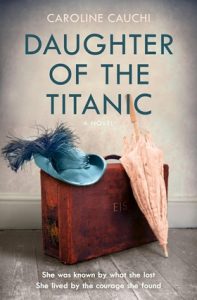
Dr Caroline Cauchi is a bestselling novelist and Reader in Creative Writing at the University of Hull. Her latest novel, Daughter of the Titanic, is published by One More Chapter.
About Daughter of the Titanic by Caroline Cauchi:
She was known for what she lost.
She lived by the courage she found.
“Find Polaris”
When the SS Titanic set sail, Captain Edward John Smith became a legend – and when tragedy struck he was a hero to some, reckless to others. But in the shadow of his infamy stood his daughter, left behind on the shore with nothing but whispers, rumors and the ache of unanswered questions.
For Helen Melville ‘Mel’ Smith, Titanic was not just a shipwreck but a fracture that split her life in two. In every newspaper clipping, every account of that fateful night, Mel searched for the man she truly knew – the father who told her to find Polaris, the star that never moves.
Spanning the years after the disaster, this is the untold story of the girl history forgot – the daughter who carried the weight of a tragedy the world claimed as its own.
Daughter of the Titanic is a moving re-imagining of loss, legacy and the fragile truth between memory and myth.
Order your copy of this amazing story online here.
And read more articles about the Titanic on Writing.ie here.


