

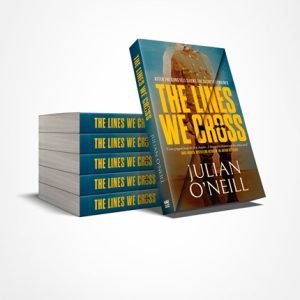
Author Julian O’Neill: the burning questions of Irish identity that became my debut novel, The Lines We Cross.
Two days from now – on 6th November – my first novel will be published. I can’t deny a sense of excitement as it finally goes out into the world.
The idea behind The Lines We Cross has been keeping me company for around ten years, so I’ve had plenty of time to get used to the prospect. Even so, seeing my name on that cover takes a little getting used to.
As I’d become interested in the people from different religious and political traditions who served alongside one another in the First World War, the novel-writing process began for me with questions – the kind of stubborn sort that will never let you be – about two men.
What might happen, I wondered, if a Protestant and a Catholic met on the same side of the battlefield? How would that go?
How about if one of those men saved the other’s life? What would those two men owe each other?
And then suppose they returned to Ireland and met again, only this time finding themselves on opposing sides of yet another conflict back home. How would that play out?
Researching and Writing The Lines We Cross
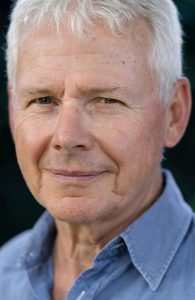
Those questions stayed with me for years, prodding and poking me endlessly until I gave in to them and eventually began the serious research and writing that became The Lines We Cross. Eventually, those questions would give me Billy McBride and Ruari O’Donnell, my protagonists whose shared experience of the Somme has consequences neither could possibly foresee.
I grew up near Belfast during The Troubles. My upbringing was Protestant, my outlook largely British, and the history I learned reflected that background. At university, I met people whose understanding of the same places and events differed considerably from mine. Things I’d taken for granted became rather less straightforward, and my own sense of identity has only grown more complex since then.
More questions!
But I’ve found writing to be a wonderful way to explore questions, through characters who have their own experiences, and whose circumstances are sometimes very different to my own. As a writer yourself reading this article, I’m sure you can relate.
A Writer’s Response
Billy, for example, has a deep Christian faith that is severely tested by war and the experiences that flow from that. Ruari has rejected religion, yet people continue to judge him through assumptions about his background. What either man believes about himself does not necessarily matter to those deciding who he must be because of the labels he carries.
As the story developed over time, another life became central to it. Marion Maguire, a young woman who becomes pregnant, faces the judgement of her family and the religious authorities. Her experiences take the novel into a Magdalene laundry and a very different relationship with Ireland as she thought she knew it.
Marion’s story gave me the space to widen the questions I was already asking…
Who really has freedom to make choices in this life?
What happens when the people meant to protect you exercise abusive power over you instead?
How far can anyone escape the identity that their community has assigned them?
The thing is, dear reader, that I’d not worked all this out before starting. In fact, I thought I was rather better prepared than I turned out to be.
Early on in my writing journey, my friend, the author Nicola Morgan, asked whether I was a planner or a pantser. I needed the second term explained (I’m sure you’re way ahead of me and already familiar). With a beginning in mind and a reasonable idea of the ending, I assumed I belonged among the planners.
Learning from my Characters
My characters, however, had a lot to teach me.
Billy, Ruari, Marion and the wider cast I’d created took me to unexpected places, demanded further research and, in one important case, changed enough to alter the ending. After a professional life involving scientific and academic writing, I found this freedom both enormously enjoyable and occasionally white-knuckle-terrifying!
My research took me back to Ulster, listening again to familiar accents and expressions, and repeatedly to the battlefields of France and Belgium. Sebastian Faulks’s Birdsong had helped awaken my interest in the First World War. Now I was finding my own way into its landscapes and lives with research that lit me up at every step.
This September, travelling by bicycle, I returned to the ground near Thiepval where the novel opens on 1st July 1916. I looked up the slope my characters would have to climb towards the German positions. Behind me was the wood; around me, perfectly cultivated fields. There was birdsong and very little else.
I wondered what Billy and Ruari would have felt, stood in that same spot. How different – how awful – that must have been for them. I’d spent hours imagining the bombardment, the smoke, and the fear. Standing there, I felt a little closer to my characters, as the hair bristled on the back of my neck.
It was an emotional moment that will live long in my memory.
Book Launch
Now, as I prepare for this coming Friday when I will celebrate my book’s launch with a party for friends and family at a local bookstore, all of these memories are sharp in my mind. There will be the pleasure of seeing it become something other people can hold, read and, I hope, argue about.
More than anything, I hope to have done my characters – and the real life men and women whose experiences have informed them – the justice they deserve.
I’m also particularly curious to discover what readers make of Billy, Ruari and Marion. Having lived with all three for such a long time, I wonder what my readers will bring to their stories.
Perhaps they will disagree about the choices those three make. I would welcome that. The questions that prompted my novel, after all, have never seemed to me to have an easy answer.
(c) Julian O’Neill
https://julianoneillauthor.com/
About The Lines We Cross by Julian O’Neill

1916: Wars abroad and at home are tearing families apart.
Eighteen-year-old Ulsterman Billy McBride leaves his family farm for the battlefields of the Somme, where a single encounter changes three lives forever.
When Ruari O’Donnell, a young Catholic from Tyrone with a dark secret in his past, saves Billy’s life, he little knows that fate will bring them together once more…on opposite sides of another conflict.
Marion Maguire, pregnant and alone after being unwittingly abandoned, faces devastating loss and unthinkable choices that lead her from a Magdalene laundry to a world of gunrunners and rebels.
The Lines We Cross brings the killing fields of France and the turbulent struggle for Irish independence vividly to life, as three young souls make choices that will haunt them for years to come.
An evocative and visceral novel that doesn’t shy away from the realities of war and conflict. Perfect for fans of Sebastian Barry and Sebastian Faulks, looking for an emotional punch to the gut.
The Lines We Cross is available from 6th November 2026 via Julian’s website: julianoneillauthor.com
See here for more Writing & Me articles on Writing.ie.


