

Claire Hennessy, author of In the Movie of Her Life, with some key pointers in the writing of flash fiction . . .
I have a new book coming out. It’s a little bit nerve-wracking, as books so often are – you work away on them in solitude for many years, and then with an editor, and then suddenly there it is, out in the world, and people might actually read it. (Or worse, and more likely, not read it.) But this one is a collection of short stories, which is something a bit different for me – while I’ve been publishing short fiction for many years, this is the first book of it, and the first book for adults (my specialist subject, if you like, is YA fiction), and it occurs to me that I may occasionally be asked reasonable questions like ‘how do you go about writing a short story?’
I need, I know, a better and more helpful answer than ‘I don’t have a clue’, even though that’s how it feels, sometimes. I’ve spent a lot of time thinking about how we go about writing novels, and have worked with many workshop participants over the years on just that, but short stories? Shrug. (Go ask Kevin Barry, for god’s sake, or Colin Barrett, or Anne Enright, or June Caldwell, or Roisin O’Donnell, or Cathy Sweeney, or Lucy Caldwell, or any other one of the many brilliant Irish writers who clearly know what they’re doing there.)
But there is one kind of short story that I have thought about, and feel vaguely confident having opinions about, and that is flash fiction. The term, for people unfamiliar with it, is a relatively recent label for very-short stories, the kind that might take up only a page or two in a book. In flash fiction competitions, the word count limit might be 300, or 500, or maybe 750 at a stretch. Ideal for our utterly-broken-attention-span era, you might say.
 Some writers and critics suggest that thinking about ‘flash’ as its own unique form doesn’t really make sense, that it’s just, well, a very short story. Others suggest it might be more useful to consider it as a distinct thing. Writing in the Paris Review in 2018, Bradley Babendir noted: “An essential element of flash fiction seems to be prizing force over narrative. Or, something like this: if the novel is a marathon and the short story is a 5K, then flash fiction is a 100-meter dash. You use the same tools, but they are very different in training, approach, and execution.” And then there’s those who’d suggest a comparison with the prose poem, pointing to the intensity of the form and the care with the language.
I think these are sometimes things to consider, but on a very practical level, here’s what I love about the form: it’s short. I don’t mean that it’s easy. Short forms are far more demanding than they initially seem, as people who begin writing picture book texts often find. But you can get to ‘the end’ of a first draft in one sitting in a way that you simply can’t with a novel, or even with a long short story. You can hold the whole thing in your head without needing to refer to notes or outlines– even if the flawed version on the page, as is so often the case with any kind of writing, doesn’t match up with your shining vision.
Regardless of the quality of what actually comes out, and whether you choose to continue working on something beyond a first draft, this all makes it a really freeing form to explore and to experiment in. It lets you be brave in a safe way, which is perhaps the goal of any creative writing exercise and how we get interesting, surprising work down on the page (versus being terrified of putting anything down, of getting it ‘wrong’). We can try things out that we’d maybe be wary of otherwise – different genres, or unusual points-of-view, or subject matter that we might otherwise shy away from. It’s a sandbox, a playground, a lab. If something doesn’t work out, it’s not the end of the world, and we have not lost too much time to it; we can also later think about why something doesn’t work by assessing the piece as a whole instead of pulling out something incomplete (i.e. we have given ourselves sufficient data to work with, here).
So. Here are five suggestions for flash fiction for you to try, if so inclined. These are based on stories in the collection, but they’re also based on prompts I’ve used with different writing workshops or individuals (and ‘rewriting a fairytale’ is kind of a classic prompt, I can take no credit for it).
More suggestions: 500 words max (if you feel like really pushing yourself, aim for exactly 500, or 100, or 250 – set the target in advance and then work to it). Try setting a timer of 30 minutes and see what you can get done. If you haven’t written in a while, try 5 minutes and tell yourself you’re allowed stop if it’s not working, but you need to fling yourself at it for those few minutes anyway. Jump in. Have fun.
Prompts:
- Revisit a familiar fairytale, but tell it from a villain’s or a bystander’s perspective.
- Your home is haunted – how do people react when you introduce them to your ghost?
- Pick a number between ten and twenty. That number is how many things your character is worrying about, right now. List them.
- Write about a historical figure from the perspective of someone who loved them.
- What might kids be bullied about in 100 years’ time? Write about it from the collective perspective of the bullies (‘we…’).
(c) Claire Hennessy
Claire Hennessy (http://www.clairehennessy.com) is a writer, reviewer, and creative writing facilitator from Dublin. She is the author of several YA novels, and her short story collection, In The Movie Of Her Life, is published by Doire Press. https://www.doirepress.com/books/poetry/feminist-poetry/in-the-movie-of-her-life
Author photography (c) Ger Holland
About In the Movie of Her Life by Claire Hennessy:
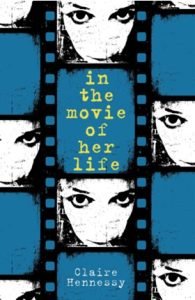
In The Movie Of Her Life, Claire Hennessy’s adult fiction debut, is a work of edgy, voice-driven short stories that go to dark places with gut-wrenching honesty few writers can master.
In 21st century Dublin, an aspiring comedian puts her career on hold in favour of her boyfriend’s, all the while pretending to ignore his disdain for her day job that holds them together; a lonely young teacher tries to distract herself from a crush on one of her secondary school students; and a single mother on a first date, in desperate need of one good night out, dodges questions about her struggling child.
In other realities, a group of girls persuade themselves a classmate’s death had nothing to do with them or their merciless pact; a young woman lives out what’s supposed to be the last hours of her life at an end-of-the-world party; and a wicked stepmother forges a connection with the witch hiding in the forest.
Haunted by the gap between what they imagined their lives would be and what they really are, these characters grapple with unspeakable longings and quiet devastation.
Order your copy of In the Movie of Her Life online here.
And see here for more invaluable advice from Claire Hennessy on Writing.ie.


