

Essie Fox, author of the riveting historical mystery, Dangerous, on how ‘there’s nothing quite like that buzz when a story comes to life . . .’
As a writer I’m best known for my historical gothic novels of the Victorian era. As such, I’m used to doing research to ensure that my work is factually correct – the settings, the events, and now and then the real people who might play a cameo in the plots’ developments, with appearances made by stars of the music hall, by Pre-Raphaelite artists, quacks with shops on Oxford Street; even Queen Victoria and an Indian prince who became one of her favourites. However, up until now, all of my main characters have been entirely fictional – until my latest endeavour set in the Regency era and centred on the man whose dramatic life and exploits have led me into the realm of a historical crime thriller … a mystery.
Dangerous takes place during a year in the life of the infamous Lord Byron, when the great Romantic poet is in voluntary exile from the land of his birth, after a series of scandals (including incest, adultery, and the failure of a marriage) cause him to flee from the law or risk imprisonment -– or worse. In Venice, the brooding and liberated man pursues all hedonistic pleasures that the city has to offer. He also learns about the recent publication of a novel with the title of The Vampyre…
So far, so true. The Vampyre had been written by a Doctor Polidori who had accompanied Byron as his personal physician when he’d first departed England, and who had kept a scrap of paper on which Byron had once scribbled what was meant to be the start of a vampire horror story. But, when Byron changed his mind and discarded those few lines as being worthless of attention, Polidori took the theme and developed it himself, and no doubt was delighted when his novel swiftly sold – though far less so when he saw a copy of the book with Byron’s name on the cover as the author of the work. Byron himself was furious with the unscrupulous behaviour of the rogue publishers, also to think that anyone believed he wrote such turgid prose. Polidori who’d held hopes for great literary fame was called a plagiarist and liar, which surely added to the woes leading to his suicide at the age of twenty-five.
These facts alone formed the basis for a dramatic piece of fiction. But my imagination soared as I took these true events from Byron’s life and then embellished them yet more with the murders of some women found in Venice with wounds to their throats, leading to rumours being spread that The Vampyre must be Byron’s confession of the murders. (Not such a leap of faith when his own poetry often featured salacious events that occurred in his own life.) Faced with a scandal even worse than anything he’s known before, my protagonist goes on to play the part of a detective as he seeks out the real killer and hopes to prove his innocence.
Having decided that my novel would be a crime mystery, I had to think carefully about the best way to approach it, and how the structure would be different to novels written in the past.
INTRODUCING THE CRIME AND THE VICTIM
 I knew what the crimes would be, and that one victim must appear at the start of the book, both to engage my reader’s interest, but also to be clear about the genre of the novel. So, in the very first chapter I made sure to establish the main character, his mood, and any background information specific to this novel. I also introduce Polidori’s Vampyre novel, thus quickly setting up the framework for almost all that will follow before the end of this first chapter – when lord Byron leaves a party and discovers a woman who is dying in an alley from a wound to her throat.
BUILDING SUSPENSE, TENSION, AND ATMOSPHERE
This novel does have a prologue – a subject of much debate. Some people like them. Others don’t. In this case it offered me a way to immediately introduce some tension and build an eerie atmosphere in a way that’s removed from the main body of the work, though firmly establishing the intense and gothic tone. The prologue scene is factually linked to the life – and death – of Byron, following the true event when his coffin was opened in its crypt at Hucknall church and the corpse was found to be almost perfectly preserved after more than a hundred years. Only at the prologue’s end do I divert to pure fictioin, when some handwritten scrolls are discovered that relate to the poet’s time in Venice – and then the lines that inform the genre of the novel: “Shall I be listed with the angels or the demons raised from Hell? You the reader must prepare to be the judge and so decide if I am guilty of the heinous and unnatural crimes of murder lately connected to my name.”
Throughout the book I use small extracts from Byron’s letters and poems, and from The Vampyre itself, to drop more clues of what’s to come or introduce uncertainty about what’s true and what is false. Tension is always present as events swiftly spiral, and at times seem supernatural, whether they really are, or due to the effects of opiates and drink. I’ve also tried to heighten emotions and confusion with Byron sometimes fearing that he’s lapsing into madness – that he may be the murderer.
A gothic atmosphere is essential to the mood, and this I hope I have enhanced by drip feeding certain facts about vampiric literature in European folklore. But the tone is also formed by the settings of the novel – the crumbling palazzo in which Byron lives, the city’s glamorous salons, and then its morgue, brothels, and prison – all the dank grandeur of Venice where danger lurks at every turn and passageways lead to dead ends, with water constantly lapping on the stones of the buildings like the whispers of ghosts. Malevolent ghosts.
With a historical crime novel, it is essential to research as much as possible about the settings and the people who inhabit your world. Visit that ‘world’. Soak in the flavour of the place. Reproduce what your reader will find familiar, but also with a slant that will help to lure them into a puzzle all your own.
MAKING CHARACTERS AND SETTINGS CONVINCING
In any story it’s essential to give characters depth, to make them complex and convincing in the world in which you’ve placed them. If, like mine, your main player is an aristocrat, there will be servants in the house. What are their relationships? Give these characters depth. Perhaps involve them in your plot. Don’t be cliched and assume a silent valet or maid would have no influence at all. Servants saw and heard a lot, were often intimately involved in the lives of their employers. You don’t need to go too far, but a phrase here or there can help to give a book more substance – to lay down clues, or sow red herrings.
Your characters don’t have to be ‘likeable’ as such, but they must have qualities that lead the reader to invest in the outcome of the book. Of course, no writer wants their reader to guess the final outcome, or who the villain really is. There must be elements of doubt, perhaps a twist in the tail to give the final surprise – and hopefully some satisfaction.
READ WIDELY IN YOUR GENRE
In conclusion, I would say one of the most important things when writing any novel is to read the very best already written your genre. Dangerous may be a historical mystery, but to prepare for that book I read lots of crime novels set in the current day, as well as Golden Age classics. By doing this any writer can assimilate the ‘tools of the trade’, using these as a basis, but also trying to make their own work something unique. Readers do like to immerse themselves in the familiar, but then they also love the rush of adrenaline that comes with the shock of the new. Be brave. Be bold. Be confident. But most of all, enjoy the writing. There’s nothing quite like that buzz when a story comes to life – particularly when it’s in a genre you’ve never explored before!
(c) Essie Fox
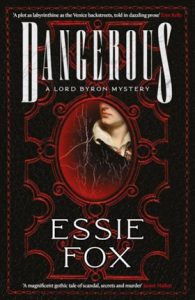
Essie Fox is author of Dangerous, published by Orenda Books.
About Dangerous by Essie Fox:
Fiction can be fatal…
Living in exile in Venice, the disgraced Lord Byron revels in the freedoms of the city
But when he is associated with the deaths of local women, found with wounds to their throats, and then a novel called The Vampyre is published under his name, rumours begin to spread that Byron may be the murderer…
As events escalate and tensions rise – and his own life is endangered, as well as those he holds most dear – Byron is forced to play detective, to discover who is really behind these heinous crimes. Meanwhile, the scandals of his own infamous past come back to haunt him…
Rich in gothic atmosphere and drawing on real events and characters from Byron’s life, Dangerous is a riveting, dazzling historical thriller, as decadent, dark and seductive as the poet himself…
Order your copy of Dangerous by Essie Fox online here.
And see here for previous articles on the writing of historical crime on Writing.ie.


