

What happens when a writer, even one you love and respect, gives you advice that you’re not sure you want – or need – to take?
As writers, the majority of our feedback comes from readers, mostly in the form of reviews and comments online and in person. Feedback and advice are similar but I think personally that feedback doesn’t necessarily come with the expectation of change. With a review, the book exists as it is and the reader either likes or dislikes it. The author can’t go back and, say, make the protagonist choose to confront the killer instead of fleeing into the woods, no matter what the majority of readers wish happened. Advice however, comes with the expectation, however unintended, to change the way we do things. To accept the advice and to use it.
So what happens when a writer, even one you love and respect, gives you advice that you’re not sure you want – or need – to take? And how do you know when to shut up and listen, and when to politely go your own way?
Advice, especially advice from a peer or even one of your heroes, can feel like holy writ. Rules passed down from writers who have the publishing career you dream of, or who might be teaching you on a course, with a whole alphabet of letters after their name. You might find yourself looking at all this advice, in blogs, articles, in lectures and seminars and in panel talks…and start to struggle to know what’s good advice and what’s just an opinion. An opinion held by someone you respect and admire, but still, just an opinion.
Well, all advice is an opinion. As unpopular as that opinion might be, I stand by it.
 It’s just that some opinions are incredibly widespread, held by virtually every writer, everywhere, until they become fact. For example, things like ‘writers should use proper punctuation’ or ‘don’t introduce twenty named characters on page one’. Yet still there are a million and one ways to break these ‘rules’ and still come out of the process with a readable, possibly even acclaimed, novel. Rules are made to be broken and every rule has an exception.
Knowing when you’re the exception involves periodically checking your ego and being able to think critically about your own work. Is the story you’re telling better served by being told in second person? Does your novel really benefit from not using indentations for paragraphs? Are you sticking with these choices because they’re good ones, or because you feel called out by your workshop group because they say your work is now hard to read? Sometimes rejecting advice can be as kneejerk as that. The urge to just ignore what we don’t want to hear isn’t limited to writing, but it can have a big impact on your work.
One piece of advice I got from a very successful author and university tutor was that I was ‘killing off too many characters’ at the end of one of my novels. I was, in fairness, killing off three, a mixture of main and side characters. I was a bit worried about this advice, as my manuscript was already with a prospective agent. In the end I declined to follow the advice to scale back on the death, and my final grade reflected the fact that they didn’t like my choice.
A different author once told me that my ‘chick-lit’ manuscript wasn’t following genre conventions because the protagonist had a ‘boring, unglamorous job’. I took a sideways look at Sophie Kinsella’s struggling office girls and decided I was actually walking fairly well trodden ground. I was, again, marked down for my choices.
I don’t think either of these pieces of advice would have made my work better or more likely to get published. I do however think that I would have achieved better marks if I’d remembered that my opinion mattered less than that of the person assessing my work. It was a valuable lesson in checking my ego, even when I ‘knew’ I was right.
Supposedly universal advice is sometimes the hardest to reject. ‘Write what you know’ is a ubiquitous catchphrase that every writer has heard at least ten times. It sounds great, in theory. It’s advice that works for some people, because those people have extraordinary lives, or can weave amazing stories from the starting point of their home town or job. However, as someone who has never been trapped on a yacht with toxic millionaires, snowed into a ghost town or stranded on a deserted island, I like to think that I do a pretty good job of imagining my way into my plots. If we all wrote what we knew, there would be a great many more books about struggling authors, and I was advised never to make my main character a writer.
In the end, it’s useful to remember that writers are also readers. Our opinions are always subjective, because they’re about art and art is subjective. Maybe there are tips and tricks that are ‘good advice’ most of the time, but that sometimes need to be ignored. Learning to tell the difference, to be your own advisor, is probably the most important thing you can do, as a writer. But that’s just my advice.
(c) Sarah Goodwin
Author photograph (c) Clifton Photographic
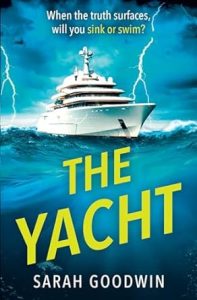
About The Yacht:
WHEN THE TRUTH SURFACES…
New Year’s Eve, 2023. When Hannah and her friends rent a luxury yacht in an Italian marina, they party in style under the stars until they pass out.
…WHO WILL SINK…
The next morning, they are horrified to find they have been cut adrift into the open ocean, with no sight of land and no fuel in the engine. And that’s when the first person goes missing…
…AND WHO WILL SWIM?
The Yacht is a twisty locked-room thriller perfect for fans of The White Lotus, The Hunting Party and The Castaways.
Order your copy online here.


