

Children Of The Night: author Richard Gadz on why vampires keep a firm grip on the human imagination . . .
In ancient Greece and Rome, the mythical lamia was a creature that drank the blood of children in the night. The Vikings called them draugr. South America has several overlapping vampire traditions, such as the Colombian tunda or the peuchen in Chile. West African peoples have stories of the adze, which hunts the young and the weak. In India, there’s the vetalas. In Japan, the nukekubi.
The Undead are pretty much ubiquitous in folklore around the world, be they walking corpses, supernatural spirits or bog-standard blood-suckers, while the literary vampire – a late-night nasty having only its food source in common with the old myths – has been haunting our nightmares since the days of Queen Victoria.
The term ‘nosferatu’, by the way, is a made-up word, with no equivalent in any East European language. It’s probably a mis-translation which was then mis-applied by Bram Stoker in his 1897 novel Dracula. Even so, it was Stoker who basically pressed the Go button on the modern vampire story, despite one or two earlier successes such as the 1845 penny dreadful Varney The Vampire, and it was Stoker who cemented vampiric lore in the popular imagination – crucifixes, garlic etc – most of which he invented himself.
Dracula’s been both template and poster boy for the vast majority of fictional vampires ever since. Along with Sherlock Holmes, Frankenstein’s monster and Mickey Mouse he’s among the most instantly recognised characters on the planet.

Why? What makes vampires rise from the grave with such clockwork regularity? Why do Dracula and its multiple film and TV adaptations, Stephen King’s Salem’s Lot, Anne Rice’s Interview With The Vampire, What We Do In The Shadows, Abigail and so many other vampire movies, books, comics and T-shirts find such a consistent and receptive audience? For the answer, I think we need to look at the context in which Bram Stoker’s original became such a hit, slap bang in the middle of a burst of activity in the fictional fields of horror and sci-fi.
*
The mid-Victorian world suffered an almighty psychological shock in the form of Charles Darwin. His discoveries removed the human race from the centre of Nature in the same way as Copernicus had removed the human race from the centre of the Universe. By the 1880s evolution had been broadly accepted, which was a remarkably quick transition given how entrenched earlier ideas had been, but the sweeping away of old certainties left much uneasiness in its wake.
Meanwhile, Britain’s industrialisation continued to draw a steady flow of people out of the countryside and into mills and factories, attracted by the higher, steadier incomes on offer. Urban overcrowding was rife, disease was endemic and city centre traffic congestion every bit as bad as it is today. Life for most city dwellers easily fit Thomas Hobbes’s 17th century description as “nasty, brutish and short.”
Crucially, what rapid urbanisation also brought with it was a vastly more complex society. With complexity came far greater personal interdependency as jobs became more specialised. City life grew more anonymous, more information-heavy, more regulated by police-enforced laws. The average citizen had an increasingly slim chance of understanding it all. Imagine being a farm labourer, giving up rural life to become a factory worker in Manchester or London. The culture shock alone must have been dizzying.
All this added up to the birth of what we’d colloquially term ‘urban angst,’ that vague sense of dislocation, of the modern world being both isolating and overwhelming, that’s generally shorthanded as ‘alienation.’ It’s what Karl Marx called Entfremdung, an “estrangement from the self,” the sort of encroaching feeling of disassociation which Back To Nature movements and mindfulness exercises have always aimed to combat.
*
Psychologists often cite a loss of control as being a root cause of anxiety – if we feel helpless, unable to change or influence our surroundings, we get stressed and, as that old TV advert for aspirin put it, “this creates a sensation of pressure and so leads to pain.” People enjoy rollercoasters because they’re a temporary, managed abandonment of control, a way to face the un-faceable, like touching a spider to get over arachnophobia.
As a species we’re like bunny rabbits watching a hungry cobra, we want to make sense of danger and chaos. We want it to mean something. It’s only logical that as life becomes harder to cope with, harder to keep up with, we’re going to look for some sort of ointment to rub on the bruises, whether consciously or unconsciously. If it’s a given that human beings are frightened by The Unknown, then the more of The Unknown there is, the more frightened as a species we’re likely to be. A more complex world is surely a scarier world.
The world of the late 19th century was rapidly becoming a more complicated and impersonal place, and out of that complexity and alienation, I would argue, came a coping mechanism in the form of horror fiction. An art form forged in the fires of industry.
Various types of horror story – vampire, apocalyptic, ghost etc – can be interpreted as a psychological response to various forms of anxiety. It’s an idea backed up by the fact that the horror genre has conspicuously been at its most inventive and popular during times of political, social and economic upheaval – the 1890s, the 1930s, the 1970s and ‘80s, the 2020s – times of change, division, radicalisation, uncertain futures. Dracula was published on the crest of the first such speculative fiction wave, surrounded by writers like H.G.Wells, M.R.James, Marie Corelli, Robert Louis Stevenson, Charlotte Perkins Gilman, even Sir Arthur Conan Doyle. The current horror wave has, according to trade magazine The Bookseller, seen sales up 55% in 2024 compared with 2023 – and that was the biggest year since accurate records began, up 54% on 2022!
*
The anxiety Dracula, and nearly all subsequent vampire fiction, taps into is the fear of disease. The vampire comes while we sleep, to drink our blood! At best we end up listless and pasty, at worst we’ve been infected and turn into creatures of darkness ourselves!
Vampires are obvious metaphors for contagion and contamination, spreading through an unwary population, feasting upon us, destroying us from the inside. It’s often said that a fair proportion of horror is about the human body in one way or another – cutting it up, mutating it, generally mucking about with it – and vampirism neatly distils much of our squeamishness about all the stuff our skin holds in. Plus, it’s a metaphor easily extended way beyond simple germ phobias, to encompass political movements or ideologies, societal change, in fact anything which might be perceived as pernicious: poverty, capitalism, the possibilities are endless. Of course, much is made of the it’s-all-about-ess-eee-ecks angle, which is a valid one and was there, tangentially, in Stoker’s book but, well, personally I’ve never been much convinced by it. Sorry, Twilight fans.
A final thought: as metaphor, zombies occupy the same space as vampires, but on a vastly enlarged scale. It may be no coincidence that the modern zombie came lumbering towards us just as the era of globalisation and mass communication was getting under way, and became a dominant force when the internet and social media first entered our homes.
(c) Richard Gadz
Author photography (c) Simon Cheshire
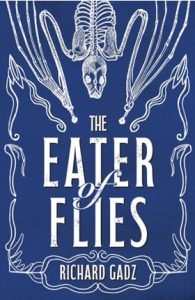
About The Eater of Flies by Richard Gadz:
Summer, 1868. London’s West End buzzes with a chaotic blend of affluence and moral decay, a place where high society and underworld meet. A valuable box from Transylvania, sealed tight, falls into unscrupulous hands. Its opening releases a vampyr, a wraith-like parasite that hides inside a host – whether young or old, man or woman – and thirsts for human blood.
For those who live and work around Holmwood’s music hall, just off The Strand, the vampyr’s arrival begins a nightmare of betrayal and death, and a race to return the creature to the grave before others of its kind come to pick the city clean.
The Eater Of Flies leaves traditional vampiric lore behind, offering a chilling Victorian gothic tale laced with crime, pitch-dark humour and, above all, rampant greed: for money, for power … for blood.
The Eater of Flies by Richard Gadz (Deixis Press, £17.99) is available from all good bookstores https://deixis.press/books/p/the-eater-of-flies


