

Author Katherine Mezzacappa on how The Maiden of Florence came to be written. Here, she shares the inspiration for her novel and the research process behind it.
In 1584, Giulia Albizzi, aged twenty, was taken from her Dominican-run orphanage in Florence to serve as a proof of virility for the Mantuan prince, Vincenzo Gonzaga, prior to his marriage with the eldest daughter of the Grand-Duke of Tuscany. Giulia was recompensed with a husband, chosen for her, and a dowry. I discovered this story quite by accident, in a doctor’s waiting-room. I’d left home in a rush with no book to read. I was faced with a pile of gossip magazines (this was before Covid) but amongst them was a medical journal – dedicated to erectile dysfunction – and it had a tiny historical column. The bones of Giulia’s story were there; Vincenzo Gonzaga’s first marriage had been annulled for non-consummation, though the reason was a malformation of his bride.

I was writing another novel at the time but I will commonly work on at least two projects at once (I find it very effective in keeping writer’s block at arm’s length, as if I get stuck on one book I move to the other and by the time I return to the first one, the problem has usually unknotted itself). I couldn’t let go of this story. Firstly, I looked for anything already written about Giulia, finding Maria Bellonci’s A Prince of Mantua (1947), Roger Peyrefitte’s The Prince’s Person (1963), and a comedy film from 1966, A Maiden for a Prince, complete with battering ram references. Though both books claimed to be non-fiction, it became apparent quickly, especially with regard to Peyrefitte’s, that what wasn’t known from contemporary sources was simply made up to fit a narrative. A common theme in almost everything I encountered was a comparison to the Decameron, as if Giulia’s experience was merely some ribald fable. Yet she was a real girl, subjected to a series of planned sexual assaults in a shuttered house in Venice, and who disappeared from the official correspondence (in the Medici archive in Florence) once she had served her purpose. The Florentine minister, Belisario Vinta, who managed the entire affair, was scrupulously detailed in his letters back to his master Francesco de’ Medici. I read that Giulia would have to be instructed not to put up any resistance but that having come from the orphanage shabbily dressed, providing her with new clothes ‘will make our task easier.’ On the journey to Venice, Vinta informs his master that Giulia has stopped eating, because, in his view, ‘she is overcome by her good fortune.’ You and I could probably suggest other reasons.
You can’t do too much research in writing historical fiction (but beware dumping all that onto the page just because you know it). The single most useful secondary source I had was Women in Italy, 1350-1650: Ideals and Realities, by Mary Rogers and my late friend Paola Tinagli, a rich resource of excerpts from diaries, letters and treatises relating to the entire arc of a woman’s life (though mostly they were written by men). I also read books on crime and punishment in Florence, the dowry system, Renaissance convents, medical treatises (particularly around pregnancy and childbirth), and about the many orphanages, charitable foundations under the patronage, mainly, of the Silk Guild and the ruling Medici family. Large numbers of orphans were employed (but not paid) in the manufacture of silk, whilst the Guild presented itself as a benefactor. Irish readers will quickly see the parallels with all those hotels, government entities and others, who got their washing done on the cheap by the inmates of the Magdalen homes.
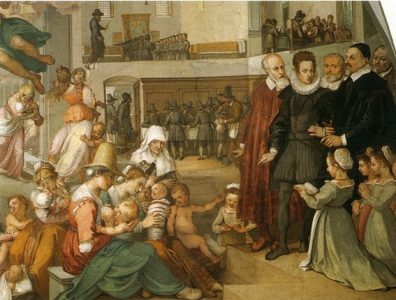
A sense of place is crucial to anyone writing historical fiction and is an expectation of anyone reading it. Often, it is a location that triggers the writing of a novel, as long as that place has not been significantly modified over the years. The dwellings of rich people are more likely to survive, because they were thought worth preserving; it is harder to understand how the teeming poor lived, because their homes were not. The Palazzo Davanzati stands in for Vinta’s home in Florence, though I moved it to the Lungarno. Vincenzo Gonzaga’s vast, rambling palace in Mantua, where in his day one thousand servants served one family, survives (though it has been denuded of most of his astonishingly rich art collection). But the lives of their servants are whispered at in corners, in effect, as in the kitchen at the Davanzati, on the top floor of the house (as was the Renaissance custom). Paintings are one source, and of course museums. The Innocenti foundling hospital in Florence has drawers of heartbreaking little tokens, left with babies when they were placed on the turntable by their mothers in the forlorn hope that they might one day be able to reclaim them.
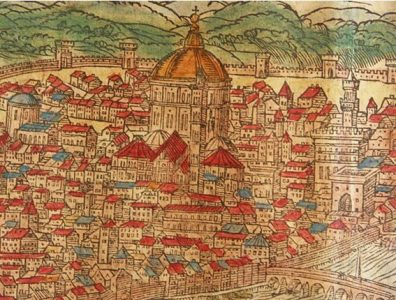
Getting the ‘voice’ of this novel right was a particular challenge because my sources were in Italian or in translation. What I do as part of my research for any book is read anything that someone at the time and place a novel is located would be reading. I hope, despite the story being told in English, that something of the style of those treatises, diaries, statutes and correspondence has transferred.
The latter half of the book, which tells the story of Giulia’s marriage and is in part narrated by her husband, is invention, because nobody thought it needed to be recorded. But in that invention, I sought to recreate what their life might have been like, two strangers brought together after the husband was in effect bribed. In a way I had to work harder at getting the detail right because I no longer had the structure of the correspondence to guide me.
LP Hartley began his novel The Go-Between with the now well-known words: ‘The past is a foreign country; they do things differently there.’ I think that’s probably the most important thing to remember for anyone writing historical fiction. The closest we can get to how people thought and spoke, is to read what they wrote, examine the objects they handled, and to find the places where they breathed.
(c) Katherine Mezzacappa
About The Maiden of Florence:
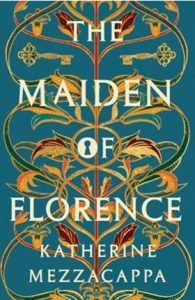
Florence, 1584. Rumours are spreading about the virility of a prince marrying into the powerful Medici family. Orphan Giulia is chosen to put an end to the gossip. In return she will keep her life – and start a new one with a dowry and her own husband. Cloistered since childhood and an innocent in a world ruled by men, Giulia reluctantly agrees, only to be drawn under the control of the Medicis’ lecherous minister.
Years later, married and with a growing family, Giulia hopes she has finally escaped the legacy of her past. But when a threat arrives from a sinister figure from her youth, she must finally take control of events – and become the author of her own story.
Based on true events and reminiscent of The Marriage Portrait by Maggie O’Farrell, The Maiden of Florence gives a charismatic voice to a woman cast aside by history.
Order your copy of The Maiden of Florence online here.
And read more Meet the Authors of Historical Fiction on Writing.ie here.


