

Author Jonathan Gershfield on the importance of family in his new novel, The House of the Rising Son.
Having recently emerged pale and blinking from what seemed like years of solitary confinement, there’s one thing I now feel qualified to assert with total conviction. Writing a first novel is tough. But it would have been a lot tougher if my story and characters had been outside my own lived experience. To write what you know certainly seemed like a sensible starting point. Sure, if I’d been a spy or a mercenary or a drug mule, I’d most likely have started with that. In the event, I decided to write about family.
Not that my own is particularly unusual. The Gershfields are hardly the Obamas or the Windsors. But dig deep enough and every family is a trove of colourful stories and quirky characters. Every family harbours a complex weft of emotions, from euphoria to despair with everything else in between – hope, fear, anxiety, ambition, pride, betrayal, self-sacrifice. And above all, that unconditional love which makes us all so vulnerable. If Life does have any meaning – it’s sure to be found in family. Because in common with most animals, we humans will stop at nothing to protect our own. So, within a family, the stakes are always high.
Personal Experience

Of course, I had my fair share of personal experience to draw on: the tricky adolescent son; the mid-life insecurities; the age-related career wobbles; the death of a parent; the long and once happy marriage that eventually hit the rocks and thrust me into unexpected singledom; the spate of online dating so rudely interrupted by a cancer diagnosis.
Layered properly, these all felt like decent ingredients for a rich fictional mille-feuille. But how do you write a book that features the very people you love, without upsetting the very people you love? After all, it’s not just Royals who get riled when their most intimate secrets are aired. Literature is littered with writers who’ve over-shared and fallen out with their nearest and dearest as a result.
The liberating thing about fiction though, as opposed to memoir, is that whilst your story can explore the themes and ideas that are close to your heart, you’re perfectly free to play fast and loose with the truth. You can heighten, embellish, invent and hyperbolise as much as you like. The only limit is your own imagination.
There again, as the process of writing potentially carries with it an element of therapy, part of me wanted to try to make sense of aspects of my own life that I still found bewildering. So, it’s no coincidence that Alex, my central character, is a straight white man of a certain age who lives in West London. With a tricky adolescent son. And a marriage that’s hitting the rocks. Nor that he directs commercials for a living. It’s a world I know after all, having done it myself for twenty years before shuffling across to TV drama and comedy. The added bonus for the story is that advertising is a young person’s game. So however successful he might have been in his prime, a director hitting sixty is likely to struggle to get work. Which will inevitably have a serious effect on his self-esteem.
Sensitivity
For obvious reasons, I had to be rather more sensitive with my other protagonists. So instead of an English rose media exec, I made Alex’s soon-to-be ex-wife a feisty therapist of Jamaican extraction. Which meant that their only son Fred was biracial. As well as pushing them a bit further away from the real-life characters of my ex and my own two sons (and making me feel less inhibited about including some of their actual characteristics) it would add another layer of potential friction between them. Or at least, help foment questions of identity.
Perhaps my greatest anxiety lay in the depiction of Alex’s mum. With my own still going strong at 97, the last thing I wanted was to upset her. For various reasons though, I needed to make her character an outsider. In my first draft she was Greek, but that insistent little voice inside me kept urging me to write what you know. And besides, some of my mum’s actual idiosyncrasies seemed far too colourful to drop. So, I took a deep breath and left her as Jewish. Instead of a dignified bridge fanatic, though, she became a lawn-bowls champion with a retired Greek ship insurer as a boyfriend, and a propensity to poison people with her dodgy cooking.
Alex’s brother Joe is good-looking and charismatic, but that’s where any similarity to my own real-life sibling ends. Because Joe is the black-sheep of the Feinstein family – a drug-dealing womaniser who spent much of his teens in a young-offender institution, and now harbours a brooding psychopathy that will eventually create mayhem.
So, what started off as a dark comic take on some of the more turbulent episodes in my own family life, gradually transformed into a story of domestic chaos, embracing along the way, an aborted suicide attempt, the trashing of the family home, a kidnap at Glasto and the devastating question of Fred’s paternity. The result, I hope, has duel benefits. A narrative which keeps readers hooked from beginning to end. And even more importantly, the fact that – up till now at any rate – all my family are still talking to me.
(c) Jonathan Gershfield
https://jonathangershfieldauthor.com
About The House of the Rising Son by Jonathan Gershfield:
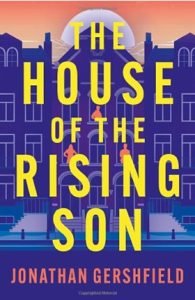
Alex Feinstein’s life is in free-fall. His career has tanked. His wife has left him. And he’s at war with his 15-year-old son. To cap it all, he’s just had a frightening diagnosis. At the end of his tether – literally – he’s about to hang himself from the living-room ceiling when his distraught ex calls to say their son’s been kidnapped at Glasto. The gang is demanding a hefty ransom, and if the cops get involved, Fred’s toast.
But who are these people – and why have they targeted Fred? With renewed sense of purpose and nothing to lose, Alex wriggles out of his makeshift noose and embarks on a frantic mission to rescue the boy – and who knows? – perhaps even himself.
The House of the Rising Son is a dark comic odyssey through the converging traumas of mid-life and adolescence, with a fresh look at family dynamics through the post#MeToo male prism.
The House of the Rising Son by Jonathan Gershfield is published by Troubador and available online and in all good bookshops. Order your copy online here.
And see here for more Meet the Author articles on Writing.ie.


