

How do I write a sex scene? Very carefully.
When I originally wrote The Realm Series, mainstream culture still branded novels with any hint of sexiness as banal bodice ripping, relegated to your sexually frustrated Aunt Barbara. Not only did the arbiters of literary taste turn up their noses at eroticism, romance sales were downward trending. And popular historical fiction at the time barely touched on amorous plot points, let alone allowed its characters to indulge in behind-the-scenes bedroom shenanigans.
Then came the Kindle. And then came 50 Shades of Grey.
Given a platform free from judging eyes, women (and some men) of all stripes, from beleaguered Aunt Barbara, to Oprah’s book club staff, swarmed to erotic romance. We all know what’s happened since: A Court of Thorn and Roses and Fourth Wing showered the industry in sales and legitimized a world of sexual indulgence previously deemed at best inappropriate, and at worse abhorrent.
In the middle of this cultural shift, I re-envisioned my books. Already set in Renaissance Europe and filled with royal intrigue, betrayals and bloodshed, passion and peril, what if I added the scenes I (a secret spicy reader myself) always wanted to write? With time now ripe in the industry, I decided to add the scenes, hints, and brushstrokes that take a closed-door romance to a doors-cast-asunder romp. But I also wanted to respect my original readers. Why couldn’t there be two versions of the same book, one for each preference? So, my “Closed Bed Curtains” and “Betwixt the Sheets” editions were born.
Adding the Sex to a Sex Scene
 But how to add the sex?
In trying to bring sexy back, I followed the same rules of any fiction writing: show don’t tell, avoid redundancy, evoke as many senses as possible, and allow the characters to drive the action. Yet evoking eroticism is different beast than a purely plot driven scene, a more intimate device of character and development, even in something so simple as word choice.
In writing a battle scene say, one can use “sword” multiple times without sounding repetitive; not so in an amorous encounter. Let’s face it, there are only so many words to describe male accoutrements, and using the same one can be detrimentally distracting. Similarly, using the aforementioned “sword” as a euphemism can bring an eye roll, diminishing the scene to juvenile derision. And yet “sheath”, while sword-adjacent, generally doesn’t garner the same response. There’s also the factor of using historically appropriate language, as the slang of today does not always translate.
Pacing
Another factor to these scenes is pacing, based not simply on the scene context itself—say, having just returned from a long absence versus spending a lazy afternoon by the river—but also within the book as a whole. My series’ second book, God & King, has a civil war to contend with. With the characters separated for large chunks of the book, I had to decide how much spicy should bracket this sexless hole, while at the same time trusting the plotting to carry readers who came wanting the heat.
There’s also the work of figuring out each character’s sexual style, and then illustrating their arcs to even more advantage. For example, my antagonist has a less precious view of copulation, so any act of tenderness would further show the reader a stark change in his circumstance or mindset.
 But underlying such craft machinations is ultimately grappling with what women want to feel in romantic relationships. What satisfies, not simply sexually, but at a fundamental level? I can only speak from my own experience as a heterosexual cis-woman navigating relationships, as well as what I’ve observed in the world. Yet I found the overarching elements of writing – indeed having – great sex are these: women want to feel revered, cherished, singular, safe, and, well, hot, in their lover’s eyes. And while these desires can dovetail, they are also distinct. And when writing romance fiction, all of these elements can reach past the everyday, gleefully allowing all we Aunt Barbara’s to live out the fantasy we may not have in our own lives.
For example, with singularity, it’s not simply the low bar of faithfulness the male protagonist hurdles, but his partner becomes the only light in the heavens he sees. No matter how many lovers came before, she is unique, set apart from all previous exploits. Indeed, each fresh encounter with her ruins him for any other.
Similarly with reverence, a mere mortal’s idea of honoring a partner with flowers on a Friday becomes a sense of raw awe in her presence, imbuing her with (singular) power by her gravitational pull. He is drawn to her by the very essence of her being, humbled yet empowered by the force of her presence.
What makes intimate encounters satisfying is when these elements are manifested through the character’s physical movements, dialogue, and prose choice. Do his eyes search a crowded room only for hers (she feels revered, hot, cherished)? Or do those eyes lazily trace the outlines of others before landing on the her, face still stoic (unsafe, just another conquest, marginally attractive)? Does his hand cradle her neck as he lays her down, and does he wonder in his mind at his luck at finding such a woman (safe, singular, cherished)?
Certainly, in other genres “good” sex scenes may call for different constraints. Yet when one wants to sink into the swoon, allowing the female protagonist to be lavished upon in mind, body, and spirit gets you well on your way, to well, finishing strong. While the famed sex therapist Dr. Ruth used to say “have fun, but keep it clean,” in writing sex, I’d say, have fun, and keep it coming.
(c) Jennie L. Spohr
https://www.instagram.com/jlspohrwriter/
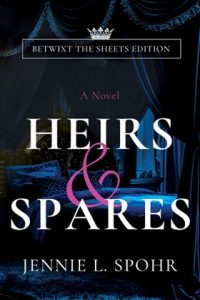
About Heirs & Spares, (Betwixt the Sheets Edition/Closed Bedcurtains Edition) by Jennie L. Spohr
For those who like more spice in their (k)nights . . .
It’s 1569. Elizabeth I sits on the English throne, the Reformation inflames the continent, and whispers of war abound. But in Troixden, just north of France, the Lady Annelore isn’t interested in royal politics. Times are hard, taxes are high, and the people in her duchy need her help just to survive. Her widowed father is a good man easily distracted by horses, and her newly knighted childhood friend . . . well, he has plans of his own.
Then Annelore receives a call she can’t ignore. When Troixden’s sadistic king dies childless, his younger brother William returns from exile to find his beloved country on the brink of civil war. He’s in desperate need of the stability that comes with a bride and heirs. But Annelore, his chosen queen, won’t come quietly. Now the future of Troixden lies in the hands of two people who never wanted the power they’ve received and never dreamed that from duty and honor they might find love and a path to peace. Heirs & Spares is one part history, two parts palace plotting, and a whole lot of spicy romantic intrigue. Break out the spiced wine and sink into this rousing read.
Order your copy online here.
And see here for some Really Useful Links with advice on writing a sex scene.


