

Growing Pains: the fact and the fiction by Joseph Ball.
Writing a novel is a dream for most people. They say everyone has a book in them, but some of us have lived a book we would rather forget, then chose to write it anyway.
The debut novel Growing Pains will be the first of four books, focusing on growing up as a neglected child, with the books created to raise awareness of neglect and cruelty, whilst helping to raise money to help those in need. It has been an intricate piece of work and has had to be built around balance.
Creating a story based on real-life events is an easy enough job; the story has already happened, and the goal is to put pen to paper and tell all. This only works if your story is entertaining enough; sometimes, you have to embellish or add characters to give the reader a hook and keep them engaged and wanting more.
This was the dilemma I faced when beginning my first novel. I knew I wanted it to be based on my experiences, and that there were plenty of positive influences in my life I wanted to pay homage to. This was the easy part; those characters could keep their identities and be shown in their true forms without risk of upsetting anyone. The main character, Alex, would be a new character himself, again, to avoid any feelings of injustice from those I grew up around, and for practicality.
Complex Characters

Complex characters, or those who caused harm, were a different challenge. I knew what I wanted to write about, and I knew the story I wanted to tell. Would it be fair to name and shame, or potentially cause heartbreak for those on the bad side of my perspective? What if I was wrong? What if I had just been a child who didn’t understand the world? This had a simple solution. Change the names and allow the polarising characters to be just that, a character in a book. This decision was the opening I needed, and one I could take advantage of to give the book some extra entertainment.
I could use the anonymity of the characters to embellish and create more drama, whilst entwining them with real events, to bring fiction into fact and use examples to raise the awareness I was hoping for. For any of these real-life characters, they would be left with their own choice. Either read the book, identify their own poor behaviours, and feel aggrieved by the writing. Something I had no issue with, as recognising their behaviours should be cause for reflection rather than complaint. Or, read the book and feel aggrieved because a character that might be you takes actions you did not take, in which case, why feel aggrieved? The perfect scenario to help anyone involved keep their distance and support the work now that time has passed, instead of challenging it.
Writing Growing Pains
The opportunity had been found, the reasoning had been found, and now the grounding needed to be found. The book was to be written solely from the child’s perspective, to show what it felt like to be neglected. With a free license to include fiction, I would need to stay grounded as an author. I was not a beaten child or a sexually abused child; I was a child who felt neglected, and this had to stay consistent. Being able to embellish and add entertainment is a great tool. However, the story still needed its original core, or the message I sought to highlight to the reader would be lost in scenarios designed to shock or provoke anger.
These are gentle books. They show a journey from childhood to adulthood while feeling the harshness of parental anger and indifference, and they are written to be immersive. The dream is for the reader to feel like the main character, to feel sadness because the incidents feel like they are happening to them, rather than pity for it happening to another. This was where the balance had to come from.
Authenticity
As each chapter came to a close, I reviewed it for authenticity: was it close enough to memory, was it clear enough, and was it consistent enough with the story so far? Oh, how easy it would be to throw in a couple of punches or a dragon and completely lose the reader.
The battle between fact and fiction became a minefield rather than the opportunity it had promised to be, and eventually, fiction was used discreetly rather than freely. Truth be told, it will be a long time before I find out if the balance was found in the end. Fiction has been used sparingly, so I am hopeful I have done the books and characters’ experiences justice. I guess the unit sales and the reaction will tell me in the end. Whatever happens next, I know I’ve told the truth as I felt it. And sometimes, that’s the hardest story to write. For now, this minefield moves on to book two, and I continue to stay as true to Alex’s story as possible.
(c) Joseph Ball
Joseph is a father of two and lives with his wife and their two cats. Joseph wrote much of Growing Pains in the early mornings before work, balancing writing with full-time employment and fatherhood. Joseph is a supermarket manager and dreams of one day opening his own bookstore. Joseph shares a birthday with his daughter.
About Growing Pains:
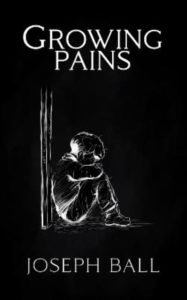
Alexander is the most normal and loved eleven-year-old boy you will ever meet. Until one day, he isn’t.
Living in the south east of England in the 1990s, Alexander’s life appears stable – a warm home, a loving mother, and a familiar school routine. But beneath the surface, things begin to shift. Affection turns cold. Words are twisted. The father he once looked up to becomes a figure of confusion and fear.
As the tension in the house builds, Alexander is forced to question everything: his place in the family, his worth, and whether the love he thought was unconditional ever really existed. While friendships and football offer brief moments of safety, the emotional pressure at home grows unbearable, and he’s left trying to make sense of a world that suddenly seems stacked against him.
Growing Pains is a raw, emotionally charged debut inspired by true events. It lays bare the hidden scars of emotional abuse and explores the quiet, persistent damage inflicted by those closest to us. Told entirely from Alexander’s perspective, it captures the confusion, shame, and resilience of a child trying to survive in a home where silence is the only defence.
Order your copy of Growing Pains online here.
And see here to read more Meet the Author articles on Writing.ie.


