

Author Tracy Martin tells us her ‘writing has been shaped by procrastination, perseverance, paralysis, pain, resilience, humour, 3am soul‑talks and by the kind of perspective you only earn by living a life that didn’t go to plan’.
Osmosis by paperback, that’s how I’ve always secretly hoped learning might work. This soul of mine has long believed it should be a possibility. I tried it in school, and again in college, where many a psychology textbook, undeniably heavy in every sense lay across my face or at my feet as I slept. Hopefully none of my lecturers are reading this, because they’d be horrified to know how often I relied on proximity rather than actual study. But there I was, convinced that if the book stayed close enough, long enough, something inside it might seep into me.
I realise now that my writing process isn’t all that different. I wish I could tell you it’s structured or disciplined or follows some elegant creative routine. It isn’t. What I have instead is a very loose, human and very unpredictable way of gathering lines, a kind of creative osmosis where sentences arrive in flashes, fragments, and half‑dreams, rather than in any orderly fashion.
Chronic Pain Plays its Part
My writing rarely arrives during respectable hours. It prefers the strange, liminal spaces, the moments when the world is quiet and my mind finally stops performing. I call it my 3am soul talk time. It’s the hour when my subconscious overrides everything else and starts speaking in its own language. Some people call it broken sleep. And in fairness, they’re not wrong. But I call it being a 50+ woman with far too many tabs open in her brain, all of them insisting on being dealt with at once. Chronic pain tends to play its own part in the party too.
Between 3am and 5am, I’m at my most prolific. Not in a glamorous, tortured artist way, more in a “Why is my brain doing this now?” way. I scribble half‑formed sentences into a notebook, that I can barely decipher in the morning or grab my phone and record voice notes in those smoky, half‑asleep tones that sound like I’m auditioning for a late‑night chat line nobody ever rings. Yet, somehow, there’s always a word or a phrase with a bit of a pulse. Something that feels like it came from a deeper place than the daytime version of me ever manages to reach.
So Not Me
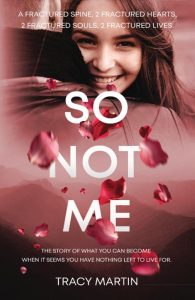
I’d love to give you a neat five-point process for how my writing comes, a tidy little roadmap you could follow, or that I could pretend to follow myself. But that would be So Not Me. Which, coincidentally, is also the title of my recently published book, no sales pitch needed, I promise. It just happens to fit the moment a little too well. The truth is, my writing arrives the same way everything else in my life seems to: unexpectedly, in the middle of the night, and usually when I’m trying to do something sensible like sleep.
Pain as a Background Soundtrack
I’ve been paralysed for 37 years now, a full-time wheelchair user with chronic pain as a kind of permanent background soundtrack, and whether I wanted it to or not, it has shaped the way I see the world. Life rarely unfolds in the neat, linear way we imagine it will when we’re young. At eighteen, I was lying on a Stryker frame bed for ten weeks with two spinal injuries and cervical traction attached, an experience my 80s ‘into the groove’, Madonna‑inspired head had never once contemplated. Not even in my wildest, most dramatic teenage fantasies.
But that’s how worlds change. One moment you’re a girl with big hair and bigger plans; the next, you’re learning to navigate a life you never rehearsed for. And somewhere in that shift, in the shock, the adaptation, the stubbornness, the humour you cling to because the alternative is absolutely unbearable, your perspective changes too.
Learning to Observe Life
I think my writing reflects that. Not in an “inspirational story” way but in the way I’ve learned to observe life from angles most people never have to consider. When you move through the world differently, you notice different things. You see the underside of moments, the edges, the quiet bits. You learn to read people’s faces, their pauses, their silences. You learn to live inside the in‑between spaces.
But then isn’t that what a writer does? We are observers.
We tilt the lens.
We look with our side eyes.
We pay attention to the things that whisper.
Listening to Body and Mind
So, I can’t give you a five-step method. I can’t tell you how to summon inspiration at will or how to force a sentence to behave. What I can tell you is that my writing has been shaped by procrastination, perseverance, paralysis, pain, resilience, humour, 3am soul‑talks and by the kind of perspective you only earn by living a life that didn’t go to plan.
Writing, for me, has never been about mastery or method. It has been about listening to the body that doesn’t always cooperate, to the mind that wanders at ungodly hours, to the soul that insists on speaking when the world is quiet. It has been about gathering what arrives, when it arrives, and trusting that the fragments will eventually make sense or at least find each other.
Maybe that’s the real process, the one I’ve been circling all along. Not a five-step plan or a colour‑coded system, but a willingness to stay open. To pay attention. To let life, the beautiful parts, the brutal parts, the boring parts filter through in its own time.
Creativity Grows in the Cracks
Because if paralysis, chronic pain and 3 am soul-talking has taught me anything, it’s this: creativity doesn’t always bloom in the tidy places. Sometimes it grows in the cracks, in the blind spots, in the darkness, in moments when morning seems an eternity away.
And maybe that’s enough. Maybe that’s the point.
My writing process may never be structured or predictable or worthy of a productivity podcast, but it is shaped by the life I’ve lived, the body I inhabit, the humour I cling to, and the perspective I’ve earned the hard way.
And if that means my best lines still arrive half asleep, in smoky voice notes or scribbled 3 am hieroglyphics, then so be it. There are worse ways to be a writer.
In fact, I’m starting to think it might be the most truthful way I know.
(c) Tracy Martin
https://tracymartinauthor.com/
Author photograph (c) Monika Reder
About So Not Me by Tracy Martin:
So Not Me is the story of what it’s like to die inside and yet somehow survive, when your heart just won’t stop beating and the life growing inside you is all that keeps you alive.
Written from the heart and infused with the wisdom of lived experience, Tracy Martin’s debut novel is a story of heartbreak, resilience, of the mysteries that linger between this life and the next, and ultimately of the courage it takes to find your soul in any circumstance.
Order your copy online here.
And read more Resource articles on Writing.ie here.


