

Editor Helen Carr: ‘I hope the collection I have brought together will open readers’ minds to the wealth of classic Irish Gothic fiction’.
Irish Gothic
I’ve been working in publishing for about thirty years, but this is my first time on the other side of the red pen. It has been really enjoyable and creative and has (even further!) increased my empathy for authors. Working in publishing, I find one part of my brain is always on the alert for book ideas – I read something in the newspaper, or learn a new fact, or hear someone on the radio and think ‘Would that be a good book?’ So Irish Gothic first grew out of conversations I had with a friend, who’s an artist and designer, about how nice it would be to do a beautifully designed edition of one of the big Irish Gothic novels.
The idea for a collection of shorter Gothic works came from talking to another friend about Carmilla by Joseph Sheridan Le Fanu – she was remarking on how page-turning, readable and fresh it seemed for a book from 1872. So much of what we now accept as vampire canon is in Carmilla, a sensual tale of a beautiful, mysterious woman who attaches herself to the narrator and her family. From the traits of the undead to the advice on how to protect oneself, the lore is all there.
Gothic Stories, Music, Films and Books

I started to think about other Gothic stories I’d loved and how they too were extremely compelling, and things snowballed from there. I got really excited by the idea of Carmilla and other stories,as I thought of it then, and began to research. I’ve always loved Gothic things – from the classic novels of the eighteenth and nineteenth centuries, through the 1980s’ goth music and films of my teenage years, to modern Gothic films and books.
I vividly remember reading Dracula (published in 1897)for the first time as a teenager, the sense of excitement as I raced through the book and being amazed that ‘a classic’ was so readable and thrilling. The Dracula on the page was as compelling as any I’d seen on screen; the book didn’t require any modernising to make it palatable: it was all there. And it was written by a man who’d lived only a mile or so from where I grew up! It amazed me that one of the creepiest and best-known characters in all of literature was created by a writer from my area: north Dublin.
Bram Stoker and Sheridan Le Fanu
Amazingly, Carmilla’s creator – Le Fanu – was also from north Dublin. What were the chances? Stoker was born in Clontarf in 1847 and Le Fanu was born in Dominick Street in 1814. It probably shouldn’t have surprised me that two of the foremost Gothic writers were Irish. So many Gothic tropes were staples of Irish culture in the eighteenth and nineteenth centuries. One fiction review of the time stated that Ireland was ‘fertile in the materials of romance’ – implying that we were seen, by readers in the UK at least, as wild and overwrought, even before the supernatural came into it.
So when I had the idea for the book, Stoker and Le Fanu loomed large, but I knew I had to think broader. I wanted to include only one story per author; I wanted to show the range of spooky topics covered by Irish Gothic writers (brave heroines, wild landscapes, dark spells, supernatural forces). Added to that, as I researched, I decided I wanted to include as many women as men. I’d read some of the authors included before – Charles Maturin, Katharine Tynan, Rosa Mulholland, L.T. Meade, Oscar Wilde – but my research opened a treasure trove.
A Treasure Trove
I’d never read any of Katharine Tynan’s supernatural fiction. I’d heard of Charlotte Liddell but hadn’t read her amazing ghost stories. I had never read anything at all by Dora Sigerson Shorter and was blown away by her dread-filled collection Tales of the Father Confessor and have included its ‘Transmigration’ – a horrifying modernist tale of a body swap. I also discovered Gerald Griffin, who was unusual for Gothic writers of his time because he was Catholic. His horrifying story, ‘The Brown Man’, is one of the earliest stories I included; it has a dark fairy-tale feel and tells of a beautiful young girl tricked by a man (or is he a man?)
Reading and Researching for Irish Gothic
I read a lot of stories, collections and novels when researching the book, and there was much brilliant writing I had to leave out, mainly to avoid repeating authors or themes. I think Bram Stoker and Rosa Mulholland were two of the hardest to choose from. ‘Dracula’s Guest’, which I included, has all the themes of a classic Gothic story. An intrepid young Englishman abroad is on his way to meet a European nobleman. Being adventurous, he ignores local superstitions and sets out for an unaccompanied walk … what awaits him in the forest? I love it so much, but Stoker has many chilling stories I’d advise everyone to read, from The Judge’s House to The Burial of the Rats.
Rosa Mulholland, too, had very many stories that appealed to me, but in the end I settled on ‘The Ghost at The Rath’, set in an isolated house in the countryside with a very particular atmosphere.
Oscar Wilde is better known for his wit than for Gothic stories, yet Dorian Gray has a genuine atmosphere of menace and real horror, making the selection of chapters a difficult choice. And I could have selected any one of several terrifying stories by Sheridan Le Fanu.
To Frighten and Intrigue . . .
The era in which these stories were written was in some ways like our own. The eighteenth and nineteenth centuries were times of change and turmoil, where people were worried about a changing society. Writers transformed some of these fears into the fear of vampires, black magic and possession. These provide a shape and an antagonist, something to be vanquished or overcome. Things that would be terrifying to face in real life can be enjoyed with a pleasurable shudder on the page. I hope the collection I have brought together will open readers’ minds to the wealth of classic Irish Gothic fiction – and to its continued ability to frighten and intrigue. The perfect spooky and atmospheric read for Halloween.
(c) Helen Carr
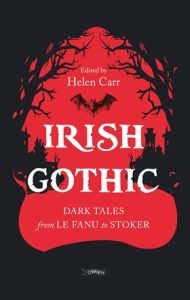
About Irish Gothic: Dark Tales from Le Fanu to Stoker
From Ireland’s best Gothic writers come ten chilling stories to cast their dark enchantment over you. The eternal struggle between good and evil plays out in tales of betrayal, obsession and ancient magic. Encounters with mysterious and alluring strangers and accounts of supernatural visitations are interwoven with gruesome stories of innocence overwhelmed.
This classic collection of Irish Gothic stories, edited and introduced by Helen Carr, includes works by Bram Stoker, Oscar Wilde, Dora Sigerson Shorter, Katharine Tynan, Joseph Sheridan Le Fanu and more.
Order your copy of Irish Gothic online here.
And read more Meet the Author articles on Writing.ie here.


