

Emma Read knew writing something a little spookier in the nine to twelve age group had potential, and so The Housetrap was set . . .
When I deliver workshops in schools, I ask classes what they like to write for pleasure and in general I hear fantasy, adventure and unicorns … that is until I find them. There’s always one – one class, one year group who are, shall we say, into something a little darker. I smile when I find them. They write about ghosts, vampires, zombies … ghost-vampire-zombies. Some—often inspired by Robin Stevens—have a penchant for the murderous but tomato/tomahto, I always know when I have found my audience, because they are me.
At around age twelve I wrote a novel called Amy about a girl who had telekinesis (yes, I had read a certain Stephen King book by this point). I loved ghost stories and creepy films (the most terrifying of all being a 1980s Disney movie called The Watcher in the Woods) and all those ‘non-fiction’ books about ball lightening and spontaneous human combustion, so I know my people when I see them.
So, when my publisher, Chicken House, asked what I’d like to write next I didn’t hesitate – I knew writing something a little spookier in the nine to twelve age group had potential, and so The Housetrap was set.
Even though my debut series was for younger readers (Milton the Mighty, seven plus) I have also written teen and YA so I felt comfortable writing in a new space; I just needed to find my middle-grade voice, focusing on my new audience’s interests, challenges, concerns and desires.
 I’ve always found the cross-over reader stages—chapter books and teen—to have surprising similarities. They are both grounded in that transitional dynamic of growing up: moving away from parental control, finding new friends, understanding a new developing brain, but writing in those areas can be tricky – in both cases it’s easy to slip one way or the other, writing up into middle grade or YA, or sliding downwards towards something too childish for your reader. But in classic middle grade lies the sweet spot where you can go head on into adventure, mystery, friendships and fun. Or in my case, fear! The challenge for me was to find another kind of balance: between delivering the thrill of a scare—something akin to riding your bike a little too fast down hill—and leaving my poor reader with nightmares; despite packing in as many horror-tropes as I could, from creepy dolls to ghostly mirrors, this was not my intention. I approached again, using voice – making deliberate use of word choice, character quirks and dialogue. It sounds obvious, but the more confident your reader the more you can challenge them – with sophisticated language and plot devices, nuance and subtext. This, in turn, allows you to temper any terrifying twists by making the most of your characters’ courage and tenacity, though the way they speak, their body language, and actions. You can lean into a comic character to provide relief in tense situations, you can use a more sensitive character to empathise with someone’s fear, or notice something calming or beautiful about the setting.
Middle grade characters are complex enough to carry a layered story but still bring home a punchy plot with a clear path from beginning to end and because of that you can really have fun with them, providing the reader an exciting thrill-ride of a novel. In middle grade friendship dynamics are just as important as at any age but here it tends to be more about the team – who is on it, who is not (and in The Housetrap not everyone is quite as they seem) and ultimately you know that the team are going to figure their way out of whatever darkness they find themselves in and find their way back into the light. Middle grade comes with Hope and A Happy Ending stamped on the cover so no matter what you throw at your characters, your reader can rest assured all will be well. Mostly.
My author voice has always lent itself to the dark side and I seek out writers of the same ilk. All my favourites influenced their way into The Housetrap: from Stephen King, to Neil Gaiman, via Gory and Hardinge, but I also found inspiration across the spectrum of reader age from picture books such as The Spider and the Fly (I have a stunning version illustrated by Tony DiTerlizzi) through Katherine Arden’s Small Spaces to the sophisticated YA horror of House of Hollow by Krystal Sutherland and beyond into adult books like Mexican Gothic by Silvia Moreno-Garcia. Like most writers I read widely and always advise aspiring writers to do the same – reading specifically contemporary novels. This is perhaps especially true for children’s writers – the narrative styles of older, ‘classic’ children’s books are so very different from those today. Having said that, a good book is a good book and I greedily absorbed and utilised all the sinister feels from The Dark is Rising by Susan Cooper as I reread it over the Christmas holidays.
Voice is a nebulous thing to describe, harder still to teach, and never complete. Mine changes with each book I read, each movie or streaming show I consume and each new age and genre I write in! To me it’s a subtle expression of who you are – never revealing itself above the narrative, never intrusive or obvious, just there. A little bit like a ghost in the walls, or a porcelain doll under the bed.
(c) Emma Read
Find Emma on: Twitter at @emmydee73, Instagram at ediereadie, Facebook at emmareadauthor and on her YouTube channel.
Website: emmareadauthor.com
The Housetrap by Emma Read is out now in paperback published by Chicken House.
About The Housetrap:
An edge-of-your-seat adventure packed full of puzzles, spooks and mystery!
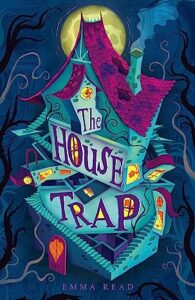
When Claude’s little sister, Amity, runs off in forbidden Badwell Woods – where children disappear – Deliah, Sam and Claude follow her to a mysterious mansion. Inside, time has frozen in the 1930s and an invitation promises a devious party game.
Not long after they find a terrified Amity, hiding from ‘ghosts’, the floor beneath their feet starts to twist and turn: the rooms are changing places. The house has rearranged itself like a giant Rubik’s cube.
To escape, they must solve the puzzle – and the century-old mystery of a girl who disappeared …
A fabulous twist on a timeless haunted house adventure from the acclaimed author of the Milton the Mighty series.
Scooby-Doo meets The Mysterious Benedict Society via Escape Room.
Full of friendship, teamwork and logic versus instinct – all wrapped up in a book with thrills, heart and bags of atmosphere.
Perfect for readers aged 9 and up.
Order your copy online here.


