

Time and space shifting: author David Cairns on the difficulties of writing detailed historical fiction set in Scotland from Australia.
I have just finished my sixth novel – all relating events in the 19th century and with a firm footing in my current home of Australia. But there are also a not inconsequential number of words that I have written about historical events in England, South Africa, even Poland; but especially Scotland. Which prompted someone to ask the question, ‘What difficulty do you experience in writing about Scotland when you live half a world away geographically and 150+ years away in time?”.
I consider myself a time-traveller of sorts – I’d have to be to write as I do – and I have to journey back in time to answer that question. I remember very clearly leaving home, in the suburbs of London, at the age of 22 to emigrate to South Africa at the beginning of what I intended to be a country-hopping multi-year adventure. There was no sun, a grey blanket hung in the sky, the sunshine of South Africa beckoned. The personal computer, the internet, climate change, AI were all but a science fiction dream, telephony an analogue dinosaur.
I arrived in a country that had no television and, although you could make a telephone call overseas, it cost a fortune and had to be booked a few days ahead. When Neil Armstrong landed on the moon, all I saw of it was a silvery moon in the sky. Communication back home was inevitably via postcards and airmail letters.
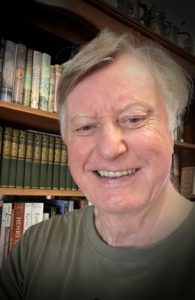
So, when I am asked about ‘the difficulties of writing detailed historical fiction based in Scotland when my home is in Australia’, I bring a perspective that Gen Z and other readers younger than me will probably not appreciate.
The world is undoubtedly smaller these days. Faster, cheaper travel. Affordable digital technologies to improve communication. News 24/7 on TV and social media. The pace of technological advancement has fostered dramatic change. A shrinking of lines of communication and the creation of an ever-expanding worldwide digital library that magically enhances everybody’s ability to figuratively transport oneself like a Star Trek adventurer from one location to another. Or at least it does for those of us fortunate enough to be able to dip into this turmoil of technology. How long, I wonder, before holographic telephony?
So, in one respect writing about ‘foreign’, distant lands is a much easier task than it has ever been and, with my digital library and a personal library of some 500 or so books mostly about historical events and particularly about Scotland’s history, I have a fertile field to plough.
However, there is more. Despite the availability of pictures and words on a screen, there is no substitute for the three-dimensional emotional and physical impact of actually being there. The city or country smells that assault the olefactory senses, the whisper of the past from an ancient cobblestoned street or a doom-filled castle, the eeriness of a fogbound path with the evanescent echoes of unseen footsteps, the sounds and sights that are, of course, totally unique and uniquely impactful when you are at the centre of your own universe.
Every year as a boy we would drive up to Scotland where the family would spend summer holidays or Hogmanay with a cacophony of uncles, aunts and cousins. When I was growing up my father would tell me that when he was a boy (one of a family of six boys and one girl), the local joke was “Have ye heard?” To which the response was, “Have I heard what?” and the punch line “The Cairnses are flittin’ again”.
He lived in a small house in High Valleyfield, Fife, Scotland – one of hundreds built to the same specification by the coalmine which provided local employment. And it was a regular feature that his mother, my grandmother, would move them from one house to another as the peripatetic urge took her. ‘Flitting’ also carried the connotation of moving to outrun your creditors which added to the humour as moving 50 yards to an identical house would hardly help in that regard.
I relate the story because I believe I inherited this particular gene writ large. I have lived and worked on four continents, stayed in or visited most of the major cities in the world, flown around the world twice and, although there are some sights I would still like to see (and God willing, I will see), my bucket list has shrunken considerably over time. And prior to taking up residence on the Gold Coast of Australia with my Australian wife five years ago, for about fifteen years we made our home in and around Perth, Scotland. While I lived in Scotland and indeed even when I didn’t, I carried with me a fascination about the history and culture of this ancient nation, and this has served me well in my writing.
It’s much easier writing about things you have personally experienced than trying to invent an emotion or experience. I use my Scottish experiences unashamedly to colour my novels. For example, Viewforth House, which plays its part in my Major Gask Mysteries series, is loosely based on houses we owned in Scotland. The House of Urrard, indeed, which overlooks the pass of Killiecrankie, is a historic treasure in its own right – the site of the Battle of Killiecrankie. One of the bedrooms apparently revealed a skeleton of a redcoat soldier during building work. The same bedroom from which a sniper shot and killed the Jacobite general, Bonnie Dundee during the battle. I often imagined the tartan-clad clansmen charging down the hill towards the house as the sun dipped below one the hills surrounding us when I lived there.
I suppose the simple answer to the question is that personal experience and wonders of telecommunications make it much, much easier to tell a story in a land on the other side of the world. I just hope my readers experience the joy of time and space travelling as much as I do.
(c) David Cairns of Finavon
David on Twitter.
About The Case of the Beth-el Stone by David Cairns of Finavon:

Is it really possible that you have stumbled across a secret lost for centuries? A secret that that could change the world order?
From the bustling gold rush and the streets of Melbourne in 1864 to the ancient city of Edinburgh in Scotland, three friends flee from a secret society out for revenge, only to find themselves at the centre of a centuries-old plot and a ‘stop at nothing’ foe.
Erroll Rait, Major Gask and Mary Mitchell find themselves pitted against the full might of the British Empire’s secret services and a centuries-old Knights Templar Lodge of the Freemasons with a secret to guard and an explosive plan that could change history. Murder, kidnap, torture, death stalk their trail. Gask and Rait alone have the key to avert a constitutional crisis and the violent conflict that would follow. But can they survive to unlock the puzzle?
Immerse yourself in the 1860s with deeply researched real background events and an intermingling with real characters of the day. This is the third book in the Major Gask series – the introductory novel was a five-star read by Reader’s Choice Book Awards.
Readers of the Major Gask mysteries have become time travellers trapped in an adventure – “..left me unable to put it down until my eyes were fuzzy and I had to sleep. First thing the following morning after dog duties etc I had to return to it”….. “The setting of the mining camp was so well done with such detail, I had to finish the chapter because I thought I had mud all over me after finishing the last sentence of the chapter”.
If you enjoy a Sherlock Holmes adventure or the atmosphere in a Dickens story – this will be right up your street. Travel back in time and join the adventure.
Order your copy online here.


