

From Tonn Tuile to Flood Tide: the daughter and translator relates. Eithne O’Neill on translating her father’s Tonn Tuile: a landmark of mid-century Irish fiction, now in English for the first time.
Translating my father’s first novel had the makings of an incestuous gesture. Tonn Tuile tells of the Ulster-born protagonist’s start in the South as a writer and newly-wed. At the same time, its span of two years, from 1939-1942, coincides significantly with my own beginnings, a first-born and the object of considerable attention. But it was in the next millennium, as a film critic and retired university teacher that I discovered the mysteriously taboo Tonn Tuile. I had it with me at the Cannes Film Festival to while away the time when standing in line. As it turns out, a work that made more impact on me than many a title then in competition.
Rather than an indication of my relation to a father long since dead, or as an addition to my own story, it was the vivid portrayal of Ireland during the Second World War that proved essential. Indeed I have never speculated as to whether the events presented tallied with fact. Were they embroidered on? Or were they figments of the imagination? You may be certain that a measure of pure innovation is evident on reading the book! It was however the over-all credibility of the reality represented, the ring of truth that I identified with. Thus reassured, I myself as translator remained invisible.
Tonn Tuile

Enthusiastically received by the Irish speaking readership of 1947, Tonn Tuile had subsequently sunk into near-oblivion. Until after 2010 when the celebrated writer Éilís Ní Dhuibhne for The Irish Times, or Paul Hutchinson, with a fine essay published in Tuairisc.ie, rose to its defence. Just as I wondered about having my translation published, these commentators stressed the unique status of the original in Irish language fiction. While Maire Nic Artain is a tale of Belfast, largely by-gone, the subject of Flood Tide is the nascent capital Dublin, the stirrings of the milieu I grew up in and the basis of today’s city. So far, so true. In Belfast, the real-life author O’Neill launched his career as writer and journalist before moving to the capital of the Republic.
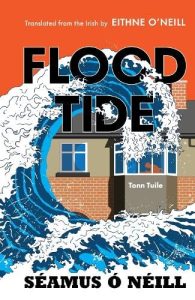
The rendering into English of the title proved more complex than the rest of the book. Helped by the medieval poem quoted as epigraph, the translated title conveys the fateful ebb and flow that is the pattern of the events portrayed, both North and South, moreover, a universal human destiny. Written in the first person singular, the highly subjective account of objective events unfolds. And unwittingly delivers the narrator’s self portrait. Together with the inborn contradictions of a man who took himself very seriously indeed. As did my father.
Flood Tide
For that reason, as a translator, I stuck to the style of the original prose. Be it cryptic or graphic, journalistic or lyrical, together with the distancing of humour and compassion. In terms of literary genre, a fictional autobiography, Flood Tide resembles a personal diary. Names and addresses are imaginary. With the made-up name of Liam De Faoite, this diarist was in a number of ways like my father. De Faoite is an Irish equivalent of ‘White’, therefore, one might add, someone without a stain on his conscience! By the same token, his bride, the educated daughter of a committed fighter for Irish freedom in the South was clearly inspired by my mother. And so, as latter-day reader, I was recognizing familiar facts and characters but in hitherto unknown intimate detail.
As Arthur Rimbaud maintained in 1871, the ‘I’ is not the master of what speaks through him. Becoming another, as reader and translator, is normal. The emotions, desires and reactions of De Faoite throng on the pages. With respect to moral principles, they are reminiscent of O’Neill. A man of national beliefs and a ‘practicing’ Catholic, my father brought me and my siblings up with a Presbyterian sternness based on the ethos of effort and self- discipline. Obedience to the pater familias was the supreme virtue. How could this writer describe in the first person a man who flings a heavy volume at a colleague who insults his pride? Is this a Jekyll and Hyde situation? Robert Louis Stephenson was one of O’Neill’s all-time favourites.
Domestic Strife
St. Augustine points out in his confessions that few of us really know ourselves and that most of us are divided within. A case in point is the domestic strife in Flood Tide set against the conflict between Nazi Germany and the Allies abroad. Two elements of the narrator’s discourse stand out, as typical of O’Neil’s outlook: the traditional and the ground-breaking side by side. The ideas correspond to O’Neill’s Irish and European perspectives at once. Faithful to the religion of forefathers- in appearance at least-but critical of Catholic Church ‘s dictates on birth control. Thus De Faoite, and O’Neill. Ahead of its time in this feminist respect, the skilful structure of Flood Tide serves the depiction of women, respectful and phallocratic simultaneously.
Starting with the figure of woman as mother. The visits of De Faoite to his mother in the North who had learned Greek and Latin roots, her subsequent death and his ultimate return to the empty house mark the end of his connection with the places of his early youth. Events that are portrayed with deep feeling. My real-life father referred to his mother rarely; to his father, almost never. My intimation of what my paternal grand-mother may, or may not, be is based on the figure drawn in Flood Tide. Was Séamus O’ Neill born of a ‘mixed marriage’? Eileen’s mother is cherished by the narrator. Through ‘him’, I have an idea of my mother’s mother. She is not blind to the rocks ahead threatening this marriage and has healing words. In turn, this second death provides the corner-stone of the tale of Dubliners.
At Loggerheads
Be that as it may, the young couple is at loggerheads. Particularly, when the narrator joins the Local Security Force; following the North Strand bombings in 1941, for example, civilian duty calls. In the novel, the situation of going out at night in uniform is incompatible with recent fatherhood and the domestic quarrelling is bitter. Personally, I have never heard my parents refer to this or related episodes. Imagined or not, it anchors the lovers’ strife in the context of Dublin at the time and for me this was a revelation. To offset this pain, the husband has an affair with a former girl-friend. In theory, the couple agreed to an ‘open’ marriage. In day-to day life, let us not forget, Flood Tide bears out male domination. Countered by the spouse’s own violence.
The upshot of this imbalance between word and deed is that the escapade reflects a disenchantment and immaturity on both parts, already souring the conjugal bond. And branded as the ‘culprit’, he gives vent to his guilt. As a writer, he is capable of describing the confusion in his mind. An adulterer, to use the old-fashioned term, he projects his guilt feelings onto his spouse repeatedly: ‘It was her fault, her fault, her fault!’ Such childish insistence is a writerly tool, carefully wielded by O’Neill. This passage is probably as close to the stream of consciousness technique that a literary publication about an urban environment in Irish came to during these war-years. Here too the ‘dizzinness’ within is conjured up: ‘A mist covered the world… I came and went like a ghost’. In a word, Flood Tide records the thorny path to self-knowledge.
Dubliners
Wonderful to relate, the picture of Dubliners is a major source of delight. The Joycean parts of Flood Tide are linked to the home of the narrator’s in-laws. The hilarious, witty, biting conversations at Christmas Day dinner, and other sadder gatherings, have echoed down the corridors of time. The Dubliners of the Forties: reading the story-board like excerpts 60 years later, I recognized the tone, the irony the teasing the biting wit of what I had actually heard still going on 40 years before. The Dublin intellectual bourgeois forging an identity: the trope that prompted me to bring the novel’s worth to a wider audience. Again, the lockdown in Paris during Covid reminded me of the war-time dress-dance. De Faoite gets drunk and clings to the lithe youthful body of his dancing partner while the pregnant Eileen (aged 29!) looks on. Incompatible with the tee-totaller O’ Neill. And yet, that night: ‘she – Eileen – comes to him’.
As a writer on film, I note that Máire Nic Artáin gives an excellent account of the custom of ‘going to the picures’. Both De Faoite and O’Neill looked down on the cinema as a plebeian entertainment. An attitude found in France too in the post WW1 era. Flood Tide contains a lone mention of the cinema. The narrator and his extra-marital girlfriend go to see the film that in 1939 – that fatal date! – took the world by storm. Astutely woven into the overall theme of Flood Tide which is the brevity of life. As a parting word and in spite of my express indifference to precise realism, towards the end of Flood Tide, I recall a specific anecdote. Brighid, my novelistic name, not yet 3 years old is walking with De Faoite in the street. She marvels at the sight of a weather-cock going round and round and makes a tremendous effort to bestow the ‘thing’ in the air with a name. What if the hold the cinema has on me now goes back to the sight of that Dublin weather-vane?
(c) Eithne O’Neill, Montparnasse, July 2026.
About Flood Tide (Tonn Tuile) by Séamus Ó Néill and Eithne O’Neill:
Dublin, 1939. Journalist Liam returns from his Rhine honeymoon just as Europe tips into war. As the Emergency tightens its grip, his marriage begins to fracture. A landmark of mid-century Irish fiction, now in English for the first time – translated by the author’s daughter, Eithne O’Neill.
Order your copy online here.
See here for more Meet the Author articles on Writing.ie.


