

Dreams of take-off: Jeff Noon tells us the inspiration behind his evocative new novel, Moon Over Brendle . . .
I was sitting at my desk, writing the first chapter of a novel. I imagined a young boy of eleven years running through the fields at the edge of a small town in Lancashire, in the north-west of England. In a dilapidated farmhouse he finds an old man, living alone, the sort of man who might eat out of tin cans under a bare bulb; a writer of strange and wonderful tales, but now past his prime. This old man, it turns out, is Ray Bradbury, the famous author of The Martian Chronicles, Fahrenheit 451, The Illustrated Man, etc. Bradbury takes the boy under his wing and teaches him how to become a science fiction writer. The first lesson begins…
Moon Over Brendle
At which point, I woke up. Yes, I had dreamed myself writing a novel. As I lay there in bed I allowed the story to expand a little, and by the time I had gotten up the idea of bringing that novel to life was fully in my head. I sat down at my desk, for real this time, and started to jot down some notes. So that was the initial inspiration for Moon Over Brendle.
As the idea developed, I realised that this story might be a way of exploring the actual process of writing: how simply putting words one after another in a line at some point becomes a story. I have, over the years, invented many different creative methods, most of which I have kept secret. My friends were always telling me that I should one day produce a “How to Write” guide, but the idea never appealed. Now I had a way of doing just that, but with the methodology woven through a fictional narrative; not only that, the method could actually be discovered through the story, as the boy struggled with the crazy ideas the older writer was throwing at him.
Ray Bradbury
Staying true to the dream, I decided to set the story in 1968. I was eleven at that time, ready to go onto secondary school after the summer holidays. That last period of true freedom, of innocent youth. Bliss. Racing along, playing games, exploring far and wide, endless sunshine (in memory, at least). Now, Ray Bradbury would only be forty-eight in that year, not at all an old man. Also, I didn’t want to use him as my character; after all, what would Ray Bradbury be doing holed up in a farmhouse on the edge of the Pennine Hills!
So I would invent my own science fiction author, making him older and more rundown, less of a success than Bradbury. G.K. Holbrook was born. I wrote out a whole bibliography for him, with made-up titles like The Space Chrysalis, A Game Without Players, and The Inside-Out Man. This was great fun! I imagined someone who had come up through the pulp magazines, all that good stuff that I love, the style, the cover illustrations, the varied subject matters. And then, one day, into Holbrook’s life steps this scruffy-haired, grass-stained, filthy-kneed kid, Joe Sutter. And everything, for the both of them, starts to change.
The Pennines
The land: the line of the Pennines, old factory towns, new housing estates, sewage farms, hidden ways through the woods, cotton mill chimneys, canal towpaths, abandoned railway lines, caravans parked on a patch of wasteland. All these went into the mix. Most of all I was drawn back to the image of a tower on a hill. This was Hartshead Pike, a real tower close to where I was brought up, a landmark seen for miles around, existing first as a Roman lookout post and then in various other brick-built guises through the years.
This became Brendle Pike tower in Moon Over Brendle, and would eventually give the book its title. Joe and his friends would go there often, and it would act as his first pointer towards the farmhouse and his meeting with Holbrook, this mysterious creator of alien beings, malfunctioning robots, and rocket ships flying towards distant planets.
Red Dust
There would be a semi-autobiographical bedrock to this story, not too much, but enough to give a local flavour and tons of period detail – family life, pop music, superhero comics. But I also wanted a science-fictional element, something simple that wouldn’t overwhelm with strangeness, or otherworldliness. As I researched the events of 1968 in Britain I came across a news item about the “red dust”. In July of that year severe thunderstorms crossed parts of the country, bringing with them a layer of mineral dust captured from the Saharan desert. What an incredible image! This dust turned the air black, and the rain red. I wondered if I could take that central idea of the floating dust and expand it, giving it more of a fantastical nature. Slowly, over the pages, the dust took on a magical or at least an unknowable aspect. I named it Greot. But Joe and his best friend Denny have their own secret name for it: Koag. Arise King Koag!
I introduced Margery Adams, an artist in her own right, who acts as companion, amanuensis and foil to Holbrook. Her story also interlinks with Joe’s and through his later years she will return, both in recollection, and in actuality. Together, Holbrook and Adams will have a profound effect upon Joe’s life. Now I had all the pieces I needed. From first inspiration in a dream, to the final expression on the last page of the dust’s true power, this was a blast to write. I am inspired by tiny facts, single ideas, one startling image: Ray Bradbury as mentor, the fall of red dust in a news report, the tower on the hill, its history, the people who have gathered there over the centuries, forever looking out over the land of my youth.
(c) Jeff Noon
Jeff Noon is an award-winning British novelist, short story writer and playwright. His new novel, Moon Over Brendle, a magical, fantastical coming-of-age story. He won the Arthur C. Clarke Award for Vurt, and his novel The Body Library was nominated for the Philip K. Dick Award.
About Moon Over Brendle by Jeff Noon:
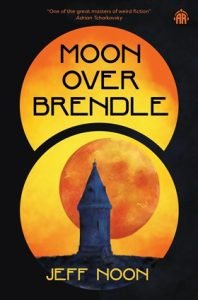
1968, Lancashire: It is Joe Sutter’s last summer before going to secondary school. His world is like ours but beyond and beside what we know is Greot; a vast swirling rainbow of many-coloured dust. It settles on the dead, it swathes cities and fields. Joe is one of the few who have the gift of always being able to see it. But no one knows what Greot is. Is it the trillion-eyed god? The history of everything told grain-by-grain? Prophecy? The magic of creativity?
Joe can’t know; all he wants to do is draw comics and listen to music. Then one day, after climbing up to the ancient tower on Brendle hill, he meets an old writer of pulp SF books who is determined to pass on the power and joy of telling stories. And everything changes.
Decades later Joe is a successful SF novelist, and the time has come to tell his story, not only of how he became a writer but also how the secrets of the dust were revealed to him, one grain at a time.
Order your copy of Moon Over Brendle online here.
And read more Meet the Author articles on Writing.ie here.


