

Author Rachel Crowther on how writing and everyday life aren’t separate things: they have to coexist, and they feed off each other . . .
There’s a favourite story in our family about my great-aunt Kathleen, who announced, soon after she left school, that she was going to be a writer, and that she’d taken the first critical step towards her goal: she’d spent all her savings on an Authorial Dressing Gown. My grandmother, who had trained as a dentist, used to repeat this anecdote with fond affection, laced with a hint of sisterly condescension. Aunty Kate never actually got around to writing anything – and who could possibly have imagined that a dressing gown would do the trick?
But many writers, or wannabe writers, will recognise the importance of such shibboleths: the right place, the right clothes, the right pen to make the writing flow.
Like many teenage girls of the late twentieth century, I was hooked on the idea of A Room of One’s Own. I fantasised about a space where I could be sequestered away with my Thoughts, and where Inspiration (but never the distractions of everyday life) would follow. I pored over photographs of writers’ desks, dismissing some and coveting others. And as life progressed, I had a few goes at creating my own ideal writing space.
In every house we lived in, I found a place for my desk: in our bedroom, in the living room, and then in the spare room, when we had one. At one happy stage I commandeered a shed and filled a pinboard with carefully chosen postcards and photographs to create the right ambience for creativity. When we left that house and moved to another, I had a corner of the garage partitioned off and a window put in, and even found some curtains I loved in a sale to frame the view of the garden.

Did it work? Well, yes and no. Through the ups and downs of family life – many jobs, many children, many crises, many moves – I did manage to start writing and keep writing. All those carefully curated spaces did get used, for a while. But two things happened that I hadn’t expected.
Firstly, the precious writing room (or writing corner, as it mostly was) got colonised by other things. Those who know me will testify to the fact that I am categorically a clutter person rather than a zen-like, Marie-Kondo-inspired, blank-wall-and-clear-desk person. I always started by selecting a range of mementoes and talismans – ornaments made by my children, or indeed by me; little pots I’d been given over several decades; birthday cards and houseplants and ancient ornaments rediscovered in a house move – and the creep went on from there. Bills, letters, forms to be filled in, books I wanted to read: they all piled up around me, and gradually the space available shrank until it would barely hold a lap top. My hobbies encroached too: little pots of mosaic glass; vats of oak gall dye boiled up the previous week; so many over-wintering geraniums that you could hardly get through the door. (At the moment my writing desk is occupied by an extremely large Serrano ham, but that’s another story of sleepless nights and stressful days and what they do to your purchasing choices.)
So much for the distractions of everyday life being kept out of the Writer’s Sanctum, then.
But I’ve come to realise that none of that was really an accident. Because Writing and Everyday Life aren’t separate things: they have to coexist, and they feed off each other. At least for me they do. And the other unexpected thing that happened, in relation to me and my writing rooms, was that I found I needed everyday life around me in order to write. Over and over again I found that I didn’t actually choose to go into the writing rooms all that often. Sometimes I’d camp at my husband’s desk when he was out, or drag a rickety side-table close to the wood-burner (very Jane Austen, no?). Recently I’ve done a lot of writing beside my youngest’s hospital bed.
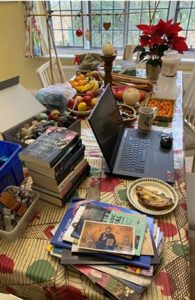
My surprise-favourite option, though, wherever we have lived, is simply to park my laptop on the kitchen table. If it gets too noisy, or I’m asked too many questions, I sometimes get irritable, but a gentle coming-and-going of people and dogs, and the muddle of family life stilled in mid-flow around me, is somehow infinitely soothing to my brain, and the most fertile ground I know for drawing out the stories of my characters’ lives.
Perhaps I’m a hermit crab writer: what suits me best is to wander around and find a comfortable space to camp out for a while – a few chapters, an editing pass – before moving on when I find another enticingly empty shell lying on the sand: another place that calls out to me to sit down and start typing. Or perhaps I can’t entirely relax when all the things and all the people I’m responsible for are shut out of the room, and the best of all worlds is to know that when there’s quietness around me it means that all is well, not that any crises are simply out of earshot.
Because here is the real truth (perhaps especially for women writers, although that might be a bit of a cliché these days): the space writers need to write isn’t a physical one, but a mental one. It’s a room in their heads that’s kept clear of everything else; a place they can retreat to, when the circumstances are propitious, and sigh a deep sigh of relief at finding their characters waiting, their plots taking shape, their words brewing. It’s the intervals of time they can carve out, wherever they are and whatever else is going on, in which creativity and imagination can flourish.
For many of us, that headspace can be even harder to find than a quiet corner of a room. But when you find it, that’s where the magic happens. That’s the place where creativity and imagination can flourish: in which you can dream up other lives which weave themselves around your own life, and draw inspiration from it, and nourish it in return.
(c) Rachel Crowther
Read more from Rachel Crowther on Writing.ie here.
About The House of Echoes by Rachel Crowther:

What happens when the past refuses to stay silent?
When Mab and Nessa’s mother died and their father disappeared to New Zealand, their lives changed forever. But the loss of their parents wasn’t the only thing that cast a shadow over their childhood…
Twenty years later, when Mab and Nessa receive the news of their estranged father’s death, it stirs up a storm of long-buried memories and emotions.
Now, as they navigate their complicated grief, the sisters are forced to confront the haunting events of the fateful summer when they were sent to stay at Lowlands, the sprawling country estate of their father’s first wife, Con.
Order your copy of The House of Echoes by Rachel Crowther online here.


