

TV was the driving force behind how I wrote my new middle-grade comedy: Séamus Almost Famous.
I consider myself very lucky to have grown up in the nineties. There were so many great books and authors (Roald Dahl, Paul Jennings, Sue Townsend, R.L Stine, Judy Blume) and so much great TV comedy: Mr Bean, Keeping Up Appearances, Father Ted, Seinfeld, Frasier, Friends… (this list is not exhaustive!) all of them comic tour de forces I fell in love with.
I remember very clearly watching these shows at a young age and wishing like mad that I could knock around to Ted and Dougal’s on Craggy Island for the craic, or go to a disaster-prone dinner with Mr Bean, or attend a swanky, over-the-top art event with Frasier and Niles, in the same way that I’d dream of sailing away to New York aboard a peach with James and his many-legged friends, or of trying on Carly-Beth’s haunted mask or consoling Adrian Mole about his unrequited love, Pandora.
This dual love of books and comedy eventually swerved me down the path of writing funny stories for children.
Comedy: a Tricky Beast

I quickly became aware, as I started out on this journey, that comedy can be a tricky beast, because humour is so subjective. What makes one person laugh may not make another person laugh. Add on top of that the fact that the audience is a considerable number of generations younger than me. Does today’s 10-year-old laugh at the same things that 10-year-old me would have laughed at?
Those outstanding comedy shows have stood the test of time, have transcended generations and become known all over the world, because they all have one important thing in common, they explore key universal truths, that almost anyone, anywhere, can relate to in some way: friendship dynamics, religion, sibling rivalry, social status etc.
Séamus Almost Famous
So, when it came to writing my new story, Séamus Almost Famous, I wanted to anchor it in a key universal truth, that every child in Ireland, whatever their social standing, whatever their family structure, whatever the home language spoken, could relate to – which is that family life is complicated.
It is often a challenge to find one’s place in a family. To feel seen. To feel understood and heard. As the only person in his family who isn’t famous, Séamus feels like he’s the black sheep. Feeling out of place in a family is something that kids often feel, with changes in family dynamics, the arrival of new siblings etc, but find hard to fully express. They say that laughter is the best medicine and I think that in these ever tumultuous, testing times we are living through, we need to laugh even more, especially kids, many of whom are dealing with a lot.
Pacing and Timing
Something else that I spent a long time mulling over for Séamus Almost Famous was pacing. We live in era where stories (particularly in TV and film) are often expected to gallop along at a million miles an hour to keep kids interested. Of course, there’s nothing wrong with a full-throttle, action-packed adventure, on the page or on the screen, but I believe that we can still hold a young reader’s attention, even when we slow the pace down a bit.
This is where comedy has an absolute advantage. Pace and timing are crucial to successful joke telling. Anyone who has ever watched a stand-up routine or a live studio comedy series will know this. The buildup to or the preparation of a joke, is almost as important, if not more so, than the punchline itself. So comedians become masters of timing. They speak slowly, they pause frequently and purposely to bring the audience along with them. This build-up process often generates as many laughs as the all-important punchline when it is finally delivered.
To achieve the type of pacing I was used to watching in my favourite comedy shows, , I made a number of key plot decisions from the get-go. Firstly, I set the story in present day Ireland, so that I was able to do away with a lot of description. World building is often essential in other genres, namely fantasy and sci-fi, because the worlds in those genres are usually made up and therefore unknown to the reader. Doing away with a lot of the descriptive passages enabled me to focus on Séamus’s thoughts and observations (the book is written in the first person) and of course, the dialogue. This gave me much more space and freedom to write in a style more in line with scriptwriting, using thoughts and dialogue to enhance jokes and skits even further.
No Fancy Plot Twists
Similarly, I kept the plot very linear and straightforward. No going backwards or forwards in time. No fancy plot twists coming at you at a million miles an hour. The story is set over 11 days, following Séamus, a ten-year old lad from Kilkenny who tries to become famous, and thus fit in with the rest of his famous family. The real fun is how Séamus tells his story, because, as I’ve observed over the years as mum of three, there’s nothing that has kids rolling over in peals of laughter than one of their friends telling them a funny story. I hope I’ve captured Seamus’s voice as I hear it in my head – and that he will make my readers laugh loudly and uncontrollably too.
(c) Jessica Scott-Whyte
About Séamus Almost Famous:
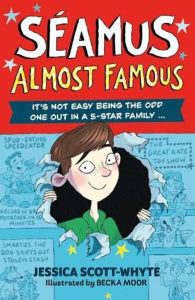
Meet Séamus Murphy, an 11-year-old from Callan, Co. Kilkenny – and the only member of his wildly successful family who isn’t even a tiny bit famous. His dad’s a 14-time all-Ireland spud-eating champion, his mam is a multi-award-winning baker, his younger sister’s just gone viral on the Toy Show and his little brother seems to be good at … well, everything!
Séamus is determined to change his fate. With his best friend Dara by his side, he’s hatching a plan to go full-on famous – red carpets, flashing lights, the whole lot. Maybe then his family will take him seriously. And maybe Grace (who he definitely doesn’t fancy, not even a little bit) will finally know he exists. After all, why just be a Séamus, when you could be a famous Séamus?
Order your copy of Séamus Almost Famous online here.
And read more Meet the Author of children’s and YA books on Writing.ie here.


