

Selling the Unreal: Five Writing Tips I Learned from My Debut Epic Fantasy, Sister Wake.
My first epic fantasy for adults, Sister Wake, comes out on the 15th of January. It’s an exploration of Ireland’s rebel history through forbidden science, enormous, monstrous gods, and unwilling saints, and I remember starting it during COVID with what now seems like a ludicrous amount of unearned confidence.
It isn’t that I went in unprepared. Sister Wake is my seventh novel. I’ve loved epic fantasy my entire life, from my battered teenage collection of The Wheel of Time to newer loves like Naomi Novik and Robert Jackson Benett.
More than that, however, I’m a firm believer that the only genre is quality and labels are for jam-makers. Every genre might have its own conventions, but good writing is good writing across the board.
Five hundred and sixty pages, six drafts, I have had the reverse of a hero’s journey and stand thoroughly disabused of all that confidence. Here’s what I wish I knew when tackling something with the scale and scope of epic fantasy.
What I Wish I Knew

- Remember that world-building, like all writing, is iterative. It is a gargantuan task to build a plausible setting for your work, and it will evolve as your work involves. Plan your world before you begin but accept that you will be amending that plan as you go. I learned to not treat writing, research and planning as separate. Writing without planning will meander and get lost, true, but planning and researching without writing will sprawl out in directions you a) didn’t intend and b) do may not need for the story you are telling.
- This is particularly true in your world-building. Like any real world, your fictional one will not be a neat progression of cause and effect. Instead, it’s a watercolour. Economics will affect religion will colour art will influence war. Yes, you should work out systems beforehand (r/fantasywriters is full of intricate and clever constructions that feel as sensical as any in our world) but like the real world, they’re not tested until they collide.
- Specificity is key in good writing. It’s perfectly fine to lean on standard tropes in a first draft; broadswords taverns with low rafters, frothy mugs of ale. The joy of Sister Wake was in the later-draft rebranding, in lifting out all those stock images and replacing them with uniquely Irish textures. We used to use hen’s eggshells as whiskey measures – that’s the kind of world-building detail you could not make up.
- World-building is the process most often talked about in fantasy, but the importance of a world comes from its people. One key touchstone for Sister Wake was the news story of the Irish female football team criticized for singing rebel songs when they beat England, and the irony of that when you think of why so many of our songs are rebel songs. It reminded me that the history of a world is a conversation that is being had over and over again. You can invent a long history for your world, you can populate it with ancient temples and complex myth, but page-by-page, importance is dictated by the character observing them. When the scope and scale of your fantasy seems overwhelming, a writer’s greatest tool is reducing it to the next step or decision our character must make.
- You do not need to describe every moment that happens. This is particularly true of fantasy, which so often involves travel at a medieval pace. By all means write it in the first draft, but there is an elegant simplicity to the line ‘They marched until nightfall.’ You are not just a writer – you are a director. Show us what we need to see.
- Fantasy is an idea-hungry genre, but the mark of a great idea is one that is used to its fullest potential. Don’t rush a cool concept to get to the next one – empty its pockets first. Interrogate it so you get the best out of it. Look for exciting knock-on effects or opportunities to show off the power or weapon in its most exciting form. This is also the difference between writing a culture and merely invoking an aesthetic. Simply dropping in a monster or a name from a culture without exploring its context and import feels shallow and unexplored.
- And the same goes for you and your characters! I spent my first draft in this new genre running away from myself, and trying to sound as important as I wanted this book to be. But if you have a unique experience, profession, interest or area of expertise, utilising it is putting the best of yourself on the page. You’ll write with confidence. With knowledge. And the more specific it is, the more likely it has not been done before, and that’s a story we need to read.
(c) Dave Rudden
About Sister Wake:
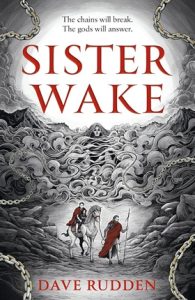
THE GODS WERE HERE. AND THEY WERE ANGRY.
For three hundred years the wild island of Croí has been subject to the Empire of the Answering. Clans have been subjugated, their language outlawed, their religion reduced to the whisper of fugitive priests.
Until Croí’s prayers are answered. The Gods return. Feral and majestic, they stride the land as colossi, throwing the Empire into chaos.
The dispossessed and the vengeful struggle for power. A ruthless priestess rallies the faithful, offering a simple choice – believe, or die – even as the empire’s Queen makes the first moves in a long and dangerous game.
But for all their machinations, one woman will decide the fate of them all . . . Sister Wake, unwilling saint of the Goddess of Death.
An action-packed, lush epic fantasy filled with rebellion, intrigue, horror, gigantic dangerous gods, and Celtic mythology, perfect for fans of James Islington, John Gwynne, and Joe Abercrombie.
Order your copy online here.
Read more from Dave Rudden on Writing.ie here.
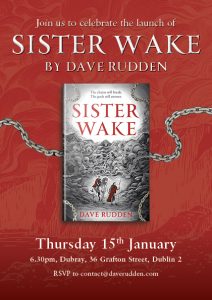
Sister Wake is out on January 15th with Hodderscape. The launch will in Dubray Grafton at 6.30pm, and Dave would love to see you there!


