

Greg Mosse, author of the bestselling thrillers The Coming Darkness and The Coming Fire, on writing the third book in the trilogy, The Coming Fire.
When the coronavirus lockdowns struck, I had two theatrical productions on my slate, with venues booked and marketing materials printed but, instead of going on the road with my actors and my musicians, I sat in an Ikea poäng chair in the corner of my study, with a laptop on my knees, and began writing what was to become a trilogy of future-dystopian thrillers.
The first character I met, in my imagination, was Alex Lamarque, a member of the French secret service. He was inspired by people I had known when I was an interpreter, working in international organisations, including NATO and other high-level diplomatic circles. And, of course, there was an element of wish fulfilment. I wanted Alex, my hero, to be better than any of those real people.
What did that mean… “better”?
It meant Alex had to be able to see through the obfuscation and politicking, the self-interest of the time-servers and the careerists, to the heart of every crisis. He needed the perspicacity, strangely, of a Jane Marple or a Hercule Poirot, but allied to the strength and stamina – the physical prowess and stickability – of a James Bond.
The Coming Darkness and The Coming Fire

In the first novel of the trilogy, The Coming Darkness, Alex’s ultimate success is mitigated by loss. Though he manages to prevent “the worst” from happening, one of the lessons he learns is that it is not possible to save everybody.
In the second novel, The Coming Storm, Alex gets closer to the heart of the unexplained conspiracy whose leader is his ultimate enemy. He witnesses self-sacrifice from both allies and enemies and begins to understand what it is that motivates the evil will behind so many cruel acts of barbaric terrorism – outrages that only he is in a position to thwart.
But Alex is not yet close enough. He needs help and help is hard to find.
In The Coming Darkness and The Coming Storm, Alex is a member of a tiny team, including the woman he loves, Mariam Jordane, and his best friend, Amaury Barra. As the “storm” breaks over the second novel of the trilogy, Alex loses touch with them and finds himself alone, marooned up-country in the desperate fragmented Republic of Haiti, a prey to thugs and bandits.
That said, he is, at last, close to his goal – within touching distance of The Coming Fire.
In the world of contemporary adventure writing, some of the biggest titles and the most recognised brands are video games. In the terminology of this explosively successful contemporary art form, at the beginning of The Coming Fire, Alex is finally close to meeting “the big boss,” the enemy that he will find the hardest to defeat, whose intelligence and deviousness he should most fear.
A couple of years on from the lockdowns, as I sat in that same poäng chair in the corner of my office to write volume three of my trilogy, I knew, at last, my hero’s destination – a citadel island in the Caribbean Sea, rising sheer out of the waves, fortified, impregnable. It was a place that had always been present in my imagination, without me knowing its precise co-ordinates.
And I knew that Alex’s allies – those that had survived – would be rushing to his aid. But the world was now a mess, travel made difficult by techno-breakdown and natural disasters, provoked by human folly. Did that mean that the teamwork surely essential to at least a fragment of a happy ending was now impossible?
The Third Volume of a Trilogy
Writing the third volume of a trilogy, an author must hold their nerve. Nothing is more tempting than to write on page one, or after ten chapters, or after fifty-thousand words: “This is what it all means. This is how it ends.”
But, in a thriller like The Coming Fire, fifty-thousand words is only half-way there. How do you keep the suspense going for another 50k?
The answer is, of course, that everyone the reader is rooting for is having to confront extraordinary challenges, desperate struggles, Alex first, but also his colleagues and friends – and the love of his life, Mariam, beyond his reach to help. With plausible, satisfying delay from complex, interlinked intermediate challenges, the final confrontation doesn’t begin until four-fifths of the way through – and then the climax lasts for twenty-thousand words.
Writing a novel is a huge undertaking, let alone writing a trilogy. Luckily, a publisher like Moonflower provides an author with outsourced brainpower from editors and copy-editors, helping to make the web of drama coherent.
That is why it makes sense, in the final lines of the epilogue, after incalculable loss, for someone – I won’t divulge who – to say: “We’ve survived. We are together. There will be time enough.”
The mood is of sorrowful triumph, still trapped on the terrace of their enemies’ stronghold, survivors of Darkness, Storm and Fire.
(c) Greg Mosse
About The Coming Fire by Greg Mosse:
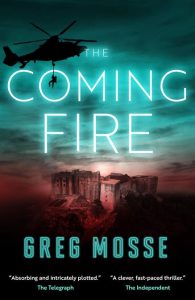
First came the darkness.
Then the storm.
Now it’s time to face the fire.
Following a fighter jet crash in the Haitian hinterland, special agent Alex Lamarque is taken captive by a violent gang, the lone authority in this lawless territory.
His only allies are busy on the other side of the world, facing a crescendo of dangers: the AI viruses crippling the digital state; the breakdown of law and order; and some unexpected, terrifying news from a Paris observatory.
With no hope of rescue, Alex must take on his greatest challenge entirely alone. Survival will take every bit of strength he has.
Don’t miss this hotly-anticipated read from the author who brought you the Sunday Times Thriller of the Year: The Coming Darkness.
The Coming Fire by Greg Mosse is published in Paperback on 17th July. Available from all good bookshops at £9.99 – get it while stocks last. https://www.waterstones.com/book/the-coming-fire/greg-mosse//9781916678057
See here for more Thriller and Crime Fiction Feature articles on Writing.ie.


