

The Visit by Neil Tully
Ask a group of emerging writers to list marketable, commercially relevant topics that might catch an agent or publisher’s eye, and AI anxiety, trauma, gender, or mental health are likely to feature frequently. The content of my debut novel, The Visit, is not. The novel is set in New Ross in June 1963, as the town prepares for the visit of President Kennedy. Garda Sergeant Jim Field feels a protective responsibility towards a local young outcast, Patrick Hatten, who is being left behind by the social changes sweeping Ireland. As the visit nears and Patrick becomes further isolated, his actions risk unravelling the town at a time when the eyes of the world are on it. There are horses, guns, violence, cats, love, rockets, tractors, and knitting needles.
The topical issues listed above can undoubtedly be explored in interesting ways by writers with original approaches, and they will write those novels better than I could, doing justice to those important issues. You might be one of them. But I had to write what I was most interested in.
The emerging writer’s goal of publication is more likely to be met by writing what they truly want to write, even when it may not feel topical, or likely to be marketed as ‘urgent.’ It might seem counterintuitive or naïve to pay little attention to marketability, but people in the publishing world are largely readers before they are anything else, and from agents to editors, readers not only value good writing, but authenticity. You can write strong, coherent sentences, but if your work lacks sincerity and authenticity, it might be admired on a sentence level, but is unlikely to move a reader.
The Visit: passions and interests

The Visit is made of a combination of passions and interests of my own. Cormac McCarthy’s Border Trilogy is my favourite work. The novels explore the fading roles of traditional life in the American west in the middle of the twentieth century, as a pair of young ranchers fight against their irrelevance in a rapidly industrialising country – like Ireland in 1963. I have always been moved by the pictures of elderly farmers in the brilliant Vanishing Ireland photobooks. I have a deep interest and respect for the people of my parents’ generation and the change they set in motion for my generation to benefit from. And of course, I find the story of a Kennedy leaving on a famine ship, and his great grandson returning as President of the United States the most symbolically powerful Irish emigration tale.
The novel took two years to write, and while there were many challenges, I was always interested in what I was writing and energised by research without ever thinking about how an agent might respond. Imagine if Annie Proulx convinced herself nobody would be interested in maritime details while writing The Shipping News, or how many times Ferdia Lennon might have been told that he couldn’t write a novel about Athenian soldiers in 412BC with modern Irish dialect.
Experimentation is Essential
Prior to acquiring an agent, I had some publications and competition successes with short stories. The work that did well and felt stronger was the work I was interested in without thinking if anybody else would be – rival farmers during a flood, a steroid-using weightlifter who wants to be a soul singer. The work that failed was when I was inauthentic and tried to adopt a voice that was not my own – a satire about social media addiction, a painfully trite attempt at a tearjerker. Experimentation is essential for an emerging writer, but it is only useful if you are learning what works for you, and why. You need to be able to admire the excellent work of very different writers, without their talent imposing on your authentic voice and aims.
‘Voice’ is often framed as something mystical, but it is more practical than that. Your voice is found by combining your own taste in books, music, film, art, with what moves you in history and current affairs, then refined through years of writing practice to come out in a clear, consistent way that is uniquely yours. Your influences remain present, but they have been calibrated by you.
Momentum
Approaching your writing this way makes the unavoidable series of rejections and passes more palatable. I can’t imagine getting a disappointing response to a submission, then trudging back to work on something that doesn’t excite me. Your work should give you momentum. Despite this, there are times when your momentum will stall and you will doubt yourself and question why you write. I have found it is best to not complicate that question. Your alternative is to stop writing altogether, but you will likely find this is even worse than the challenges of writing. Again, bringing your own curiosities, passions, and interests to your writing will sustain you. The fact that we have the freedom to write and the opportunity to publish is reason enough to keep going.
I go back to the ordinary people depicted in The Visit, in Ireland in 1963, when even some of our best novelists like John McGahern and Edna O’Brien were censored. How many men and women might have thrived nowadays – with our wealth of writing communities, book clubs, writing groups, festivals, library events, brilliant booksellers, and submission opportunities to magazines run by people passionate about stories? Remove the goal of publication from your mind, and change the goal to writing something that you would love to read yourself, and chances are things will begin to move in the right direction.
(c) Neil Tully
About The Visit by Neil Tully:
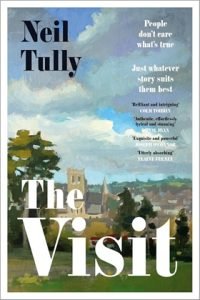
‘The Visit is an engrossing and tender portrait of a small town under pressure … Stark and elemental – at the heart of the novel is a sort of quiet yearning and a longing for love and for completion that makes Neil Tully’s novel so brilliant and intriguing’ – Colm Tóibín
“The lad is a bit like a stray dog. I keep an eye on him and throw him a few scraps. There are plenty of people in this town who’d just as soon drop him off in the wilderness and hope there’s no scent to follow home. The problem is that Patrick could find his way out of any wilderness and they wouldn’t like whatever starved thing came back.”
Sergeant Jim Field feels a guilty paternalism for Patrick Hatten, a young man struggling to find a job, a life and a purpose in a small-town Wexford community. Both are used to being on the fringes but while Jim is a romantic with bad health and regret, Patrick is full of anger and action, and his actions could have devastating effects.
Order your copy of The Visit online here.
And read more Meet the Author articles on Writing.ie here.


