

When History and Fiction Collide: The Wretched and Undone by J.E. Weiner
It all started on a stroll on a frigid December afternoon along the streets of Bandera, Texas. A somber church steeple on a rise overlooking the Medina River towered over St. Stanislaus Catholic Church in the equally somber winter gloom. To the left of the sanctuary’s entrance stood a granite monument in a small, carefully manicured flower bed, its blooms long dormant. A dedication etched into the stone’s smooth and polished surface read: “Erected in grateful memory of the pioneer Catholic Polish settlers and founders of this St. Stanislaus parish. Bandera, Texas, February 2, 1855.” Sixteen names followed. A little further along a dusty path and through a rusted chainlink gate stood a small cemetery filled with headstones dating back over one hundred and sixty years and bearing these same sixteen names repeatedly, generation after generation.
I was intrigued. Who were these people? What brought them to this desolate scrap of land? Why did they stay? While my gut as a writer told me that this was a story worth telling, my instincts as a historian told me that I needed to know much more about Bandera’s people and history before I could even begin to answer these questions.
My training in Russian history as an undergraduate at Wesleyan University and a graduate student at Columbia University framed the task, and my intellectual muscle memory kicked into high gear. Understanding who did what and why–or, in historian-speak, who had agency, and what the social, political, and economic context was at the specific time and place in question–would require immersing myself in traditional historiographical literature, of course. However, from my experience analyzing contemporary news accounts for the “Soviet Television Project” at Columbia and translating survivor interviews for the “Holocaust Oral History Project” in San Francisco, I knew the critical importance of personal narratives in telling any history. They are the whispers and stories spoken aloud, memoirs scribbled by candlelight, things collected, or oblique references between the lines of official accounts. These are the spaces where both historians and writers can attempt to fill the gaps and silences often imposed by those who get to write history.
I leaned in and started to explore. My first stop was the Frontier Times Museum, the life-long passion project of J. Marvin Hunter, a newspaperman in the late 1800s turned publisher, historian, author, and ultimately museum founder after settling in Bandera in 1921. He founded and ran the Bandera New Era and Bandera Bulletin newspapers from 1921 until his death in 1957, launched the Frontier Times magazine dedicated to “frontier history, border tragedy, and pioneer achievement” in 1923, and established the Frontier Times Museum in 1927 which housed Hunter’s collection of artifacts, art, photographs, and a few local oddities, including a curious array of taxidermy. Among the exhibits were pictures of those founding families of Bandera carved into the monument up the hill. They arrived in 1854 on the S.S. Weser from Bremen, Germany to the Port of Galveston, Texas, and made their way by oxcart to Bandera. I could now see their faces, but I also needed to hear their voices.
My next task was to explore their personal stories. So, I began with the local newspaper archives and Hunter’s Pioneer History of Bandera County published in 1922, which included extensive interviews with the town’s founding families. The accounts, particularly the few from the founding mothers, were harrowing. On their grueling nine-week journey over the Atlantic, fleeing violence and political unrest in their home country in search of a better life in the “land of the free,” the early pioneers arrived in a sparsely settled wilderness at the dangerous and morally ambiguous crossroads of conflict with both the Comanche and the Northern states on the eve of the American Civil War.
Mrs. Constantina Adamietz recounted, “Every day was just alike, and at night, a stillness as of death settled about us.” Mrs. Mattie Jones spoke of a desolate and often lonely life on the frontier and “a constant state of dread all of the time.” Others spoke of nearly endless childbearing and the pain of losing many of those children, being widowed and saddled with crushing debt, and war. Again, the voice of Constantina Adamietz echoes: “When the Civil War came on, we remained aloof from partisanship…Men were hung for their sentiments, and many disappeared to never be heard of again. These were terrible times.”
Among these first-hand accounts and throughout the monthly editions of the Frontier Times magazine, I also gleaned the first hints of other fascinating but little-known stories and voices of Bandera’s past. A group of twenty Mormon families led by Lyman Wight broke away from the rest of the Church in protest against Brigham Young’s leadership. Wight took his followers to Texas in search of a new Zion but did not find the warmest of welcomes among the predominantly Protestant population. I stumbled upon the tale of six camel wranglers who arrived from Greece, Turkey, and Egypt along with seventy camels in 1856 and served at Camp Verde as part of the now infamous U.S. Camel Corps experiment. Most were unable to return home after the Civil War and stayed on to build new lives across the Southwest. Several reports referenced the life and work of José Policarpio “Polly” Rodriguez from Zaragoza, Coahuila, Mexico, a frontiersman and U.S. Army scout who refused to serve either the Union or the Confederacy. Rodriguez eventually became a Methodist minister and “had the confidence of all men.” And then there was the journey out of slavery in Tennessee of a man called Andrew Jackson, a freed black man who enlisted in the U.S. Army after the Civil War and served at several frontier posts before purchasing a small ranch in Bandera in 1870 and living out his days as “a peaceable, and law-abiding citizen.”
And so, the backstory for The Wretched and Undone slowly but surely revealed itself amidst the rich and unexpected tapestry of families and communities, found and otherwise, both explicitly and implicitly chronicled over the past century and a half. The characters in the novel–those drawn from real life as well as imagined on the page–are inspired by these first-person narratives and are, in many ways, an homage to the intrepid souls who, in their quiet and often unrecognized ways, helped forge the American frontier.
(c) J.E. Weiner
Learn more about J.E. and her writing at her website.
About The Wretched and Undone by J.E. Weiner:
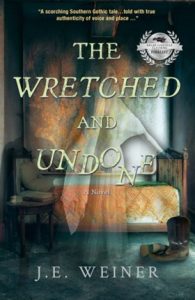
On the eve of the Civil War, Polish immigrants Marcin and Agnieszka Anderwald arrive in Bandera, Texas, seeking a fresh start in a new land of faith, fertile soil, and freedom. But their dreams quickly become nightmares when Marcin provokes a sinister specter hell-bent on revenge. A battle ensues for the hearts, minds, and souls of the Anderwalds and their extended family of immigrant outcasts, Arab camel wranglers, wounded warriors, and a songstress on the verge of madness. As the generations unfold, each faces its own harrowing ordeal against unrelenting evil. Will the Anderwalds break free or remain forever wretched and undone?
Order your copy of The Wretched and Undone by J. E. Weiner online here.


