

Sharon Black tells us about her new writing room and the huge improvement it has made to her writing process . . .
J.K. Rowling wrote in cafés. Isabelle Allende begins writing every new book on January 8th.
Some writers can only write in absolute silence – others need noise around them. I know writers who have Instagram-worthy desks. Mine is definitely not one of those.
Until relatively recently, I didn’t even have my own writing room. I had a desk (one of those amazing wraparound yokes) with room for everything at the end of my kitchen. And luckily, the kitchen is big, having been extended a couple of times down the years while we raised our children. The problem was, I never knew when someone would be coming in to make tea. Or just to ask me something.
And then two years ago my two older children moved out at the same time. It took me a year before I finally set up a large, fold-out table in the eldest’s bedroom.
Close the Door . . .

It only took me moments to close the door and stick a sign on the handle that reads Feck Off, I’m Writing. Pithy, I thought. Hugely successful, as it happens. Now people knock and wait for me to answer. And they don’t even knock very often.
It’s a large room with an old fireplace (the house was built in 1933) and a fold-up treadmill. The treadmill isn’t unfolded very often but I try to remember to get up every half hour to do some stretches or make another coffee.
I have a view overlooking our garden (trees mainly, but I like trees) and other people’s rooftops. Sometimes I glance up and get distracted by birds. But that’s about it. And I’ve come to appreciate working in silence.
I work on a laptop with an external keyboard and mouse. One of the most practical skills I learned in my early twenties was touch-typing. To this day, I find it satisfying to simply place my hands on the keyboard and rarely need to glance down – I prefer to focus on the words on screen.
And then earlier this year, my whole ‘set-up’ got seriously elevated when my husband took it upon himself to buy me a large external monitor so I wouldn’t be hunched over my laptop anymore. I didn’t realise I was hunched over, to be honest, and when this huge box arrived, I regarded it worriedly. Where would it go, I asked, picturing my messy desk.
Turns out a bit of a tidy up and a connecting wire from the new monitor into the side of my laptop was all I needed.
Now I wonder how I ever lived without it.
My New Writing Room

So, the details. My last book, Love Like the (Real) Reel Thing, which was published by Poolbeg Books in November, was the first one I wrote from start to finish in my new writing room. And it’s where I’m writing my current one.
I know that everyone’s process is different, and my advice, for what it’s worth, would be find whatever works for you. You might have to experiment a bit at the start. Mine is to write a synopsis first, then plot the story roughly out and write down as many details as I know about my characters.
Once I’ve all that done, I just start the painful first draft. I know lots of people love that first draft – the not knowing where their characters will go or what will happen next. I see it as something I have to get out of the way. A sort of vomit onto the screen. By the end of it, I might have between sixty and seventy thousand words (my books come in at ninety thousand words) but only some of these will be in the right place. Or actually useful.
Once the first draft is done, I breathe and take a bit of a break. Not too long, just long enough that I won’t be tempted to start hating it. And then I print it out and start to read.
The Second Draft
The second draft is really the first big structural edit. As I’m reading, I scribble down any major problems I see. Yes, there are usually lots of them. But writing them down is a start. Once I start the second draft, that’s what I’m working on.
And once I come back to the document on screen, I open up a second document. This one is for my takeouts – sometimes large chunks of text that doesn’t fit once I’ve gone through the whole thing. The good thing about keeping it all in a separate document, is that if you change your mind later, or find you’ve a better place in the book for some of it, it’s still there.
Once the second draft is done, I print it out and start the process all over again. With every draft, the aim is to see more things, layer up more of the story, polish it better.
I’m also quite superstitious about throwing out any notes or printed-out drafts until after the book is published.
Now you know why my desk isn’t tidy.
Or my corner of the room, if I’m being completely honest.
But I get to close the door.
(c) Sharon Black
About Love Like the (Real) Reel Thing:
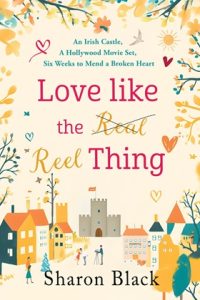
When Hollywood comes to Mayo’s Linford Castle in the west of Ireland to make a romantic comedy, hotel group marketing manager Jess Bradley is asked to troubleshoot.
Eager to escape a failed relationship with her colleague Adam Rourke, Jess jumps at the chance to decamp to the countryside for six weeks. And when charming local resident Robert asks her out, it seems she’s finally moving forward with her life.
But as a series of mishaps threaten both the movie and the hotel’s reputation, Jess finds herself juggling crises on and off set. Just as she’s starting to get a handle on it all, Adam shows up – and to Jess’s shock, it seems he’s moved on too.
When one of the stars suddenly goes missing, Jess must decide exactly who she can trust to help her get everything back on track — and maybe find her own happy ending in the process.
Order your copy online here.
Read more from Sharon on Writing.ie here.


