

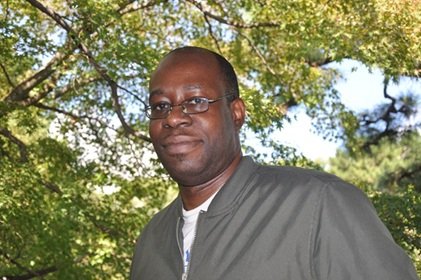
Author Dwight Thompson tells us how his decision to move away from home played a major part in the writing of his new novel, My Own Dear People.
V.S. Naipaul once said, “When I learnt to write I became my own master, I became very strong, and that strength is with me to this very day.” That’s how I felt when I discovered my talent. But I also learned it took discipline to get to the level of writing publishable work.
I had some luck along the way, luck in coming across helpful librarians in my teens who took me under their wings and cultivated my gifts, luck in having a library rich in Caribbean literature at my disposal, and luck in my decision to move away from home to develop my craft in solitude.
A writing paradox
But there was something of a paradox involved, I felt like I had to keep one foot in the door so my access to my past life would never be closed off, even though I’d moved away. I had to lay claim to my corner of the world by nurturing a bond to my past experiences, a special way of feeling. “To become a writer, that noble thing, I had thought it necessary to leave,” Naipaul writes elsewhere. “Actually to write, it was necessary to go back. It was the beginning of self-knowledge.”
So an adventurous spirit had pushed me outside of the society that had shaped me. But writing would anchor me inside that culture, and help me to make sense of my upbringing. I had felt oppressed by the small town life of my city and its prejudices, its narrow way of seeing the world and rejecting things that ran afoul of its ‘ethics’. My intelligence told me I’d outgrown Montego Bay and its people, with their stagnant lives and outmoded views. But that was a kind of arrogance. Because to write well, one must respect everyone’s humanity to understand how they’ve arrived at the point of being who they are, no matter how objectionable they might seem.
A writer never takes sides, ideally. But this skill isn’t arrived at by mere decision. You have to become a baby, a born-again, to trust description, character, dialogue and event to evoke the world that had shaped you. You have to learn how to take the backseat, and let the writing do everything for you.
Writing comes from deep inside
Writing comes from the deepest recesses and the writer himself doesn’t know those recesses, there’s no explanation: the explanation is the work itself. This sort of spirituality of the craft came to me once as I was out with my Japanese girlfriend (who’d later become my wife).
We lived in Hiroshima and she picked me up one Sunday for a ride to the beach.
Arrived, we held hands and watched a big red and black trawler far out at sea; I counted two trawlers in tow. The cold spray of the water on my skin was beginning to bother me.
After some time we got up and walked back up the reef and back down the beach. An old couple watched us as we walked past the changing rooms. My girlfriend stopped suddenly. She pointed to the hill across the street from the beach’s parking lot. “Let’s climb that hill. I’ve never climbed that hill before.”
I looked at the hill. “What’s up there?”
“I don’t know. But can you see the wooden steps going up?”
I could see the wooden steps.
So we exited the parking lot, crossed the street and climbed the hill.
As we climbed the hill, some of the wooden steps—that were really planks of smooth round wood laid in the earth at regular intervals—felt a bit shaky underfoot, and my girlfriend became scared the higher we went and held on to me tightly. “Kiwotsukete,” I said. “Be careful.”
“Hai.”
Quiet and green and peaceful
We reached the top. The ground was soft and moist and covered with yellow-green bamboo leaves and twigs. All around us, tall bamboo trees grew in clumps. The place felt quiet and green and peaceful. It was a good way up, too, and from that height the beach and the parking lot looked small. We saw a small wooden building with a thatched roof a few chains from where we stood; an ancient looking bell on a raised concrete platform stood beside it.
“It’s a temple,” my girlfriend said.
I took my camera from my pocket and was about to snap a picture but she stopped me. I didn’t protest. We walked over to the shrine and looked inside; it was dark and empty inside except for a small grilled window that allowed a little light on a small dusty spot on the floor.
My girlfriend said, “Where is God?”
She might’ve been joking. I wasn’t sure.
After we had clasped our hands in front of our chests and clapped twice then bowed, then clapped twice again and bowed once more, we just stood there, peering into the darkness, trying to make some sense of it. I said, “Do you believe in God?”
She shrugged. “Sometimes…my family is Buddhist.” Then she turned to me. “Are you a Christian?”
I shrugged. “Sometimes.”
She seemed satisfied.
We made our way back down the hill. By now it was getting dark and we were getting hungry. We called it a day and left the beach.
It slowly came to me on the drive back that writing was a search for the divine, a spiritual journey that had led me all the way to an unfamiliar country to pore through myself to discover the true me.
Emigrating
When I told my mother I was migrating to Japan she was surprised as anyone else but in her calm way had said, “Remember, you might think you’ve outgrown a place but you can’t outgrow yourself.”
Her statement puzzles me to this day. Whenever I write a mother figure in my stories, including My Own Dear People, my mother’s mystique is a part of most of them. And I thought of her again as I left the temple that day.
The next day as I drove to work, I stood in the bus and watched a young mother with a baby on her lap. The child dropped the bus card from her little hands and the mother picked it up and gave it back to the baby and she dropped it again and the mother patiently picked it up and handed it back to her. And all I could think about was the fact that my mother had never aborted me. And I suddenly loved her very much—deeply, terribly. The emotion was an unexpected rush. Like adrenaline. I feel a similar filial rush sometimes when I mould my stories, the patience and commitment required to become your own master—to submit to the sweet mystery of the soul.
(c) Dwight Thompson
About My Own Dear People:
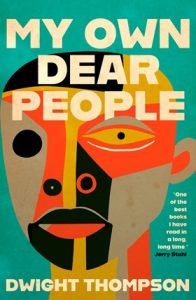
Nyjah Messado has built a life away from home, but he is haunted not by a ghost, but by a memory: the moment he witnessed a brutal sexual assault and chose silence.
Raised within the rigid masculine codes of an elite Jamaican boys’ school, Nyjah learns early what is expected of him: loyalty to other men, contempt for weakness, and the careful management of guilt. Years later, returning to Montego Bay, he must navigate a city shaped by class divisions, colonial legacies and violence, while confronting the moral cost of what he failed to do.
My Own Dear People is a fierce, lyrical coming-of-age novel about masculinity, complicity and self-deception. Unflinching in its treatment of rape culture and homophobia, it asks whether forgiveness, of others, or of oneself, is ever truly possible.
Order your copy online here.
And read more Meet the Author articles on Writing.ie here.


