

Author Rachel Sargeant: Being able to talk about books is the gateway to connecting with other readers and writers.
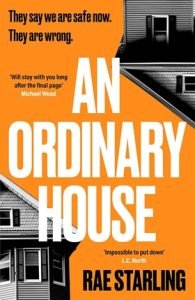
In my latest thriller, An Ordinary House, written under my new pseudonym Rae Starling, a traumatised teenager finds his story sensationalised after rescue from years locked in a suburban house. As well as navigating lurid headlines and false allegations, he must suppress nightmarish memories of his ordeal to stop himself spiralling out of control. We see him face scrutiny not only from the media but also from detectives, lawyers, psychologists and social media keyboard warriors.
The novel started life as part of my PhD studies at the University of Birmingham, where my supervisor was bestselling Irish novelist Professor Ruth Gilligan. The thesis comprised a draft of the novel – seventy-six thousand words at the time – and a twenty-four-thousand-word analysis of the techniques used by various writers to avoid ‘trauma appropriation’ (i.e. the misrepresentation of trauma in novels).
As you might expect, my bibliography ran to thirteen pages. However, I believe that all writers, not just those engaged in academic studies, should be avid readers.
Sometimes new writers avoid reading for fear of copying. But if you know the story you want to tell and stick to your own ‘voice’, your book will emerge as your unique work.
Apart from the pleasure of curling up with a story, there are other reasons to read books and learn from their writers:
To Understand What Successful Writing Is
The more often you experience the joy of a good book, the more you will understand what ingredients make that experience. I don’t only read in the genres I write (crime fiction, psychological suspense and dark thrillers), but I also read literary, historical, horror and romantic fiction. As well as forming my own opinions on a title, I like to look through reviews by other readers to see what chimes with them.
To Speak the Language of Writers
Being able to talk about books is the gateway to connecting with other readers and writers. I spend a lot of time, both in person and online, talking to my agent, my publisher, other writers, book bloggers and readers about books we’ve read. Reading is the language of the writing world. Everyone in the book ‘business’ – and I include readers here – share a love of reading and have a brilliant knowledge of books.
To Develop Your Craft
As well as enriching my vocabulary and my worldview, reading improves my understanding of writing technique. Here’s a snapshot of how three books I read for my PhD helped me develop my craft:
Good Me Bad Me by Ali Land
Annie’s mother is arrested as a serial killer following Annie’s tipoff to police. The reader doesn’t know whether Annie will summon bad or good traits in herself to adapt to her new life in care and fears she may eventually explode. The way the author built suspense inspired me to create a ticking timebomb within my protagonist.
A Girl is a Half-formed Thing by Eimear McBride
This literary novel tells how being groomed by her uncle affects an unnamed Irish girl. The author uses childlike vocabulary within complex, non-standard constructions, and the novel makes for a vivid exploration of trauma. Although my style is different, McBride’s writing encouraged me to be experimental in the language choices for my narrator.
10 Years of Freedom by Natascha Kampusch and Heike Gronemeier
My thriller explores captivity and trauma. It was important to read memoirs of those with first-hand experience. In 2006, eighteen-year-old Natascha Kampusch escaped from the man who had abducted her eight years earlier. In her second memoir, she describes on-going media intrusion and distortion of the facts. It was a sobering reminder that captivity and the aftermath are not just the stuff of psychological thrillers but sensitive, real-life topics I needed to write about with respect.
About An Ordinary House by Rae Starling:
We lived in a house on Beech Avenue.
Outside-People say we’re safe now.
But one of us wants to go back.
Back to that house and the darkness it held.
Police raid an ordinary house in a quiet suburban street and find a traumatised teenager held captive with his family. They call him a survivor, but he doesn’t know what to believe. His memories don’t match what his siblings and the press tell him about his home.
As he struggles to make sense of his new world, he must find and face the truth.
With one of his siblings set on revenge, should he forget his family, or turn from victim to killer?
A dark, compelling and twisty thriller, perfect for fans of Room, Girl A and Alice Feeney.
Order your copy online here.
And read more Resource articles on Writing.ie here.


