

I’ve had a varied writing career, having been at different times, or even simultaneously, a poet, a poetry editor, a theatre critic, a wine writer, an international newspaper columnist and even a tennis correspondent. I’ve written a few books on subjects ranging from the Roman poet Horace to satellite earth observation, via the follies of Brexit and how to impress your friends with wine jargon.
This may sound random, and in a way it is, but it reflects both the breadth of my interests and passions and my belief that writing is a continuum which encompasses both craft, or ;professional practice’, and art. In the popular imagination, or one strand of it, when someone announces that they want to be a writer, the scene shifts to a garret in Montmartre or Rome, a noble Bohemian rejection of conventionality accompanied by free love and untimely death.
A Damascene Moment
A Damascene moment came for me while studying English Literature at Cambridge University – or rather a sleepless night resulting in the conviction that “I have to be a writer”. I haven’t reneged on that but I’ve always interpreted the brief more widely than Tosca’s ‘vissi d’arte’. It helped (I think) that I was attracted to journalism, or certain forms of it, and edited or co-edited magazines at school and university. The denigration of journalism, most often by journalists themselves, as ‘hackwork’ has always infuriated me. Of course it’s part of a peculiarly English habit of self-deprecation. But journalists don’t have to demean themselves as hacks. There’s no reason why journalism, or writing for newspapers, can’t include, say, essay-writing, criticism, even poetry of the highest quality.
I was inspired to become a theatre critic, in part, by the wonderful writing of Irving Wardle, for a while my ‘boss’ as chief drama critic of the Times where I was the lowly number 3, who managed to turn the 900- (or later 600-) word theatre review into a work of art as thought-provoking as the play itself.
My Kind of Writing
For a while I found the perfect outlet for my kind of writing and my preferred free range of subject-matter when I was asked to write a weekly column, entitled Slow Lane, on the back page of the Saturday Financial Times’ Life and Arts section. Slow Lane had a number of inspirations: they included W.B. Yeats’ ‘The Lake-Isle of Innisfree’ (remembering that the poem yearning for rustic peace and slowness was actually written in Hammersmith, London), the essays of Michel de Montaigne, examining the contents of his mind through the prism of his beloved classical authors and possibly a glass of his own wine, and the unclassifiable art of Paul Klee, who set out to “take a line for a walk”. I liked the idea of ‘taking an idea for a walk’, not knowing exactly where or by what byways that would lead.
A relatively early one of the 500 or so columns I wrote for the FT’s international audience was about the Indian sage and educationalist Jiddu Krishnamurti; I’d decamped to the Krishnamurti Centre at Brockwood Park in Hampshire to avoid a UK general election campaign which I considered mildly poisonous. Little did I know then how much more poisonous subsequent general election, and referendum, campaigns would become.
I’d become interested in Krishnamurti having been introduced to him by a potter friend. I read a number of his books and then visited Chennai, where he lived as a boy and was discovered by the luminaries of the Theosophical Society, who proclaimed him to be the next World Teacher. From Chennai I travelled to Rishi Valley School in Andhra Pradesh, which he founded in the 1920s on land – now a bird sanctuary – close to the village where he was born.
Gurus held little appeal for me but Krishnamurti (or K as he is often known), as I wrote in the column, was an anti-guru. I loved the fact that he’d renounced the title of World Teacher and all the trappings that went with it. I saw him as a kind of latter-day Socrates, though with a more holistic interest in the workings of the mind, not just logic or reason.
Vishwanath Alluri
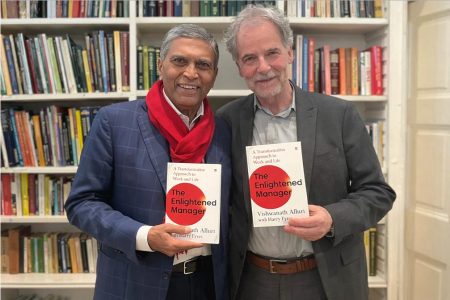
That column, which was for a while displayed at Brockwood Park, came to the attention of Vishwanath Alluri. Vish was a highly successful tech entrepreneur who had become Secretary of the Krishnamurti Foundation India, involved in the dissemination of Krishnamurti’s teachings and the education of teachers.
Vish got in touch with me and asked if I might be interested in co-writing a book which looked at management and entrepreneurship through the lens of K’s teachings. I met Vish in London and immediately liked and was impressed by him, but had to explain that I was a complete ignoramus on the subjects of management and entrepreneurship. That didn’t matter, Vish assured me: we would both learn as we went along.
Writing as a Journey
The process was quite slow and organic, partly because of geography and Covid, partly no doubt because of my slow cast of mind. I decided to frame the book as a road trip, based partly on a real road trip we made from Vish’s home city of Hyderabad to Rishi Valley school, whose core consisted of a series of conversations between an entrepreneur and a writer, not entirely dissimilar from Vish and me. Another inspiration was the Don Camillo series of books by Giovannino Guareschi about an Italian priest in the 1950s, his sparring partner the Communist mayor Peppone, and a talking crucifix. As it happened, Vish not only had family connections with Indian left-wing politics but also turned out to be a big Italophile, and our writing journey also took in two Italian trips, one to Rome and one to Naples. My wife was suspicious about how much work these involved.
Quite slowly at first, and then much more quickly, the book came to birth. I hope at the very least it’s unlike most other business books, that it may puncture a certain amount of business bombast and hype, and that it may introduce readers to a quiet source of insight, above all into their own minds. Because that’s where we all have to start.
(c) Harry Eyres
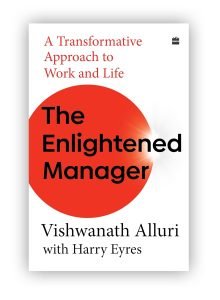
About The Enlightened Manager: A Transformative Approach to Work and Life
What if better leadership began by questioning the very essence of work?
CEO and entrepreneur Vishwanath Alluri and columnist and poet Harry Eyres gained clarity in life and work through the teachings of Indian sage J Krishnamurti, whom some describe as the “guru of gurus” but is known by others as, simply, “the friend on the bench”.
Now Alluri and Eyres have teamed up to think through the management problems of today in the light of Krishnamurti’s timeless insights. Can we be more productive and make better decisions by becoming radically self-aware? How can humility and compassion make us more effective leaders? Is there more wisdom in a single story about a man pushing a bus, than in a hundred strategy powerpoints?
The Enlightened Manager is informed by the life experience of Alluri, an entrepreneur who has founded and led several global tech companies, but it is so much more than a business book. It is the beginning of a journey which inspires us to redefine success, rethink management, and transform the essence of work itself.
Order your copy online here.
And see more Resource articles on Writing.ie here.


