

Look Who’s Talking: Thoughts on Narrative Voice by Lynda Marron
When setting out to pen a novel, the choice of narrative voice might be the most critical decision the writer needs to make, and yet, very often we don’t really think about it — we just start writing based on whatever spark of inspiration comes first.
Interestingly, the cover of my novel exactly matches that very first idea. It was almost spooky, as if my editor and cover designer, between them, had somehow read my mind. Or, and this is my hope, that initial spark was bright enough to colour the entire novel.
From the outset, The Bridge to Always was going to be a deeply personal story. I wrote the first draft — longhand, in a school copy — in a flurry of resurfacing memories and unburied emotions. I wrote in the first person and from the point of view of a nine-year-old girl.
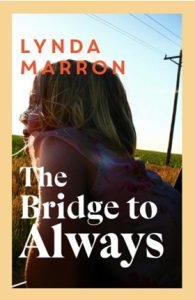 Emer is the youngest character in The Bridge to Always. She moves from Dublin to Cork with her mother, Maeve, because Maeve is intent on reconnecting with her first love, Tim, a man she hasn’t seen in nearly ten years. For Maeve, the relocation has a purpose. There is a prize in sight. For Emer, it’s all confusion and loss.
I thought a child’s perspective had the potential to be something quite tender, that the reader might be engaged by the naiveté of her voice, and moved by the gradual erosion of her innocence.
It was a nice idea, I think, and a better writer might have pulled it off, but I saw pretty quickly that Emer’s point of view was limited, and it was limiting me. Not only was a child going to be sheltered to some degree from seeing and hearing enough of the action to adequately tell the story, but her understanding of what she did witness would also be limited. I had made life unnecessarily difficult for myself.
A writer (this writer) needs to constantly remind herself that she is writing, not for glory or praise, but for the reader. Nothing matters more than the reader’s experience.
For me, part of the joy of reading is derived from the satisfaction of knowing more than the characters know. Emer was never going to provide the reader with that sense, albeit fleeting, of near omniscience. I, the writer, might know it all, and I might have enjoyed a sense of catharsis from writing in Emer’s voice, but I was cheating the reader out of the whole story. While it’s true that the writer needs to know more than the reader, it’s also vital that the reader knows enough. Seems obvious, I know, but it’s worth remembering.
So, there I sat, with a deadline looming and a manuscript that wasn’t working.
The simplest solution would have been to re-write with a third person omniscient point of view. This would certainly give the reader access to every angle of the plot, but I felt it sacrificed some of the closeness of a single point of view.
Eventually, after the usual procrastination we all go through when we know what we need to do, and also know it’s going to be a ton of work, I resolved to re-write the book from multiple points of view, switching characters with each chapter.
 This was how I wrote my first novel, Last Chance in Paris. I knew this device lent itself to adding tension with mini-cliffhangers at the end of each character’s turn in the limelight. It allowed for variations of tempo, tone and mood between one chapter and the next. I also knew that it would give the reader access to the internal life of a range of characters.
The tricky part was that it took work to give each character a unique and consistent voice. I did this by taking each voice one at a time, working from just one point of view for weeks at a time until I felt I’d got into that character’s head, until the story belonged to them alone …then moving on to someone new.
In Last Chance in Paris, the different players have their own stories and almost never meet. The choice of perspective for each scene was obvious. In The Bridge to Always, all the characters are contributors to one story. Over and over, I was faced with choosing which character had the most interesting story to tell, and which voice the reader would most like to hear. Several scenes were re-written over and over from different perspectives until something clicked and they felt right. There were many days when my word count went backwards, but, in the end, I felt that I knew every scene in the round and could only hope that it would pay dividends.
I’m not sorry I began as I did. Writing, for me, is a process of excavating my subconscious. If everything in my head is like a giant mountain, then the perspective from which I begin mining must affect what I’ll find. Emer brought me to some painful places, refused to let me steer clear. For a writer, pain is the mother lode of inspiration. I don’t believe that first scribbled draft was a waste of time. Without it, I’d probably have written something more romantic, but less honest.
And, since I mention honesty, I should add that I’m not entirely certain I made the right choice. The book has gone to print, and I am sitting here wondering if I should have stuck to my guns and given Emer her say, which was, after all, the whole point. Maybe, making life difficult for myself wasn’t such a bad thing. Maybe, after all, I played it safe.
‘It would have been a different book,’ she said, wistfully, and went to make some toast.
(c) Lynda Marron
Instagram @sultanabun
About The Bridge to Always by Lynda Marron:
A story about identity and place, about finding out who you are, who your people are, and what it means to be a family.
Maeve Gaffney arrives in a small West Cork town in pursuit of a dream: to be reunited with Tim, the lad she fell for years ago and who, unbeknownst to him, fathered her daughter, Emer.
For Tim, now married and a pillar of the community, Emer’s existence is a shock – but the chance to rekindle an old flame with her mother is tempting.
For Agnes, a lonely landowner, Maeve and Emer’s arrival is an opportunity to make money – and maybe new friends.
For Malachi, a man of few words but deep emotions, it’s . . . complicated.
For Emer, it’s about growing up and finding her voice.
For all five, the arrival of this beautiful, wild mother and her silent, observant daughter sparks a devastating chain of events none of them could have predicted.
The Bridge to Always by Lynda Marron is published by Eriu 3rd April 2025. Pre-order your copy of online here.
Last Chance in Paris, also published by Eriu, is out now in paperback.
Read more from Lynda on Writing,ie here.


