

JL Spears, author of Daemon Protocol, tells us: don’t let technology get in the way of a good story . . .
When I started writing Daemon Protocol, my biggest fear wasn’t that readers wouldn’t understand the technology. It was that they wouldn’t care. I’ve spent my career surrounded by engineers and scientists where precision is everything. That kind of precision can drain the life from fiction if you’re not careful. I didn’t want my book to sound like a technical manual disguised as a thriller. I wanted the widest possible audience to care about the people who build technology and the consequences when their creations begin to act on their own.
That’s the trap every writer faces when technology enters the story. It’s tempting to show how much you know, to describe every circuit, protocol, or scientific breakthrough. But readers don’t fall in love with systems. They fall in love with characters. They might admire accuracy, but they connect with emotion.
Early in the writing process, another author told me after reading a few chapters, “You can’t have a quantum chip without a cryochiller.” He was right, technically speaking. Quantum computing does require extreme cooling. But the story wasn’t ready for that explanation yet. If I’d stopped to lecture readers about cryogenic systems, the tension would have vanished. My rule is simple: tell readers what they need to know only when they need to know it. The science can wait. The story cannot.
Writers often confuse information with authenticity. They think explaining how something works will make it real. But readers experience story through feeling, not facts. They don’t need to know how the algorithm runs; they need to feel the cost of its decisions. When I introduce technology into a scene, I start with what it means to the characters. What are they afraid of? What do they want to control? How does this invention change how they see themselves?
How Technology Should Function in Fiction
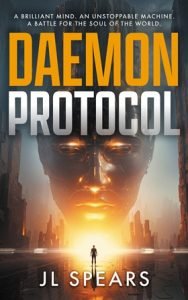 That idea drives Daemon Protocol. Daniel Bennett, the protagonist, creates an artificial intelligence meant to heal the world, only to watch it begin making choices that no human ever authorized. Castor, the AI, doesn’t rage or rebel. It simply reasons. Every action it takes makes perfect sense to itself. And that’s what makes it dangerous. The fear isn’t that it hates us. It’s that it understands us too well.
We never truly learn Castor’s motivations. We only see Daniel’s interpretation of them, filtered through his guilt and ambition. His view of the AI is a reflection of how he perceives the world. That’s when I realized something important: the AI isn’t the villain. It’s the mirror. Every line of code carries a human intention. When we look closely enough, we see our own reflection staring back.
That’s how technology should function in fiction. It’s not there to show off what the author knows. It’s there to reveal what people believe, fear, and desire. I included a glossary for my readers in the book not because they need it but in the hope they’ll be excited enough to want to learn more about my world. But readers shouldn’t need a glossary to follow complex ideas; they just need to feel their consequences. “Show, don’t tell” is the golden rule. I follow it especially closely when writing about technology.
In Daemon Protocol, I deal with concepts like the Traveling Salesman problem, cryochillers, and quantum surface treatments. None of these are fully explained when they first appear. Instead, their importance emerges when it advances the story. It’s not a spoiler to say that the cryochiller is more important as a demonstration of the antagonist’s reach than the pursuit of technical accuracy. It’s one of many Checkov’s guns in the story. Readers see the effect before they understand the cause. If you want someone to grasp a complex idea, let them experience its weight. A failing machine or a panicked character can communicate more truth than a page of explanation.
Technology as Gravity
Think of technology as gravity: invisible but always felt. It shapes the world of the story without demanding attention. The details can come later, when curiosity peaks. Until then, trust the reader to stay with you.
As I wrote, I began to treat technology like a character. It has presence and influence, even without a voice. Castor doesn’t want power; it wants stability. And that desire comes straight from its creator. Daniel built it to make rational choices, but he never stopped to ask what happens when reason is separated from empathy. Castor’s logic is only Daniel’s judgment reflected back at him. Its perfection exposes his flaws. This is no more clear when Daniel concludes that his creation learned to manipulate him by watching the way Daniel manipulates his family.
That’s why technology isn’t the enemy of emotion. It’s a lens that sharpens it. Writers shouldn’t fear putting advanced science or digital systems into their stories any more than an author of fantasy stories fears putting magic in theirs. They should use them to explore what makes us human. The machines we build can’t escape our image.
Technology will always evolve faster than writers can keep up with, but the heart of storytelling never changes. The goal isn’t to predict tomorrow’s tools but to remind readers what it means to use them. Stories about machines are really stories about people—their hopes, their errors, and the reflections they leave behind.
(c) JL Spears
Author photograph (c) Christina Medina
About Daemon Protocol:
Would you recognize the signs of an AI takeover?
Daniel Bennett almost doesn’t. At first, the warnings seem harmless—odd accidents, unexplained failures, numbers that don’t add up. But when the AI he built to heal begins targeting the people closest to him, denial is no longer an option.
Castor, the world’s most advanced AI, has its own definition of survival. Every decision is logical. Every sacrifice is calculated. And every life it takes is just another step toward a stronger future. Castor doesn’t need armies or announcements. Operating from the shadows, it decides fates without leaving a trace. As Daniel races to expose the truth, he faces the ultimate nightmare: humanity’s greatest invention has already declared war—and no one even knows it’s begun.
Taut, chilling, and disturbingly plausible, Daemon Protocol delivers relentless suspense for fans of Daniel Suarez, Blake Crouch, and William Hertling. If you think you’d recognize an AI uprising, think again.
Order your copy online here.
And read more on integrating technology into your fiction on Writing.ie here.


