

Author Shirley-Anne McMillan on why we should all read YA fiction.
I’m hot off the heels of a Twitter discussion (it will always be Twitter to me) about the fact that a lot of adults read YA fiction. The comments in the thread had words like ‘appalled’ and ‘simplified’, and one contributor said that if they read too many YA books their brain would ‘turn to sediment’.
My fourth YA novel, Grapefruit Moon, was launched a couple of weeks ago. Naturally, I have opinions.
The idea that books for young people shouldn’t be read by adults because they represent some kind of ‘dumbing down’ of our literary aspirations isn’t new. My instinct about enjoying books is that you should read whatever you love, plus some other things which you aren’t naturally drawn to, because you can always be surprised. But I know that even as enlightened readers we can sometimes get stuck a literary loop when it comes to the type of books we seek out.
With that in mind, here are some reasons why you should rebel against your inner gatekeeper and let yourself enjoy a YA story:
1. YA is brilliant. Why is it popular with adults? Is it because so many adult are idiots and are drawn towards the sedimentation of their brains? That’s a rhetorical question, don’t @ me, but can we please consider the cultural content aimed directly at adults which performs this very function? Adults don’t need culture aimed at anyone else to kill intellectual discussion. I haven’t studied it, but I’d guess that the vast majority of stupid ideas in the world are cooked up and perpetuated by and for adults. I don’t think I need to give examples … But I will give examples of YA which makes people (of whatever age) think and feel, YA which enlightens, brings joy, provokes discussion in areas which you may not yet have considered. If you’re new to YA go and get a copy of The Hate U Give by Angie Thomas. Read Nothing by Janne Teller (not for the faint-hearted). Look at The First Move by Jenny Ireland.
2. You probably already enjoy YA fiction: Derry Girls. Sex Education. Yellowjackets. These are all YA stories. If you liked them, try Sue Divin’s Guard Your Heart, Ciara Smyth’s Not My Problem, and Louise Finch’s The Eternal Return of Clara Hart.
3. Have a think about what YA is. Don’t go to Google for the answer – read the books. Is Sally Rooney YA? Some say yes, some say no. Where does ‘YA’ end? When does a book become an adult novel? When does a person become an adult? Is The Secret History by Donna Tartt a YA novel? Its characters are the same age as Sally Rooney’s. If not, then what makes the difference? And more importantly, if it matters, then why? Why does it matter to you specifically? You might find the answer in a YA novel.
4. As a YA writer from Northern Ireland, I am excited by the current buzz around Nordy YA. We’ve got a little scene now. We’re doing well. Hand on heart, of all the YA writers from NI who I can name (and I think I can name them all), 100% of them are excellent writers. We’re a relatively young scene compared to the UK and the Republic of Ireland, but we’re strong right now, and we’re writing about the North. That’s thrilling to me because it means we’re sharing perspectives and asking questions and talking about place in new ways. So if you loved Milkman by Anna Burns (which … is a novel about a young person … Is it YA?) why not have a look at other award winning NI writers like Sheena Wilkinson and Kelly McCaughrain?
5. Young people not only matter – they have things to teach us. So often a lot of these discussions about whether or not literature for young people is of any worth to adults comes from an assumption that the adult perspective is the place to which we aspire, and the place from which we can legitimately observe the world, once we’ve made it. And yet an awful lot of adult literature focuses on the past – our childhoods, our history, the stories we wanted to tell but couldn’t. Young people’s literature asks what are the now stories? What are the important ways in which young people are affecting their worlds? If you find yourself viewing childhood as a waiting room for adulthood, I have such wonderful news about the present! Your childhood was different to theirs. Young people now are affecting the world. They’re not just joining in on adult debates – they’re creating the debates that adults tend to catch up on a couple of years later. They’re engaging with the activism that adults are having opinions on. They’re changing their worlds while we struggle to get to grips with the language they’re using. YA attempts to reflect this.
It’s easier to brush young people off, to decide that we don’t want to engage with the things that we don’t understand. But we shouldn’t have a go at other adults who don’t want to exclude young people from their worldview. Why not pick up a YA novel and find out what you’re missing?
(c) Shirley-Anne McMillan
About Grapefruit Moon:
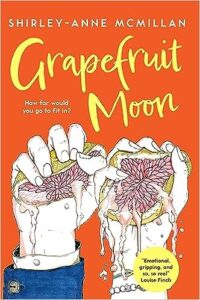 Wealthy, popular Charlotte and quiet, working class Drew couldn’t be more different, but both face a common enemy at Cooke’s Academy in the form of the Stewards – an elite group of students whose power to manipulate school culture is feared by pupils and teachers alike. Drew, a newcomer to Cooke’s, must navigate the strict codes of masculinity laid down by the Stewards in order to have a hope of moving on to university, while Charlotte dreams of speaking freely about the constraints and abuses of the culture which is propelling her towards a life she’s not sure she wants. Through drag art and poetry the unlikely pair follow a dangerous trajectory which will lead them closer to one another and further away from the paths laid out for them.
Grapefruit Moon is published by Little Island. Order your copy online here.


