

A Kind of Magic: 4 Tips for Writing Fantasy Fiction by Dan Coxon, editor of and contributor to Writing the Magic.
Due in part to the popularity of Game of Thrones – as well as the rise of ‘romantasy’ – we’re currently seeing an explosion of interest in fantasy fiction. And when the marketplace is flooded with imitations and hastily scrawled derivatives, it can be hard to find the gems in the dragon’s hoard.
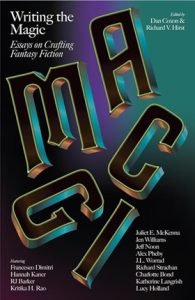
This is one of the reasons why we compiled Writing the Magic, our latest collection of essays on the craft of writing. As with the three previous titles in this series – Writing the Uncanny, Writing the Future, and Writing the Murder – we’ve tracked down some of the most exciting writers working in the genre today, to ask them for their experience and advice. More than just a ‘how to’ manual, Writing the Magic offers you new pathways to head down – and new treasures to uncover.
The essays contained within Writing the Magic present a multitude of different viewpoints, and sometimes even contradict each other (the jury is still out on whether it’s best to world-build extensively before writing, or just muddle your way through) – but there are plenty of nuggets of wisdom to be mined from the contributors’ experiences. Here are four of the best:
Tips for Writing Fantasy Fiction
1. Character is key
 When writing fantasy, you can easily get carried away with the very act of creation. After all, where else can you create entire worlds to inhabit, filled with magic – and dragons! While these imaginative elements of fantasy are part of the attraction, don’t forget that you’re still trying to tell a story, and all good stories rest upon character.
Here’s Jen Williams, from her essay ‘Building a World and Getting Away with It’:
Everything, ultimately, from complex historical fiction about the Tudor court to an epic quest by a bunch of rabbits to find a new home; from a trio of ghosts in a graveyard spying on a grieving Abraham Lincoln to a very hungry caterpillar (no, really, we’ve all been hungry, right? We’ve all transformed ourselves at one point or another, right?) – all stories are, at their heart, about people.
2. Keep your magic grounded
Magic is a fundamental part of many fantasy novels, but once again, it’s easy to get carried away. When creating your magic system, make sure that it’s an intrinsic part of the world you’re creating. As Lucy Holland writes in ‘Between Me and My Shadow: Magic in Le Guin’s Earthsea’:
In a good fantasy novel, magic should feel like an essential and organic component. As readers, we need to believe that it has arisen naturally, that it belongs in the world the same way people do, or mountains and seas. Such a powerful force becomes intersectional, meaning it cannot be separated from social structures such as politics and economics.
3. Find your voice
There are many decisions to be made during the writing of a book, from character traits to magic systems – but what truly makes your work unique is your voice. Finding that voice can often feel like the hardest part of learning to write.
Here’s Kritika H. Rao’s take on it, from her essay ‘Authenticity and Voice: A Reflection on What Voice Can Tell Us About Ourselves’:
The treasure you seek is not the prose, the style, the point of view, or plot decisions. The treasure you seek is to be connected to that deep flow-state, to be submerged, where voice surrounds you. That voice, a thing that comes into existence based off your influences, your perspective, your ever-evolving personality, is a look into yourself. You are not what you write. But the more you dive, the longer you practise, the more you will inhabit your work in a way that only you can.
4. Persistence is key
In her essay ‘What Can Tolkien’s Creative Process Teach a Writer Today?’, Juliet E. McKenna looks at the lessons a modern writer can learn from J.R.R. Tolkien, and specifically from his writing process. The last thing the genre wants – or needs – is more Lord of the Rings epic-fantasy clones, but there’s no doubting that Tolkien was a master of his craft.
McKenna draws many lessons from his life and his work, but the following feels particularly useful for the aspiring writer, and as good a place as any to end this article:
Every writer’s process is different. The key is learning what works for you… Tolkien says, ‘I forced myself to tackle the journey of Frodo to Mordor’. Writing a book is a lengthy process. Every author finds times when inspiration is lacking and work becomes a stubborn trudge. The only way out is through, as various writers have said in various ways.
In other words: keep working on your writing, work on finding your own, unique voice – and don’t give up.
(c) Dan Coxon
About Writing the Magic:
From The Lord of the Rings to Game of Thrones, over the last hundred years few genres have captured the public imagination as powerfully as fantasy. Whether it’s epic quests of dwarves and elves, wizards and paladins, or the influential childhood classics of Alan Garner and C.S. Lewis, the appetite among readers for all things magical seems insatiable.
Pulling together a fellowship of some of the best writers of modern fantasy fiction, Writing the Magic invites you to step through the portal and discover what gives these tales such enduring appeal. Writers such as Jeff Noon, Hannah Kaner, RJ Barker and Jen Williams pull back the curtain on how they write fantasy, demystifying topics such as worldbuilding, sources of magic, creating authenticity, and how best to deploy your dragons.
An essential map for anyone wanting to write their own world into being, Writing the Magic explores the perilous realms of fantasy fiction – and arms novice writers with everything they need to embark on their own adventure.
Contributors: Francesco Dimitri, Hannah Kaner, RJ Barker, Kritika H. Rao, Juliet E. McKenna, Jen Williams, Jeff Noon, Alex Pheby, J.L. Worrad, Richard Strachan, Charlotte Bond, Katherine Langrish, and Lucy Holland.
Writing the Magic, edited by Dan Coxon and Richard V. Hirst, is published by Dead Ink Books.
Order your copy online here.
And read more on writing fantasy fiction on Writing.ie here.


