

How a Leadership Book Slowly Wrote Itself
For years, I thought writing a book belonged to “other people”. Real writers. Academic people. People who knew what they were doing. Meanwhile, I was busy leading organisations, raising a family, paying mortgages and trying to survive meetings that should probably have been emails. And yet, somewhere in the background, the idea of writing a book kept following me around like a persistent labrador.
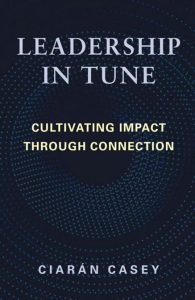
The strange thing is, I didn’t suddenly decide to write a book. The book slowly emerged from years of conversations, observations, workshops, coaching sessions and moments where I found myself thinking: “Why does leadership so often feel out of tune even when people mean well?” That question eventually became the foundation for my book, Leadership in Tune.
But writing it was far messier than I expected.
Why I Wrote the Book
When people ask me how I wrote the book, they usually expect some impressive routine involving 5am starts, colour-coded notebooks and monk-like discipline. The truth is far less glamorous. I wrote it in bursts. Some mornings the words flowed beautifully. Other times I spent forty minutes changing one sentence and rewarding myself as if I had completed a marathon.
What surprised me most was that writing a book was less about inspiration and more about repeatedly returning to the work. That sounds obvious, but it matters. Because most people don’t fail to write because they lack ideas. They stop because they believe every writing session needs to feel productive or profound.
It doesn’t.
The Relational Experience of Leadership
Sometimes writing is elegant and insightful. Sometimes it’s deleting three pages while questioning every life choice that led you there. Both count.
I think one of the biggest mistakes aspiring writers make is waiting for clarity before beginning. My experience was the opposite. Clarity came through writing. In fact, many of the ideas in the book only fully revealed themselves after I had written versions that weren’t quite right. Some chapters changed completely. Others disappeared entirely.
At one point I realised I wasn’t writing a book about leadership behaviours at all. I was writing about the relational experience of leadership – about how people feel working around leaders. I could not have “planned” my way to that insight. The writing uncovered it.
My Practical Advice
So, my practical advice is simple:
- Don’t wait until you know exactly what you want to say.
- Write your way towards it.
The first draft is allowed to be terrible. This may be the most liberating lesson of all. Early drafts are not performances. They are thinking tools.
I initially made the mistake of trying to write and edit simultaneously. That’s like trying to drive with one foot on the accelerator and one on the brake. I eventually learned to separate the two processes:
- first, get the ideas out,
- then come back later and improve them.
Good writing usually emerges through rewriting. And rewriting. I also discovered that books are not written alone, even when the physical act of writing is solitary. Some of the biggest breakthroughs came through conversations:
- with trusted friends asking difficult questions,
- workshop participants challenging assumptions,
- people saying “that part feels true” or “I’m not sure what you mean here.”
One friend repeatedly asked me: “How’s the book going?” Honestly, there were moments I dreaded the question. But in hindsight, those gentle nudges mattered enormously. Writing needs community more than writers sometimes admit.
Not sounding clever was a hard lesson for me. Like many first-time writers, I initially felt pressure to sound “bookish.” More intellectual. More polished. But the writing improved dramatically when I started sounding more like myself.
Clarity, Honesty and Connection
Readers are not looking for verbal gymnastics. They are looking for clarity, honesty and connection. Some of my favourite feedback has come from readers saying: “It felt like you were talking to me.” That matters more to me than sounding impressive.
I thought I was writing a book when in reality, the book was also reshaping me. Writing forced me to slow down and clarify what I actually believed. It exposed contradictions. It sharpened ideas. It made me more reflective and, I think, more honest.
There’s something strangely revealing about seeing your thinking sitting in black and white on a page. You can’t hide behind vague intentions anymore. And perhaps that’s why writing matters, even for people who never publish a book.
Writing helps us hear ourselves more clearly.
If you are thinking about writing; whether it’s a book, a blog, poetry, memoir or simply your own reflections my advice is this:
- Start before you feel ready.
- Write badly at first.
- Keep returning to the page.
- Trust that clarity often arrives after movement, not before it.
And remember that most writers are making it up as they go along far more than they’d like you to believe. Some are just slightly better at looking confident while drinking coffee and staring thoughtfully into the middle distance.
(c) Ciaran Casey
About Leadership in Tune:
Leadership in Tune introduces the Conscious Relational Impact (CRI) Model™ a relational framework grounded not in control, but in conscious alignment. It begins from a simple premise. Leadership succeeds or fails in the space between people. At its heart, CRI reframes leadership as attunement. The capacity to notice what is happening between people and respond with intention rather than reflex.
Drawing on more than thirty years of leadership experience and five years of focused leadership development work, Ciaran Casey offers a practical and deeply human approach to leading in complex environments.
Leadership in Tune can be pre-ordered here: https://www.buythebook.ie/product/leadership-in-tune/
And you can read more Writing & Me articles on Writing.ie here.


